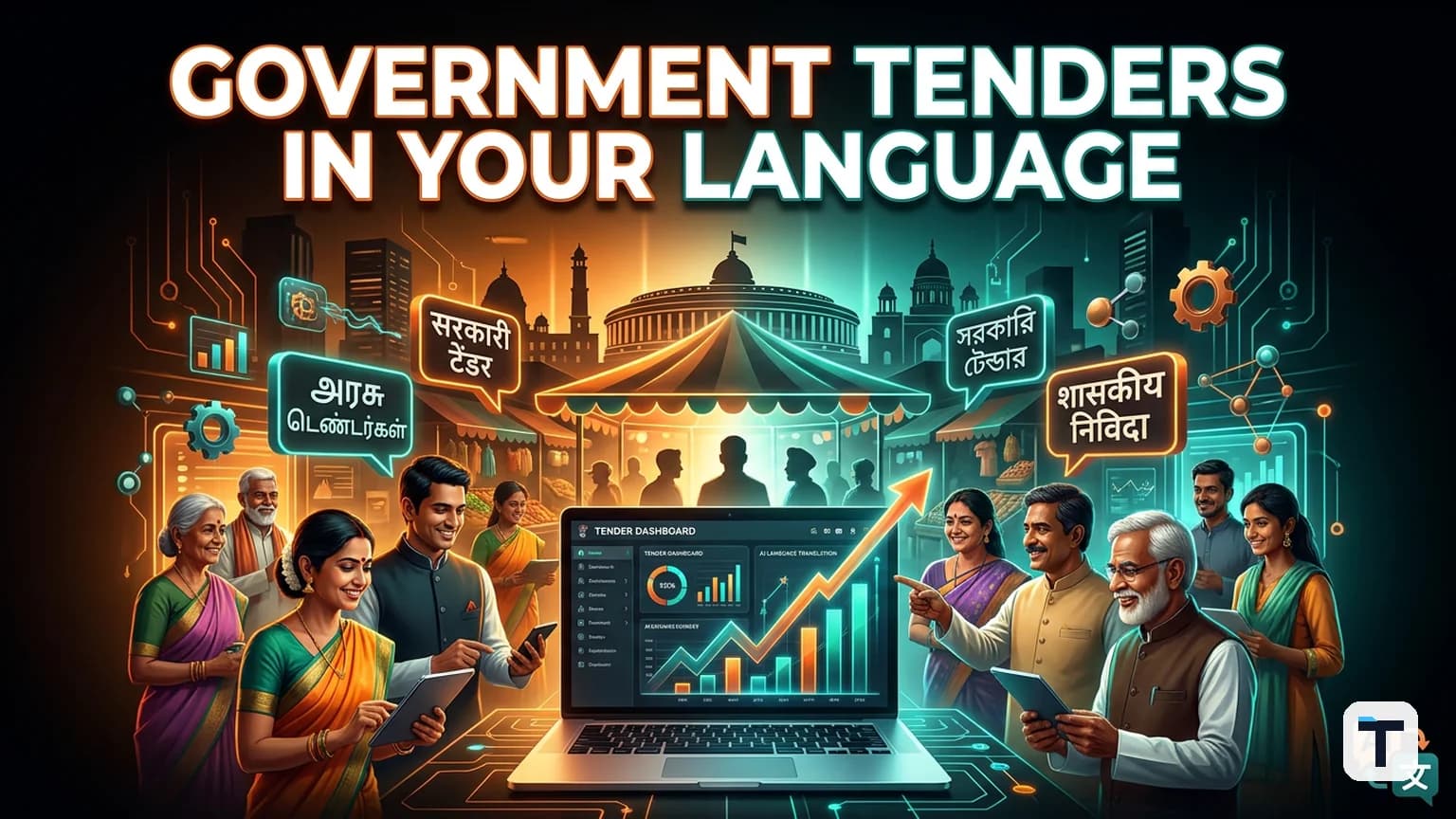

Verdict: The 15 June 2026 MoU between the Government e-Marketplace (GeM) and Digital India BHASHINI Division is a practical move to remove English as a gatekeeper for public procurement. By integrating Bhashini's AI translation, voice, and generative AI into GeM, sellers in India's 22 officially recognised languages — and several regional languages beyond them — will eventually be able to register, navigate tenders, and communicate with buyers in their own language. For MSMEs, startups, and first-time entrepreneurs outside metro India, that could be the difference between staying local and bidding national.
Last verified: 2026-06-17
- What changed: GeM and Bhashini signed an MoU to add multilingual AI to public procurement.
- Languages covered: 22 officially recognised Indian languages, plus additional regional languages.
- Who benefits: Buyers, sellers, MSMEs, startups, entrepreneurs, and local enterprises.
- Key tech: Translation APIs, voice-first interfaces, generative AI, domain-specific language models, voice bots.
- Program name: "BHASHINI for Seva/Sanchalan — A BHASHINI Sahayogi Program".
Why does language matter on GeM?
Government procurement is one of the largest business opportunities in India. GeM — the national public procurement portal under the Ministry of Commerce and Industry — lets ministries, departments, PSUs, and other eligible entities buy goods and services from registered sellers online. But until now, the platform has largely operated in English, which automatically filters out businesses whose owners or staff are not comfortable with it.
Language barriers show up at every step: seller onboarding, tender discovery, technical specification reading, bid preparation, and post-order communication. For a small manufacturer in Lucknow, a textile unit in Surat, or a first-time founder in Guwahati, English-only workflows mean either hiring a middleman, relying on someone literate in English, or simply skipping government tenders. The Bhashini partnership is an attempt to change that default.
What exactly will the MoU deliver?
The MoU, signed under the "BHASHINI for Seva/Sanchalan — A BHASHINI Sahayogi Program", will integrate Bhashini's language AI into GeM's existing digital platforms. Bhashini is India's National Language Digital Public Infrastructure, run by the Digital India BHASHINI Division (DIBD) under the Ministry of Electronics and Information Technology (MeitY) through the Digital India Corporation.
The collaboration will build multilingual digital resources across several Bhashini initiatives:
| Initiative | What it is expected to do for GeM |
|---|---|
| Bhashini Udyat | Industry-facing multilingual AI tools and integration support. |
| Mitra | Conversational or assistant-style support for platform users. |
| Appmitra | Multilingual help inside applications and reference apps. |
| Sahyogi | Co-creation partnerships with government bodies (this program itself). |
| Pravakta | Speech, voice, and voice-bot services for spoken-language interaction. |
The work also covers translation API integration, domain-specific language models trained on procurement terminology, multilingual glossaries, voice-enabled technologies, reference applications, voice bots, and linguistic datasets built specifically for public procurement and government service delivery.
Will this really work for non-English sellers?
The short answer is: the infrastructure is being built, but the real test is execution.
Bhashini already powers more than 800 government websites, supports 36 Indian languages for text, 23 Indian languages for voice, and 35 international languages, and processes over 15 million AI inferences daily, according to platform metrics reported by DIBD. That scale suggests the underlying translation and voice engines are production-ready for broad use.
However, government procurement has its own vocabulary: tender clauses, eligibility conditions, technical specifications, compliance documents, bid security terms, and payment milestones. Generic translation often fails on specialised terms. The MoU explicitly mentions domain-specific language models and multilingual glossaries for procurement, which is the right fix — if the training data is deep and current enough.
The partnership also plans voice-first interfaces. That is important because many Indian business owners are comfortable speaking their language but not typing it. A voice-enabled GeM could let someone ask "Show me open tenders for uniforms in Assam" in Assamese and get useful results. But voice accuracy in technical domains, plus the workflow of actually submitting a bid, will need careful design.
What this means for MSMEs and startups
If implemented well, this partnership lowers three practical barriers:
For founders who are still deciding how to turn a government-facing idea into a real business, our guide on how to build a profitable AI startup in 2026 maps the same discipline to a broader market.
- Discovery: Sellers can search and understand tenders in their own language instead of relying on translated summaries from agents.
- Onboarding: Registration forms, KYC steps, and product catalogues can be filled in a familiar language, reducing dropout.
- Communication: Queries, clarifications, and order messages can move in the seller's preferred language, speeding up resolution.
This does not remove every barrier to winning government work — pricing, quality certification, delivery capacity, and compliance still matter. But it removes a structural friction that currently pushes smaller, regional players out before they even compete.
For AI-powered small-business operations more broadly, this is also a signal: Indian public platforms are moving toward native-language AI interfaces, which will change how customers expect to interact with any business online.
How does this fit India's larger AI and sovereignty story?
GeM is only the latest government platform to join Bhashini's Sanchalan/Seva track for central ministries. Similar multilingual AI MoUs have been signed with bodies like the Pension Fund Regulatory and Development Authority (PFRDA) and the Centre for Railway Information Systems (CRIS). The pattern is clear: India is treating language AI as a layer of digital public infrastructure, not a nice-to-have feature.
That aligns with the broader push for sovereign AI and domestic language models. Bhashini is building indigenous language technology rather than depending on foreign translation and speech systems. For a procurement platform that handles government contracts, that sovereignty has operational and security value too.
What should sellers do now?
The MoU is an agreement, not a fully deployed feature set. Based on similar Bhashini rollouts, the rollout is likely to happen in phases — starting with translated web content and basic APIs, then voice features, then domain-specific models.
Practical next steps for sellers and MSMEs:
- Register on GeM now if you have not already. The platform already has buyers; being ready before multilingual features arrive gives you a head start.
- Prepare product information in your local language. Translation quality improves when source content is clean and consistent.
- Watch for GeM announcements on language options, voice bots, and regional seller support workshops.
- Train staff on the basics of tender navigation so the AI layer helps rather than replaces human judgment.
- Keep compliance documents ready in both English and your regional language, since bilingual verification may still be required.
For founders building agentic or AI-native business workflows, this is also a reminder: government-facing interfaces are becoming voice-first and multilingual, so customer-facing tools should plan for the same.
Related reading
- local AI voice cloning for multilingual teams
- scale a D2C brand on quick commerce in India
- Free vs Paid AI Tools: What Should a Small Business Pay For?
FAQ
Q: What is the Bhashini–GeM partnership? A: It is an MoU between the Digital India BHASHINI Division (DIBD) and the Government e-Marketplace (GeM) to add AI-powered multilingual and voice support to India's public procurement platform, making it accessible in Indian languages.
Q: When was the MoU signed? A: The MoU was signed on 15 June 2026, reported by multiple news outlets citing a Ministry of Electronics & IT press release.
Q: How many languages will GeM support? A: The partnership targets the 22 officially recognised Indian languages plus additional regional languages.
Q: Who will benefit from this? A: Buyers, sellers, MSMEs, startups, entrepreneurs, and local enterprises that currently face English-language barriers on GeM.
Q: What technology is being integrated? A: Translation APIs, domain-specific language models, multilingual glossaries, voice-enabled tools, voice bots, generative AI, and linguistic datasets for public procurement.
Q: Is this live today? A: No. The MoU is a commitment to co-create and integrate the technology; the actual features are expected to roll out in phases.
Q: Can sellers already use Bhashini separately? A: Yes. Bhashini offers public APIs, a translation plugin, a mobile app, and the BhashaDaan crowdsourcing platform at bhashini.gov.in.
Discussion
0 comments