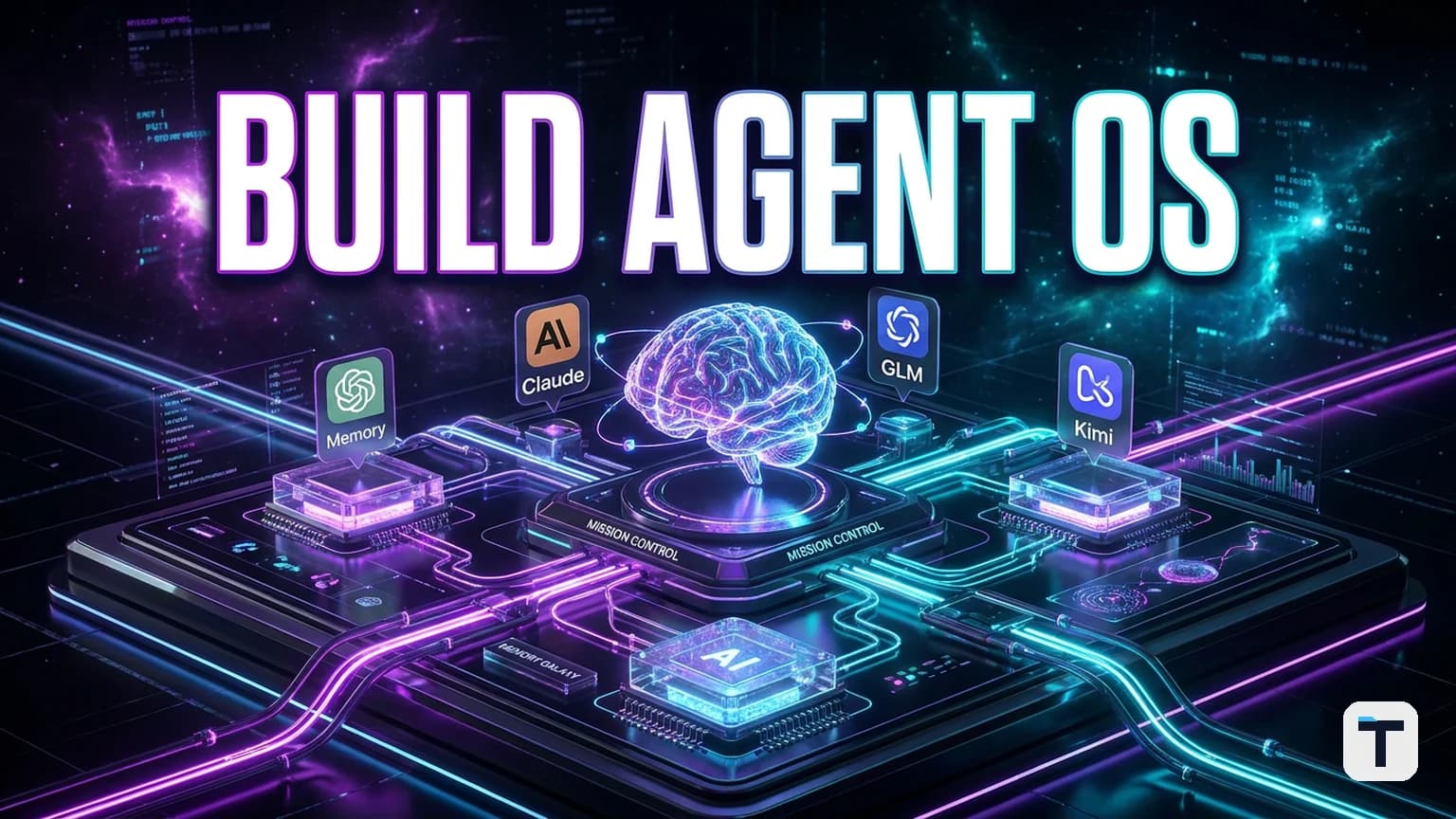

Verdict: A personal or small-business "agent OS" built around Claude Code, a shared memory layer, and a small bench of models can already do real work in 2026. The strongest setups are simple: one dashboard, one memory store, a router that picks the cheapest model for grunt work and the strongest model for hard calls, plus a grader that sends weak outputs back for a second pass. You do not need to be a developer to wire this together, but you do need to be ruthless about scope—most first attempts fail because they add too many tools before the memory works.
Last verified: 2026-06-17 · Best for: small teams and solopreneurs automating content, code, and ops · Cost: $20–200/mo for Claude access + optional model credits · Caveat: model availability, pricing, and benchmark claims change fast.
What an agent OS actually is (and is not)
An agent operating system is not a new model. It is a coordination layer: one place where your agents can read the same project memory, accept jobs, route to the right model, run predefined workflows, and return a result you can check.
The mistake is treating it like a sci-fi operating system. A useful first version only needs four parts:
- A host agent that talks to you and holds context. Claude Code in the terminal, Claude Desktop, or a self-hosted agent such as Hermes Agent all work.
- A shared memory store that agents read at the start of every job—project notes, brand voice, past decisions, and a corrections log.
- A model router that can call cheap models for easy tasks and strong models for complex ones, including a fallback when a model is pulled or rate-limited.
- A quality gate—a second agent or judge that scores output and rejects weak work before it reaches you.
That is the operating system. Everything else (image generation, game studios, voice control, Kanban boards) is an app running on top.
Why 2026 is the right time to build one
Three changes made the agent OS idea practical this year:
- Claude Code and its peers can act on your behalf. Anthropic's Claude Code can read a codebase, edit files, run tests, commit changes, and spawn subagents inside a single terminal session [Anthropic, Claude Code]. Its May 2026 Dynamic Workflows update lets a plan fan out across many parallel subagents, which matters for large refactors, audits, or research sweeps [Anthropic, Claude Opus 4.8; third-party walkthrough at pasqualepillitteri.it].
- Open Chinese coding models rival closed ones. Z.ai's GLM 5.2 launched June 13, 2026 with a 1-million-token context window and MIT open weights; it is positioned as a coding-first model and is already compatible with Claude Code [Z.ai subscription page; Z.ai docs; third-party guide at lushbinary.com]. Moonshot AI's Kimi K2.7 Code, also released June 12, 2026, is a 1-trillion-parameter open-weight MoE model with a 256K context and roughly 30% fewer "thinking" tokens than its predecessor [Moonshot AI docs; Hugging Face model card]. These give small teams a fallback that does not depend on Anthropic staying available.
- Fable 5 just showed why model-agnostic design matters. Anthropic launched Claude Fable 5 on June 9, 2026 and suspended it globally on June 12 after a U.S. Commerce Department export-control directive [Anthropic, Fable/Mythos access statement]. If your whole workflow relied on one model, you were offline. If your OS can swap a model in one line, you keep moving.
The four layers of a working Claude Agent OS
1. Intelligence layer: Claude as the default brain
Start with Claude because it is currently the strongest general reasoning layer for mixed work. Claude Opus 4.8 (May 28, 2026) is the latest flagship; it leads on Anthropic's SWE-bench Pro and OSWorld-Verified benchmarks and kept the same pricing as Opus 4.7 ($5/M input, $25/M output) [Anthropic, Introducing Claude Opus 4.8; ComputingForGeeks summary]. For most small-business tasks—briefs, code reviews, data analysis, customer replies—Claude Sonnet 4.6 or Haiku are cheaper and fast enough.
Claude Code is the practical entry point. Install it via npm (npm install -g @anthropic-ai/claude-code) or the native installers Anthropic publishes for macOS, Windows, and Linux [Anthropic product page; npm registry]. After claude auth login, you can point it at any folder and start delegating.
2. Memory layer: one source of truth every agent reads
Memory is the single highest-leverage upgrade. Without it, every agent starts from zero and you repeat yourself forever. With it, new agents inherit brand voice, past decisions, and project context.
A minimal memory layer has three files:
| File | What it holds |
|---|---|
PROJECT.md |
Goals, audience, tone, constraints, stack |
MEMORY.md |
Decisions, lessons, recurring preferences |
UPDATES.md |
Corrections and re-verification dates |
Store these in the same workspace your agents see. Claude Code reads CLAUDE.md and README.md automatically; Hermes Agent has a built-in three-tier memory system and learns from past failures [Nous Research / Hermes Agent; OpenAIToolsHub review]. Either works, but pick one and stick with it.
3. Router layer: model-agnostic model selection
A router lets you send cheap work to cheap models and hard work to strong models. In mid-2026 the practical bench looks like this:
| Model | Best for | Pricing context (June 2026) |
|---|---|---|
| Claude Haiku / Sonnet 4.6 | Quick answers, drafts, routine edits | Included in Claude Pro/Max plans |
| Claude Opus 4.8 | Complex coding, analysis, multi-step planning | $5/M in, $25/M out [Anthropic] |
| GLM 5.2 | Long-context coding, self-hosted or Z.ai API | ~$1.40–$4.40/M via providers [LLM-Stats] |
| Kimi K2.7 Code | Open-weight coding, agentic tool use | $0.95/M input, $4.00/M output [Moonshot docs] |
| OpenRouter Fusion | High-stakes synthesis when you want multiple brains | Sum of panel + judge cost, ~half of Fable 5-level solo spend [OpenRouter] |
The cheapest setup routes everyday work through GLM 5.2 or Sonnet, reserves Opus 4.8 or a Fusion panel for the 10% of tasks where a wrong answer is expensive, and falls back to the other bench member if one model is down or throttled.
4. Quality layer: a judge that rejects weak work
The best production pattern is not one perfect agent. It is a loop: agent produces, judge scores, agent revises until the score passes.
Anthropic's Claude Code now supports Performance Outcomes and grader hooks in subagent workflows [third-party production playbook at totalum.app]. In simpler setups, you can add a manual judge prompt: "Score this 1–10. If below 7, list exactly what is missing and ask the agent to fix it." Either way, the principle is the same: quality control must live outside the agent that did the work.
How to build your first version this week
You can get a usable Claude Agent OS running in an afternoon. The goal is not a Hollywood dashboard; it is a working loop.
- Install Claude Code in a project folder and write a
CLAUDE.mdthat describes your business, your voice, and your common tasks. - Create one repeatable workflow as a shell script or Claude skill. Start with something small, such as "write a weekly SEO brief" or "review a landing page for clarity."
- Add one alternate model. Connect GLM 5.2 or Kimi K2.7 Code through OpenRouter or their native APIs so Claude can route to them on request.
- Add a memory file. After every completed job, update
MEMORY.mdwith what worked, what did not, and any decisions the next agent should know. - Add one grader check. For any output that leaves the OS, run a second prompt that scores it against a short rubric.
Once this loop is reliable, expand to a second workflow. Resist adding image generation, voice control, or game studios until the core four layers work.
What this means for you
For a small business or solo operator, a Claude Agent OS is less about replacing people and more about replacing context switching. Instead of five AI tabs, five logins, and five explanations of who you are, you get one place where work enters, gets routed, gets checked, and leaves as a finished artifact.
The real advantage is resilience. When a model is banned, rate-limited, or just worse at your specific task, you swap it in the router and keep the same workflow. That resilience is now a competitive edge, not just a nice-to-have.
Related reading
FAQ
Q: Do I need to be a developer to build a Claude Agent OS? A: No, but you need to be comfortable with a terminal and a text editor. Claude Code handles most of the code; your job is defining the workflows and checking the outputs.
Q: How much does it cost to run? A: A Claude Pro or Max subscription covers most light use. Heavy coding or multi-model routing can add $50–200/mo in API credits. Using GLM 5.2 or Kimi K2.7 Code for bulk work can cut that significantly.
Q: Is Claude Code the same as Claude.ai chat? A: No. Claude Code is a terminal-based agent that can edit files, run commands, and use tools across your local project. Claude.ai is a chat interface.
Q: What happens if Anthropic limits or bans another Claude model? A: This is exactly why the router layer matters. If your OS can call GLM 5.2, Kimi K2.7 Code, or an OpenRouter Fusion panel, a single-model outage does not stop your workflow.
Q: Can I use this for content marketing, not just code? A: Yes. The same loop works for blog briefs, email drafts, social posts, and SEO analysis. The memory layer is even more important for content, so every piece stays on-brand.
Q: What is the biggest mistake first-timers make? A: Building the dashboard before the workflow. Start with one job you do every week, automate it end to end, and only then add a second one.
Discussion
0 comments