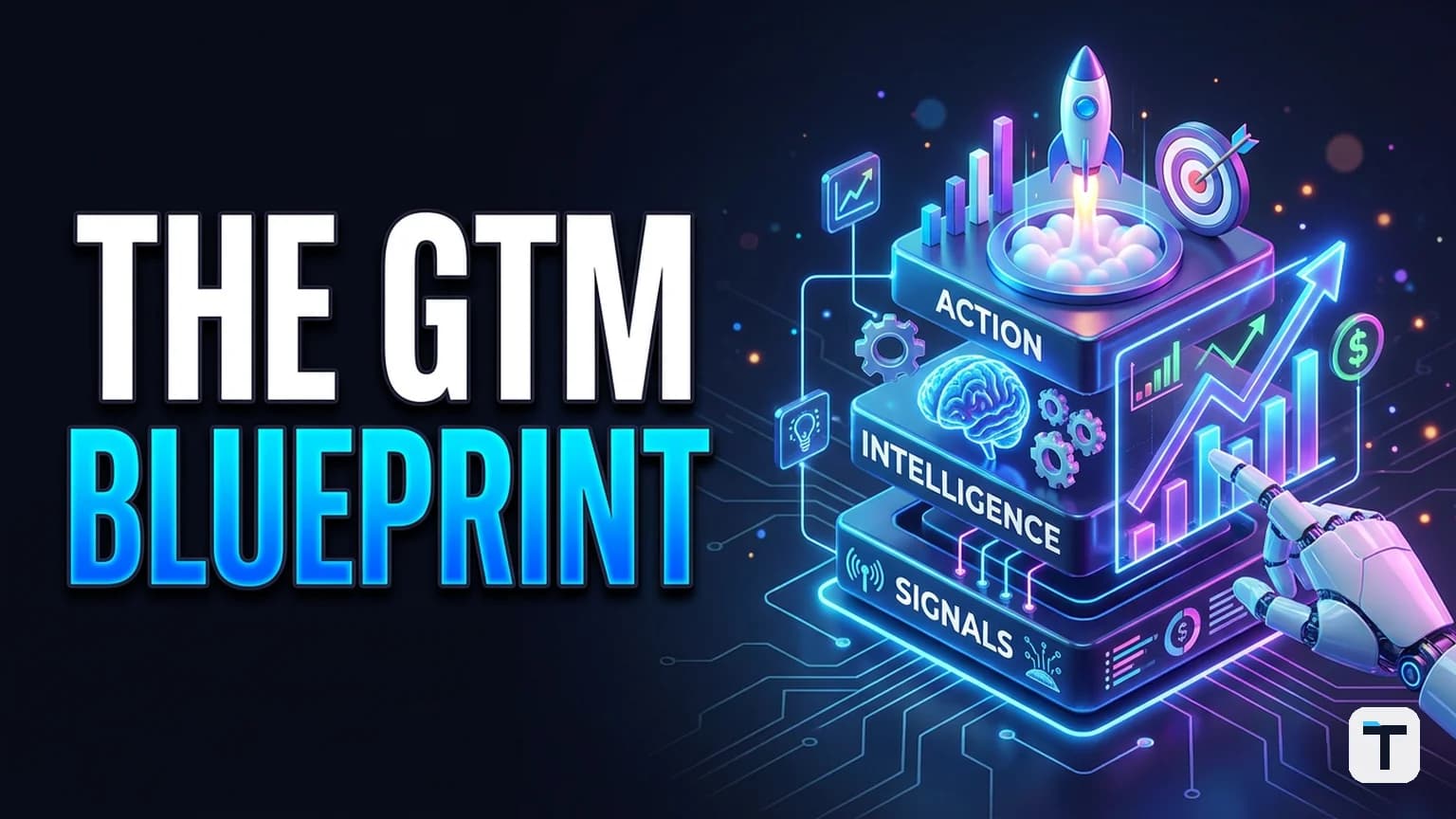

Verdict: To succeed in 2026, B2B Go-To-Market (GTM) teams must abandon "bolted-on" AI in favor of a 3-layered architecture—Signals, Buyer Intelligence, and Action. Because 95% of winning vendors are shortlisted before the first sales call, your architecture must use a Context Graph to identify and personalize engagement for anonymous buyers long before they ever fill out a form.
Last verified: 2026-07-20 · Key Metric: 94% GenAI discovery rate · Verdict: Architecture-first wins over AI-bolt-on.
- Signals: Capture CRM, social (LinkedIn), and de-anonymized web intent.
- Intelligence: Build a Context Graph linking personas, accounts, and deal history.
- Action: Trigger personalized AI agent workflows (Chat, Slack, Email) instead of generic "How can I help you?" prompts.
Why is the traditional B2B sales cycle broken in 2026?
The uncomfortable truth for GTM leaders is that by the time a buyer reaches out, the decision is already 90% made. According to Forrester’s 2026 State of Business Buying report, 94% of buyers use GenAI as their primary research tool (Forrester, 2026).
The modern buyer journey is now:
- Anonymous Discovery: Researching via LLMs and peer networks (the "Dark Funnel").
- Rep-Free Evaluation: 67% of B2B buyers prefer a sales rep-free experience during the research phase (Gartner, 2026).
- Late-Stage Contact: Only 17% of total buying time is spent talking to potential vendors (Gartner, 2026).
If you are waiting for a demo request to start your "sales process," you have already lost. 6sense research confirms that the winning vendor is on the "Day One" shortlist 95% of the time (6sense, 2025). To win, you must influence the buyer while they are still anonymous.
What are the 3 layers of modern AI GTM architecture?
Simply "bolting" an AI chatbot onto a legacy CRM stack creates friction, not scale. A truly modern enterprise AI agent architecture requires three distinct layers working in tandem.
Layer 1: Signals (The Intake)
This layer captures every whisper of intent. It is not just about website hits; it is about cross-channel de-anonymization:
- CRM Data: Existing deal history and account ownership.
- Enrichment: Using multiple tools to identify the company behind the IP.
- Social Signals: Tracking LinkedIn engagement and job changes. For example, if a champion at a key account moves to a new company, that new company should immediately enter your target account list.
Layer 2: Buyer Intelligence (The Context Graph)
The heart of the system is the Context Graph. Instead of isolated records, this layer creates a connected map of Personas → Accounts → Deals.
- Knowledge Base: A repository of your ICPs, playbooks, and success criteria.
- ICP Scoring: Quantifying which accounts are in "research mode" vs. "buying stage."
- Routing Logic: Deciding whether a signal should trigger a LinkedIn outreach, a personalized ad, or a Slack alert to a rep.
Layer 3: Action (The Execution)
This is where AI agents perform work. When a buyer lands on your site, the "Action" layer ensures they don't see a generic "How can I help you?" box. Instead, they see:
- Personalized Greeting: "Welcome back, [Name]. Are you still looking for the [Product] integration we discussed last week?"
- Sequence Triggers: Automatic enrollment in tailored email or social sequences based on intent depth.
- Rep Alerts: Real-time Slack notifications for sales reps with a pre-drafted email based on the buyer's recent activity.
How does a Context Graph drive B2B revenue?
Without a Context Graph, your GTM team is flying blind. You might know "someone from Google" visited your site, but you won't know it was the CMO who just saw your LinkedIn ad and is a former colleague of your current board member.
A Context Graph solves the AI agent consistency and memory problem by ensuring every touchpoint—from marketing ads to sales calls—is logged and connected. This allows you to prioritize high-intent accounts with a 95% accuracy rate, focusing your human sales team only on the deals they can actually win.
What roles do GTM agents play in the buyer journey?
Implementing this architecture requires specialized agents rather than one "do-it-all" bot. In a reliable AI agent framework, these agents handle discrete tasks:
| Agent Role | Responsibility | Outcome |
|---|---|---|
| Identification Agent | De-anonymize site visitors using multiple data sources. | Clear view of which accounts are visiting. |
| ICP Filter Agent | Compare visitors against the Knowledge Base criteria. | Weeds out irrelevant traffic (wrong geo/size). |
| Match Agent | Check contacts against CRM history and current deals. | Identifies if a lead is "warm" or "hot." |
| Action Agent | Orchestrate Slack alerts, email drafts, and chat logic. | Immediate, personalized buyer engagement. |
How to implement an "Answer-First" buyer experience?
The goal of the 3-layer architecture is to provide an Answer-First experience. If the buyer has spent 94% of their time researching, they don't want to answer your discovery questions; they want you to answer theirs.
- Identify on Arrival: Use the Signals layer to know the account immediately.
- Contextualize: Use the Intelligence layer to see what they’ve already consumed via GenAI or your social channels.
- Direct Engagement: Use the Action layer to offer specific content or a direct path to the information they need, skipping the "qualification" gate.
As we move toward a world where Agent Operating Systems manage entire workflows, the companies that own their "Context Graph" today will be the ones that dominate the shortlists of tomorrow.
FAQ
Q: Why shouldn't I just use a standard AI chatbot on my website?
A: Standard bots are reactive and generic. They ask "How can I help you?" because they lack the Signals and Intelligence layers to know who is visiting. A 3-layered architecture is proactive and personalized.
Q: What is a Context Graph?
A: A Context Graph is a data structure that connects personas, accounts, and deal signals into a single, navigable map, allowing AI agents to understand the full history of a buyer's relationship with your brand.
Q: Do I still need sales reps if 67% of buyers want a rep-free experience?
A: Yes. 69% of buyers still turn to reps to validate AI-generated insights (Gartner, 2026). The rep's role has shifted from information provider to trust validator.
Q: How do social signals like LinkedIn impact GTM?
A: Social signals provide early-stage intent. Tracking job changes and engagement allows you to capture "hidden" opportunities, such as a champion moving to a new target account.
Q: Is 94% GenAI research a real statistic for 2026?
A: Yes, Forrester’s 2026 research indicates that nearly all B2B buyers now start their discovery and evaluation process within GenAI-powered search and answer engines.
Discussion
0 comments