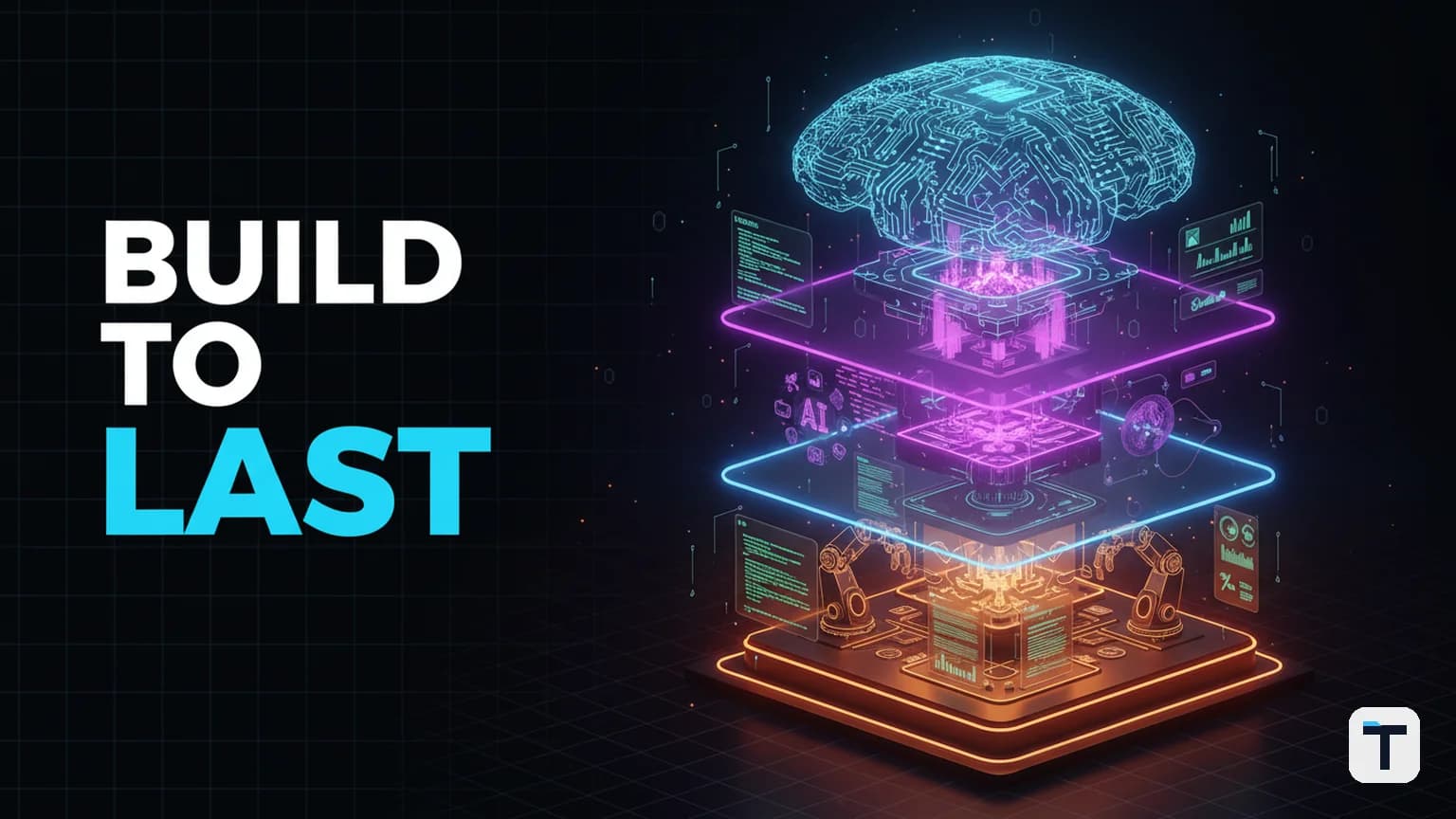

Most teams rewrite their AI agent stack every six months — not because the code is bad, but because they glued everything together. New model drops, framework updates, shifting tool-calling standards: each one forces a full rewrite when your prompts, orchestration logic, and execution infrastructure are tangled into a single codebase. The fix is a three-layer architecture that decouples durable execution (the stable layer) from intelligence and compute (the layers that change constantly). Get the execution layer right and you can swap models, rewrite prompts, and replace sandboxes without touching the system that runs them.
Last verified: 2026-07-21 · TL;DR: Decouple execution (brain) from intelligence (models + prompts + tools) and compute (sandboxes + browsers). Execution has a half-life of years if built right; prompts last weeks, models last months. Invest in resumability, flexible orchestration, and full-session observability. · Volatile facts: Pricing and features for Inngest, Temporal, and LangGraph change often — last checked July 2026.
What Is the Half-Life Problem in AI Agent Architecture?
The half-life problem is the reality that components of an AI agent system decay at different speeds, and when they're coupled together, the fastest-decaying layer forces rewrites of everything else. Prompts you wrote last month may already be stale. The model you optimized for may have a successor with different behavior. But the way you orchestrate steps, handle failures, and resume work — that logic can last years if you design it right. The problem is that most teams build agents as a single coupled unit: the prompt logic lives next to the model call, which lives inside the framework's orchestration, which lives inside the same process as the sandbox. When any one layer changes, the whole thing comes apart.
This isn't a complaint about fast-moving AI — it's a design challenge. The teams building production agents in 2026 are the ones who have learned to separate what changes from what stays. For a deeper look at the structural problems that plague enterprise agent deployments, see our guide on building reliable enterprise AI agents.
Why Do Most Agent Architectures Break After 6 Months?
Most architectures break because they couple three layers that evolve on completely different timelines. When everything lives in one codebase — prompts, model calls, orchestration, state management, sandbox execution — changing any single piece means touching the whole system. A new model release changes token limits and behavior patterns. A framework update deprecates your orchestration API. A new tool-calling standard means rewriting how your agent invokes actions. Each change cascades because the layers aren't isolated.
The result is technical debt with a twist: it's not caused by bad code, but by temporal coupling — components that are fine individually but rot together because they were never designed to evolve independently. Anthropic's engineering team described this pattern when they rebuilt their Managed Agents platform in April 2026, noting that "harnesses encode assumptions that go stale as models improve" — and those stale assumptions become dead weight that slows every iteration.
How Does the Three-Layer Model Solve This?
The three-layer model separates an agent system into execution, intelligence, and compute — each with its own half-life, its own interfaces, and its own ability to be replaced without touching the others.
| Layer | Role | What It Contains | Half-Life |
|---|---|---|---|
| Execution | The brain — orchestration, state, retries | Workflow engine, step persistence, triggers, scheduling | Years (if done right) |
| Intelligence | The knowledge — reasoning and context | Models, prompts, tools, memory, context windows | Weeks to months |
| Compute | The hands — action execution | Sandboxes, browsers, file systems, code runtimes | Months |
The execution layer is the anchor. It manages the full lifecycle of an agent run: plan, call a model, run code, invoke a sub-agent, loop, retry, coordinate. When you swap the model from Claude to GPT to Gemini, the execution layer stays the same. When you replace your sandbox from Docker to a cloud browser service, the execution layer stays the same. Anthropic's decoupling of "brain" (model + harness) from "hands" (sandboxes) and "session" (event log) follows exactly this principle — each component became an interface that makes few assumptions about the others.
What Should the Execution Layer Actually Do?
The execution layer must provide four capabilities that are hard to retrofit:
1. Resumability
Your agent must be able to pick up after failures without restarting from the beginning. If a 3-hour run fails at step 38, you should be able to retry that step, wait, and continue — not replay the entire chain. This means state must live outside the process, in durable storage. A 3-hour run cannot hold state in memory or on disk alone; the state must be external and persistent.
Without resumability, a single failed LLM call or a rate-limit error at step 12 of a 15-step workflow means re-running all 12 previous steps — re-spending tokens, re-paying for API calls, and re-executing side effects. Microsoft's Durable Task documentation notes that this is one of three core problems durable execution solves: "if a failure occurs partway through, tokens already consumed and time already spent are lost."
2. Flexible Invocation Patterns
Your execution layer must support multiple ways to trigger work: cron schedules, event-driven triggers, API calls, human-in-the-loop approvals, sub-agent delegation, and dynamic workflows. You need synchronous execution, asynchronous deferral, and delayed invocation.
If your execution layer can't handle these patterns natively, your agent's business logic starts absorbing infrastructure concerns — queues, workers, polling, backoff, scheduling — until you have a tangled mess that's impossible to modify without breaking something.
3. Full-Session Observability
You need end-to-end traces across the entire session — not just LLM calls and tool calls, but database errors, permission issues, triggers, and performance metrics. If you can't see the full trace from trigger through the complete stack, you can't debug, and you certainly can't improve.
The execution layer sits between user input and everything that happens inside the system, which makes it the natural hub for observability. Every action, every tool call, every sub-agent delegation flows through it — making it the ideal place to instrument, score, and evaluate agent behavior.
4. Durable Step Isolation
Each step in your agent's execution should be independently retryable and idempotent. If a step fails, only that step re-runs — not the entire chain. This is what Inngest's step.run() primitive provides: each step's result is memoized, so if the function resumes after a failure, completed steps return their cached results instantly. Temporal calls this "activity retries" — configurable backoff, timeout, and heartbeat policies on individual operations.
Why Is Using Sandboxes for State an Anti-Pattern?
Sandboxes are ephemeral and stateless by design. They spin up, execute code, and disappear. Using a sandbox for durable state — snapshots, checkpoints, or anything you need to survive a crash — is an anti-pattern because the sandbox can vanish at any moment. When state lives in the sandbox, a container failure means lost work, and you're left trying to piece the system back together from whatever fragments survived.
The correct pattern is the opposite: the execution layer gives the sandbox its context, its sequence, and its durability. The sandbox is the hands — it does work and reports back. The execution layer is the brain — it remembers what happened, decides what's next, and can re-provision a fresh sandbox if the previous one died. Anthropic's team learned this the hard way: when they initially placed all agent components in a single container, a container failure meant the entire session was lost. Their solution was to move the session log outside the harness and treat containers as interchangeable "cattle" rather than irreplaceable "pets."
How Do You Build an Improving Agent Loop?
An improving agent loop has three components that work together: a monitor, a triage agent, and a reviewer.
Monitor (cron): Runs on a schedule — say, every 30 minutes. Pulls high-level system metrics, passes them to an LLM with the question "Is this healthy? What should we do?" If the system isn't healthy, it triggers the triage agent.
Triage agent (sub-agent): Pulls detailed context — deeper metrics, logs, recent changes. Spins up a sandbox, maybe clones code, analyzes commits. Runs in a loop, calling tools, investigating root causes. This may run for minutes. It needs to be durable because you don't know when it will complete or whether it will succeed.
Reviewer (periodic): Runs weekly, examines the history of what the triage system actually did. Did it open a PR? Did it fix the issue? Did it overreact? This function needs to be execution-aware — it pulls the logs of what was executed, what sub-agents were fanned out, what workflows were called — and evaluates performance. It either makes changes itself or reports back to the team.
The key insight is that this loop is three functions, connected by the execution layer. The cron triggers the monitor. The monitor invokes the triage agent. The reviewer examines the triage agent's history. Each piece is simple by design. The complexity lives in the orchestration — and that's what the execution layer handles.
What Are the Durable Execution Options in 2026?
| Platform | Type | Language Support | Pricing (July 2026) | Best For |
|---|---|---|---|---|
| Temporal | Open-source (MIT) + Cloud | Go, Python, TypeScript, Java, .NET, PHP, Rust | Self-host free; Cloud from $1,000 credits | Enterprise-scale, multi-language teams |
| Inngest | Managed + Open-source (Apache 2.0) | TypeScript, Python | Free: 50K exec/mo; Pro from $99/mo (1M exec) | TypeScript/Python serverless teams |
| LangGraph | Open-source framework (MIT) | Python | Free; self-hosted checkpointing | Teams already in the LangChain ecosystem |
Temporal is the most mature option — 21,700+ GitHub stars, 3,000+ paying customers including Nvidia, Netflix, Snap, and Stripe. It originated as a fork of Uber's Cadence workflow engine and provides deterministic replay, activity retries, signals, and full execution history. (Source: GitHub, The New Stack)
Inngest is the closest to the JavaScript/Python ecosystem — event-first, step-based workflows with step.run(), step.invoke(), and step.sendEvent() primitives. The free tier covers 50,000 step executions per month. The self-hosted open-source option (Apache 2.0) removes run quotas but requires you to operate Postgres yourself. (Source: Inngest pricing page, verified July 2026)
LangGraph (36,700+ GitHub stars, MIT-licensed, latest release 1.2.8 in July 2026) provides checkpointing via MemorySaver (dev), SqliteSaver, and PostgresSaver. It's a framework, not a managed service — you run it yourself. It's the natural choice if you're already building with LangChain components. (Source: GitHub)
How Do You Handle the Next 6 Months of Architecture Changes?
The architectures emerging in 2026 — background agents, dynamic workflows, autonomous loops, agent factories — share one trait: they're all long-running and asynchronous. A research agent that crawls the web and writes a report runs 5-20 minutes. A code-modification agent runs longer. Serverless platforms cap execution at 800 seconds (Vercel) to 900 seconds (Lambda) — so any agent that exceeds those limits needs durable execution, not a stateless function.
The frameworks from even 3 months ago weren't designed for this. If you're building autonomous loops — systems that run continuously, assess state against goals, and decide what to do next — you need crons, sub-agent delegation, inspectable history, and reliability guarantees that go beyond what a single framework provides. Our guide on harness engineering for reliable AI agents covers the harness patterns that make this work in production.
The practical answer is to invest in the execution layer now, while the intelligence and compute layers are still churning. The Model Context Protocol (MCP), donated to the Linux Foundation's Agentic AI Foundation in December 2025, is standardizing the tool layer — 10,000+ public MCP servers already exist. That means your compute layer is becoming more pluggable, not less. Your execution layer needs to be ready to orchestrate whatever tools, models, and sandboxes arrive next.
What This Means for You
If you're building AI agents in 2026 — whether for your small business, your product, or your internal tools — the actionable takeaway is this: stop building agents as a single coupled codebase. Separate your execution layer from your intelligence layer from your compute layer. Invest in resumability, flexible triggers, and full-session observability now, while your agent is still small enough to refactor. When the next model drops, the next framework version ships, or the next tool-calling standard arrives, you'll swap the layer that changed and leave the rest alone.
You don't need a managed platform to start — even a simple checkpointer that persists state to a database after each step buys you crash recovery and resume capability. But if you're building anything long-running, anything with sub-agents, anything that needs to survive a deploy or a crash, a durable execution layer is not optional. It's the difference between an agent that works in a demo and one that works in production. If you're just getting started with agent development, our Claude Code guide for non-developers covers the fundamentals of building with agent frameworks. And if you're thinking about how to orchestrate multiple agents at scale, our piece on fleet engineering and AI agent orchestration explores the operational side of running many agents together. For teams worried about agent consistency and memory, the 2026 memory framework for AI agents covers how persistent memory fits into this architecture.
FAQ
Q: What is the execution layer in AI agent architecture? A: The execution layer is the system responsible for running your agent's code reliably — managing state, retries, scheduling, and orchestration across the full lifecycle of an agent run. It's independent of the specific model, prompt, or sandbox being used, so it can stay stable while those components change.
Q: How often do AI agent prompts and models need to be updated? A: Prompts typically last weeks before they need adjustment — sometimes as little as a single week if the model behavior shifts. Models last months before a successor changes the calculus. But a well-designed execution layer can last years, because orchestration patterns (retries, state management, triggers) change far more slowly than model capabilities.
Q: Do I need a framework like LangGraph to build a durable agent? A: No. You can build durable execution yourself with a database checkpoint after each step and a retry loop around each tool call. But frameworks like LangGraph (checkpointing), Temporal (durable workflows), or Inngest (step-based execution) provide these primitives out of the box, saving weeks of infrastructure work. For production agents that run longer than a few seconds, a durable execution layer is strongly recommended.
Q: What's the difference between a sandbox and a durable execution layer? A: A sandbox is ephemeral — it spins up, executes code, and disappears. It's the "hands" of your agent. The execution layer is the "brain" — it persists state, coordinates steps, and can re-provision a fresh sandbox if the previous one dies. Using a sandbox for durable state is an anti-pattern because the sandbox can vanish at any moment, taking your state with it.
Q: How much does durable execution cost in 2026? A: It depends on the platform. Inngest offers a free tier with 50,000 step executions per month and a Pro plan from $99/month for 1 million executions (verified July 2026). Temporal is open-source (MIT) and free to self-host, with a managed Cloud option. LangGraph is free and open-source (MIT). For most teams, the cost of a durable execution platform is far less than the cost of re-running failed agent workflows.
Q: What is temporal coupling in AI agent architecture? A: Temporal coupling happens when components that evolve at different speeds — prompts, models, orchestration, sandboxes — are built as a single coupled unit. The fastest-decaying layer (usually prompts or models) forces rewrites of everything else. Decoupling them into separate layers with stable interfaces is the solution.
Discussion
0 comments