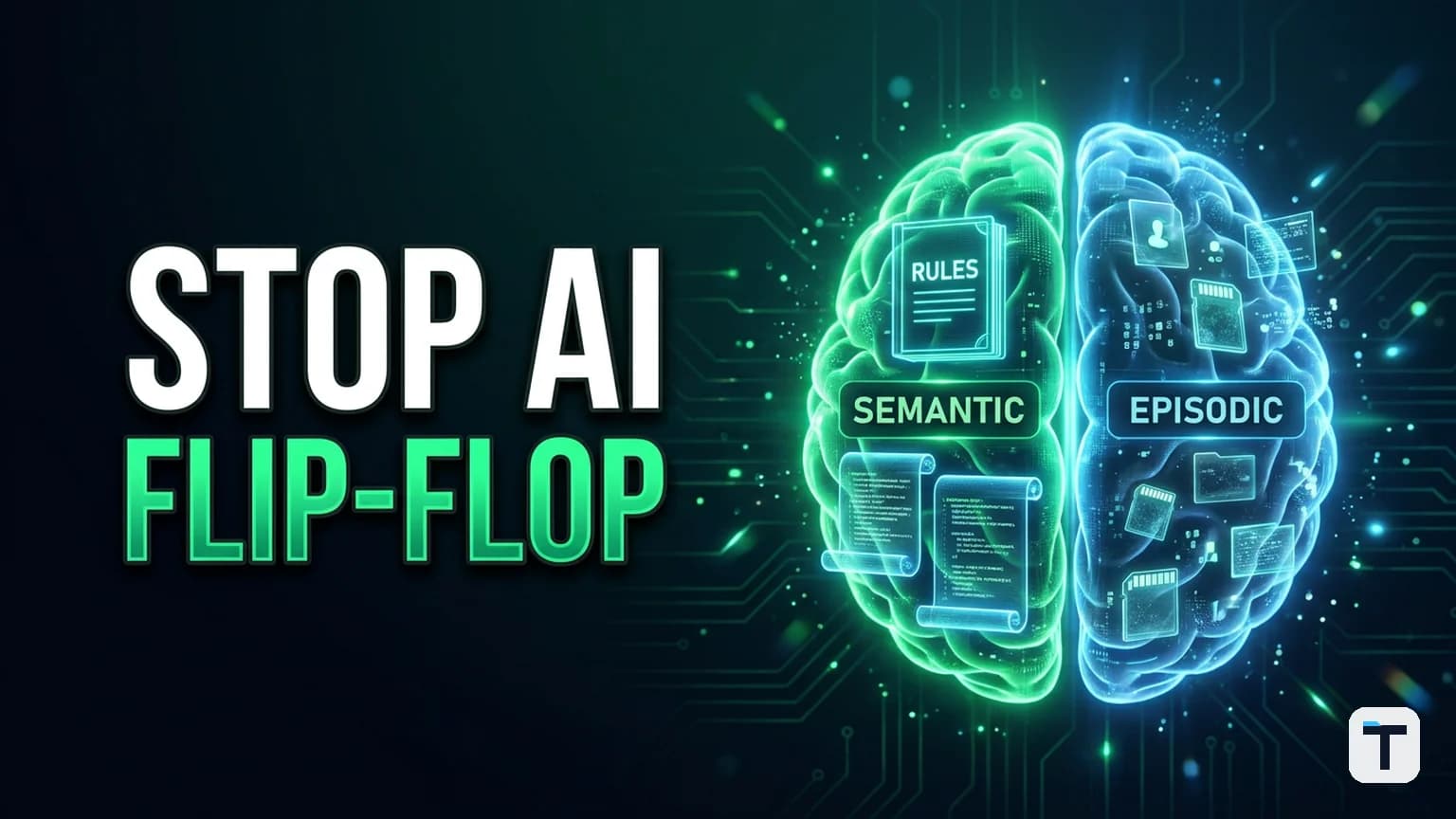

Verdict: AI agent inconsistency isn't a failure of intelligence; it’s a signal of unresolved ambiguity. By shifting from expensive fine-tuning to a "Memory Triad" of semantic clarity and episodic reference, teams can reduce agent flip-flopping by over 60% while building an adaptive system that learns from every disagreement.
TL;DR
- The Problem: Agents show "flip-flop" behavior on ambiguous inputs (the Gray Zone).
- The Cause: Anthropic’s Persona Selection Model (PSM) shows models simulate characters; ambiguity breaks the "Assistant" persona.
- The Solution: Use Query by Committee to identify disagreements, then apply the Memory Triad.
- Semantic Memory: Hardcode domain rules and policies (e.g., "Always label X as Y").
- Episodic Memory: Use RAG to reference past human-verified decisions for similar cases.
Why Your AI Agent Disagrees With Itself
In mid-2026, the dominant failure mode of production AI agents isn't "hallucination" in the traditional sense. It is inconsistency.
You pipe the same input into the same model and get a "Positive" sentiment label at 9:00 AM, but a "Negative" label at 9:05 AM. In cybersecurity triage, an agent might flag a login attempt as "Malicious" on the first run and "Benign" on the second. This flip-flopping creates a critical trust gap: if the agent can’t agree with itself, why should a human trust it?
Research from Anthropic’s Persona Selection Model (PSM), published in February 2026, suggests this happens because LLMs are essentially "persona simulators." When an input falls into a "Gray Zone"—where context is thin or company policy is unclear—the "Assistant" persona loses its footing. The inconsistency isn't a bug; it's the model pointing out a lack of clarity in its instructions.
The Gray Zone: Where Trust Dies
Inconsistency is almost always concentrated around the decision boundary. In a study of security alerts, approximately 25% of alerts were found to flip-flop across multiple runs. These cases typically involve:
- Inherent Ambiguity: Data that even human experts would disagree on (e.g., a "neutral-leaning" customer review).
- Missing Context: Information that exists outside the prompt (e.g., a specific customer’s past behavior or a non-standard company policy).
To build autonomous AI workflows that scale, you must move from "blaming the model" to providing the missing clarity.
The Solution: Augmenting with the Memory Triad
Instead of reaching for expensive fine-tuning, top engineering teams are now using a lighter, more adaptable framework: the Memory Triad. This approach combines Active Learning with structured memory to sharpen those fuzzy decision boundaries.
1. Identify the Disagreement (Query by Committee)
LLM uncertainty scores (the "probability" the model is right) are notoriously unreliable in 2026. Instead, use Query by Committee: run the input through the model 3–5 times. If the verdicts disagree, you’ve found a Gray Zone case that requires intervention.
2. Semantic Memory: The Rulebook
Semantic memory stores explicit, declarative facts and "if-then" policies. This is where you hardcode the nuance that a generic model can’t know.
- Example: "If a login attempt fails but is followed by a successful MFA challenge, label it as Benign." By injecting these rules into the agent's context, you provide the "North Star" that prevents flip-flopping.
3. Episodic Memory: The Case History
Episodic memory uses Retrieval-Augmented Generation (RAG) to look at how similar cases were handled in the past.
- Example: "I've seen 5 alerts like this before; in 4 cases, the human analyst marked them as False Positives." This allows the agent to resolve recurring noise automatically. According to experiments by Diane Lin (Datadog/Chromeinnate), episodic memory can resolve up to 60% of flip-flop cases without any new human labeling.
Implementing the Continuous Learning Loop
The real power of this framework is that it creates a virtuous cycle. When a case is truly novel—meaning episodic memory has no reference and semantic memory has no rule—it is escalated to a human. The human’s decision is then:
- Stored as a new Episode (for immediate automation).
- Distilled into a Semantic Rule (to sharpen the overall boundary).
This "human-in-the-loop" strategy ensures your AI-native team roadmap remains grounded in reality while achieving the high review-debt scoring required for enterprise production.
What This Means for You
If you are building agents for small business or enterprise, stop trying to "fix" the model's stochastic nature with better prompts alone.
- Instrument for Consistency: Run critical evaluations multiple times to find your Gray Zones.
- Externalize Your Knowledge: Build a "Semantic Store" of your specific business logic.
- Log Your Episodes: Every human correction should be a retrievable episode for your agent.
For more on building robust evaluation systems, see our guide on Item Response Theory for LLM Evaluation.
FAQ
Q: Does Query by Committee significantly increase latency? A: In production, you don't need to run every query 5 times. Use a small, high-speed "per-turn classifier" to identify potential Gray Zone inputs first, or only run the committee on high-stakes tasks.
Q: Can't I just use a higher 'temperature' setting to fix this? A: No. Temperature (0.0 to 1.0) controls randomness, but even at temperature 0, LLMs can be inconsistent across different deployments or slight prompt variations. Inconsistency is a data/knowledge problem, not a randomness problem.
Q: How does this differ from simple RAG? A: Standard RAG fetches information to answer a question. Episodic memory fetches past decisions to ensure consistency in judgment.
Q: Is there a tool that automates this memory cycle? A: Frameworks like Hermes Agent OS and Zylos are increasingly building "Persistent Memory" layers that handle the episodic storage and retrieval natively.
Discussion
0 comments