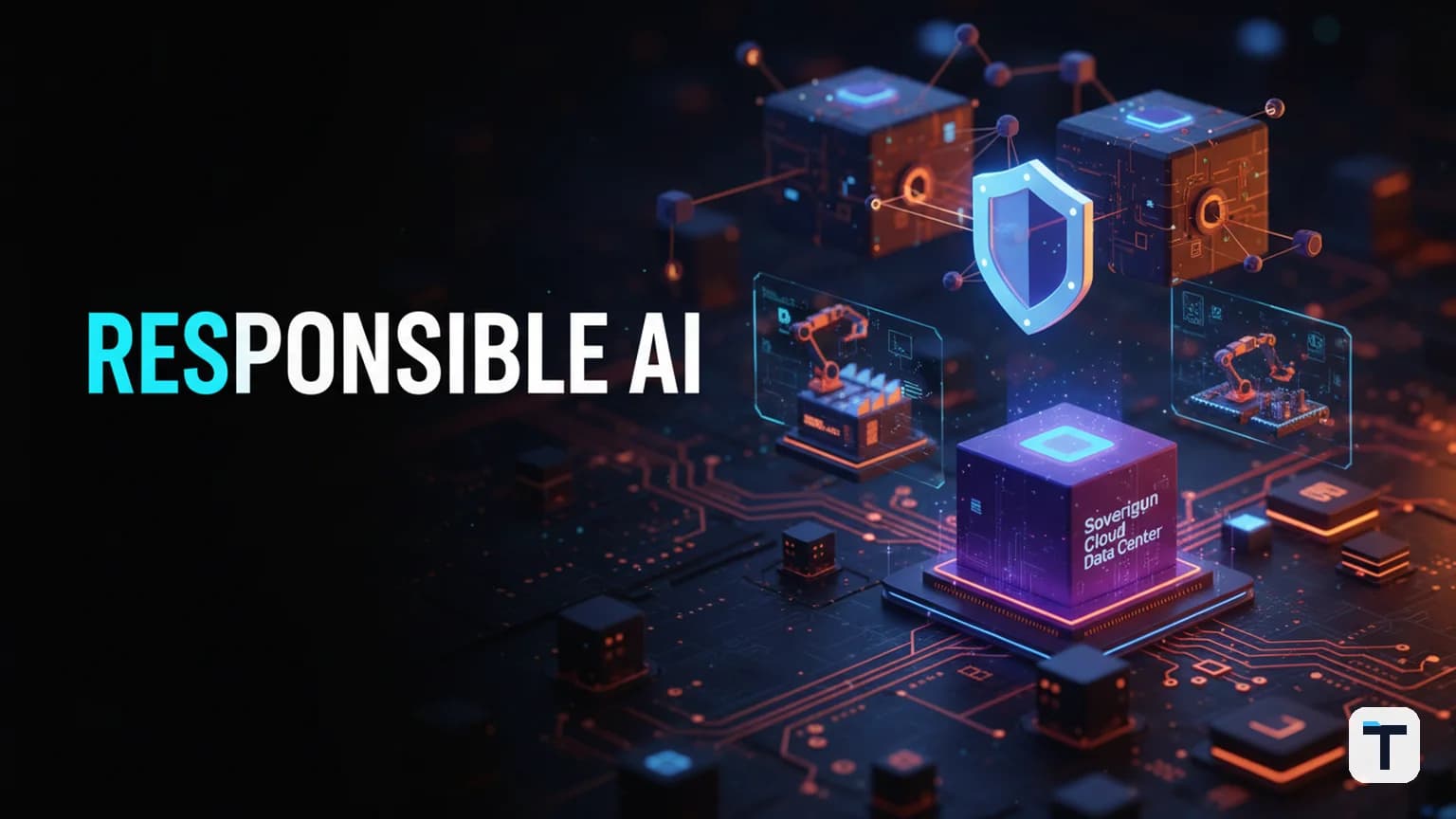

India's Global Capability Centres are done experimenting with AI. The 2,117 GCCs employing 2.36 million professionals across India have shifted from pilot projects to production deployments, and the conversation has moved from "how much AI are you using" to "are you using it responsibly enough to trust in safety-critical systems." The framework emerging from India's most mature GCCs rests on two pillars — viable AI (does the economics work?) and ethical AI (are the guardrails strong enough?) — and it is reshaping how global enterprises measure the value of their India operations.
Last verified: 2026-07-21
- India hosts 2,117 GCCs with $98.4B revenue and 2.36M professionals (NASSCOM-Zinnov FY26 report)
- Karnataka targets 500 new GCCs and $50B economic output by 2029
- The headcount-to-growth linearity is broken — outcome-based models are replacing time-and-materials
- Responsible AI = viable AI (ROI/economics) + ethical AI (guardrails/human-in-loop)
- Bosch's QwAI quantum-inspired framework and sovereign AI cloud with NxtGen are case studies in the shift
- Volatile facts: GCC counts, revenue figures, and partnership details change frequently — last checked July 2026.
What Is a Global Capability Centre in 2026?
A Global Capability Centre (GCC) is a captive offshore unit owned by a multinational company that performs strategic work — engineering, product development, AI, cybersecurity, R&D — for the parent organization. In 2026, India's GCCs have evolved through three phases: cost centres (1990s–2000s), capability centres (2010s), and now innovation centres that own end-to-end product lifecycles and drive enterprise AI roadmaps.
According to the NASSCOM-Zinnov "GCC Value Orbit" report published May 2026, India hosts 2,117 GCCs operating across 3,728 units, generating $98.4 billion in revenue and employing approximately 2.36 million professionals. Roughly 506 of the Forbes Global 2000 companies now operate GCCs in India. Nearly half of all GCCs established since fiscal year 2021 were designed with AI as a core focus from inception, and over 1,200 GCCs have already embedded AI and machine learning capabilities (Economic Times, BusinessWorld).
The label itself has shifted. What started as "captive centres" — a term many found derogatory — became "global cost centres," then "global capability centres," and is now trending toward "global innovation centres." This evolution tracks the value journey: from grunt work to decision-making work, from hourly effort to business outcomes.
Why Is Headcount No Longer the Right Metric for GCC Success?
The linear relationship between headcount growth and business value is broken. AI has decoupled output from input volume, and the operating models of the future are non-linear. This means you can no longer measure a GCC's contribution by how many engineers it adds — you measure it by the outcomes those engineers deliver.
The shift is already visible in how GCCs talk about their work. Leading centres have stopped discussing headcount in boardrooms and started discussing product ownership, market impact, and customer outcomes. The old time-and-materials (T&M) model — billing by the hour — is giving way to outcome-based pricing, platform-as-a-service, and agents-as-a-service models. This mirrors the broader pivot happening across Indian IT, where outcome-based AI pricing is replacing the annuity model.
The NASSCOM-Zinnov report confirms this: hiring is becoming more selective, with companies prioritizing reskilling, redeployment, and AI-led productivity gains over linear headcount growth. Demand for AI-centric skills has risen by 1.5 percentage points in just six months, while traditional coding roles are being redefined (BusinessWorld).
What Is the Viable AI + Ethical AI Framework?
The responsible AI framework being adopted by India's most advanced GCCs has two interlocking pillars. Together, they answer the two questions every enterprise board is now asking: "Can we afford this AI?" and "Can we trust this AI?"
Viable AI: Does the Economics Work?
Viable AI is about measuring whether AI deployments generate real return on investment — not just efficiency gains, but business outcomes. This matters because the cost structure of AI is volatile and unpredictable.
Consider what happened when large language model providers shifted from user-based licensing to token-based charges: costs jumped by roughly three times for many enterprises. If your AI deployment was marginally profitable under per-user pricing, it may now be underwater. The AI infrastructure layer is still evolving — LLM costs, compute requirements, and model capabilities change every six months — making it impossible for either GCCs or their customers to predict long-term pricing.
The viable AI discipline asks GCC leaders to:
- Map AI ROI per use case — not aggregate "AI spend," but line-item economics for each deployment
- Avoid vendor lock-in — because locked-in vendors can raise prices post-adoption
- Budget for cost volatility — assume LLM and compute costs will shift 30–50% every six months
- Move beyond efficiency metrics — the low-hanging fruit (automating repetitive tasks) is picked; the next wave is about products, services, and experiences
Ethical AI: Are the Guardrails Strong Enough?
Ethical AI is about ensuring AI systems operate within safety boundaries, especially in industries like automotive, medical devices, and industrial manufacturing where errors can be catastrophic. The core principles:
- Human-in-the-loop: AI cannot be fully autonomous in safety-critical decision-making. A human must review and approve consequential actions.
- Accountability: When an AI system makes a mistake, you need to know who is responsible and what went wrong. Black-box autonomous systems fail this test.
- Guardrails: Predefined boundaries that prevent AI from taking actions outside its scope — critical for AI agent access control and secure autonomous operations.
For GCCs serving automotive and industrial clients, ethical AI is not optional. The same AI that personalizes a driver's experience must not make unreviewed decisions about safety-critical vehicle functions. This is why roles like "ethical AI architect" are emerging as new specializations within GCCs.
How Are GCCs Moving AI Past the Hype Cycle?
The hype cycle for AI is over — at least inside India's mature GCCs. The conversation has shifted from FOMO-driven adoption ("our competitor did it, why haven't we?") to data-based, business-outcome-driven decision-making.
The pattern of the last 18 months is instructive. Early adopters excited by the technology side of AI launched thousands of pilots across the industry. Many of those pilots succeeded individually but failed to reach industrialization — what some call "death by a thousand pilots." Each pilot was a technical success, but together they never added up to a business success.
The GCCs that are scaling AI successfully have done three things differently:
| Approach | Pilot-Phase GCCs | Production-Phase GCCs |
|---|---|---|
| Success metric | Technical feasibility | Business outcome (revenue, cost, quality) |
| Deployment scope | Single team, single use case | Enterprise-wide platform |
| Cost model | "We'll figure out ROI later" | Per-use-case ROI tracking (viable AI) |
| Governance | Ad hoc reviews | Dedicated ethical AI function with guardrails |
| Talent | Coders using AI tools | System thinkers, forward-deployed engineers, AI architects |
The efficiency gains from AI — automating repetitive tasks in the software development lifecycle — were the low-hanging fruit. They served a dual purpose: they delivered measurable savings AND they got people comfortable with AI-driven change. But efficiency is no longer the focus. The next wave is about AI in products, AI in services, and AI-created experiences — particularly personalization at a scale that was previously impossible.
What Is Sovereign AI and Why Does It Matter for India's GCCs?
Sovereign AI — the idea that a country should control its own AI infrastructure, data, and models — is becoming a strategic priority for India. The parallel is the Bharat digital stack (UPI, UHI, and related public infrastructure) that onboarded over a billion users and created unprecedented scale. The same thinking is now being applied to AI.
In March 2026, Bosch Software and Digital Solutions (Bosch SDS) and NxtGen Datacenter & Cloud Technologies announced a partnership to launch what they describe as India's Sovereign Industrial AI Cloud. The platform combines Bosch's Industry 4.0, digital twin, simulation, and engineering platforms with NxtGen's sovereign cloud infrastructure, edge data centres, and GPU-as-a-Service capabilities — all hosted entirely within India (CRN Asia, Voice&Data).
The sovereign AI cloud addresses three concerns for Indian enterprises:
- Data residency: Sensitive operational data stays within Indian borders, complying with regulations like the DPDP Act
- Latency: Local hosting reduces the latency that comes with foreign servers — critical for real-time manufacturing AI
- Control: Enterprises retain control over their AI infrastructure rather than depending on foreign cloud providers who can change pricing or terms
This connects to the broader sovereign AI India movement, which is shifting from last-mile applications to first-mile infrastructure. For GCCs, sovereign AI capabilities mean they can offer their global parent organizations India-based AI infrastructure that meets both Indian and emerging global data sovereignty requirements.
What Is QwAI and How Does Quantum-Inspired AI Work?
One of the most concrete examples of responsible AI innovation from India's GCC ecosystem is QwAI (Quantum with AI), a framework developed by Bosch Global Software Technologies. QwAI applies quantum-inspired principles — not quantum computing, which remains years away from widespread affordability — to optimize AI models on today's classical hardware.
According to Bosch SDS's official product page, QwAI addresses three problems with traditional AI scaling: runaway model costs, unreliable outputs (hallucinations), and cloud-first architectures that keep intelligence away from the edge (Bosch SDS QwAI, Bosch SDS Accelerator).
The framework claims to:
- Compress AI models so they require less memory and compute
- Reduce data requirements for edge deployment
- Speed up training times (Bosch claims up to 10x faster)
- Reduce hallucinations for more reliable enterprise outputs
- Enable AI to run on edge devices with millisecond latency
For GCCs, the practical implication is significant: if you can shrink the data and model size without losing insight, you reduce the cost of running AI — which directly supports the viable AI pillar. You also enable on-device AI, which supports the ethical AI pillar by keeping sensitive data local rather than sending it to the cloud.
How Are Software-Defined Vehicles Changing the Automotive GCC?
The automotive industry is undergoing a fundamental transformation where software — and especially AI — is becoming the primary value differentiator. The value pool in a vehicle is shifting from the physical hardware (the box) to the software layer on top.
At CES 2026 in Las Vegas, Bosch unveiled its AI extension platform, a high-performance computing unit that retrofits existing cockpit systems with advanced AI functions — without changes to current hardware or system architecture. The platform is built on the NVIDIA DRIVE AGX Orin system-on-chip, delivers 150–200 tera operations per second (TOPS) of additional compute, and connects via simple power and Ethernet interfaces (Bosch Mobility, S&P Global AutoTechInsight).
Bosch projects the AI-enabled in-vehicle infotainment (IVI) market will reach approximately €17 billion by 2030, and the company targets over €2 billion in sales from IVI solutions by end of decade. This is not a niche play — it's a bet that the car becomes a "third living space" where AI personalizes everything from cabin climate to navigation to payment systems.
For India's automotive GCCs, this means:
- New skill demands: AI voice assistants, interior scene understanding, and predictive personalization
- Regionalization: Indian users expect different features, languages, and behaviors than Western or East Asian users — creating an opportunity for India-based teams to own regional product development
- Safety-critical AI: The same platform that adjusts your seat temperature must not interfere with safety systems, making ethical AI guardrails non-negotiable
What Kind of Talent Do GCCs Need in 2026?
The talent profile for GCCs is fundamentally changing. Coding ability alone is no longer the primary hiring criterion — AI can generate code. What GCCs need now are system thinkers who can architect solutions, understand business context, and navigate the ethical implications of AI deployment.
The emerging roles include:
| Role | What They Do | Why It's New |
|---|---|---|
| Forward-deployed engineers | Work directly with customers to implement AI solutions | Blends engineering with consultative problem-solving |
| Ethical AI architects | Design guardrails, human-in-loop systems, accountability frameworks | Safety-critical industries require this as a dedicated function |
| AI platform architects | Build shared AI infrastructure (model registries, inference services, governance) | The highest-leverage investment a GCC can make |
| System thinkers | Understand how AI components interact across the full tech stack | Replaces narrow tool-specific skills |
This talent shift is urgent because AI coding tools have a complicated productivity story. A 2025 randomized controlled trial by METR (Model Evaluation & Threat Research) found that experienced developers using AI coding tools were 19% slower on real-world tasks, despite believing they were 20% faster. The 39-percentage-point perception gap reveals how poorly we measure AI productivity — and why GCCs need system thinkers who can evaluate where AI genuinely helps versus where it creates hidden costs (METR study, Plexive/Engineering Enablement analysis).
The talent pipeline is also being rebuilt at the university level. GCCs are collaborating with universities to integrate cross-functional curricula — blending computer science, electronics, and domain expertise — so graduates arrive with the system-level thinking the industry needs. Karnataka's announcement of an AI university with a specific AI curriculum is one early signal of this shift.
Will India Hit 5,000 GCCs by 2035?
The projection of 5,000+ GCCs in India by 2035 is a common industry forecast, and the policy push is real. Karnataka alone aims to add 500 new GCCs by 2029, creating 350,000 jobs and generating $50 billion in economic output, as announced by Chief Minister DK Shivakumar at the Katalyst Connect event in July 2026 (New Indian Express, Deccan Herald).
The CII-NASSCOM-Deloitte report projects India's GCC sector could grow from $68 billion in direct gross value added (FY25) to $155–199 billion by FY30, with wider economic impact reaching $470–600 billion (Financial Express).
However, infrastructure remains the biggest challenge. Bengaluru's traffic congestion and urban stress are well-documented constraints. The "Beyond Bengaluru" push into Tier-2 and Tier-3 cities — Mangaluru, Hubli, Dharwad, Belagavi, Kalaburagi — is the policy answer, but it requires matching infrastructure: universities, talent availability, and the ecosystem that makes a GCC successful. Office space in Tier-2 cities costs roughly half of Bengaluru's $1–1.5 per sq ft, and the Karnataka government is offering double floor area ratio (FAR) to enable multi-storey construction in these cities.
For now, the most mature GCCs are focused on transformation over expansion — deepening their existing capabilities rather than spreading into new cities. The business decision to expand to Tier-2 is driven by talent availability, university ecosystem, and proximity to customers — not by policy alone.
What This Means for You
If you're a business leader evaluating whether to establish or expand a GCC in India, or if you're already running one and trying to navigate the AI transition:
Stop measuring headcount. Start measuring outcomes. Your board doesn't care how many engineers you have in Bengaluru — they care what those engineers ship, what revenue they generate, and what risk they mitigate.
Build the viable AI discipline now. Track per-use-case ROI for every AI deployment. Budget for 30–50% cost volatility in LLM and compute expenses. Avoid vendor lock-in that could trap you when pricing models shift.
Treat ethical AI as a function, not a checkbox. If you're in automotive, healthcare, industrial, or any safety-critical domain, you need dedicated ethical AI architects designing guardrails and human-in-loop processes. This is not optional — it's the difference between deploying AI and trusting it.
Hire system thinkers, not coders. The METR study showing 19% slowdown for experienced developers using AI tools is a warning: don't assume AI coding tools automatically improve productivity. You need people who understand the full system, not just the tool.
Watch sovereign AI infrastructure. If your operations touch Indian data, the sovereign AI cloud ecosystem is maturing rapidly. The Bosch-NxtGen partnership is one early example; expect more. This matters for compliance, latency, and cost control.
Think ecosystem, not solo. The most successful AI deployments in India's GCCs are collaborative — combining GCC domain expertise, startup innovation, and university talent. Companies trying to do everything in-house are slower than those that partner strategically.
FAQ
Q: What is a Global Capability Centre (GCC)? A: A GCC is a captive offshore unit owned by a multinational company that performs strategic work — engineering, AI, product development, R&D, cybersecurity — for the parent organization. India hosts 2,117 GCCs generating $98.4 billion in revenue and employing 2.36 million professionals as of FY2026, according to the NASSCOM-Zinnov report.
Q: What is the difference between viable AI and ethical AI? A: Viable AI measures whether AI deployments are economically sustainable — tracking per-use-case ROI, managing cost volatility, and avoiding vendor lock-in. Ethical AI ensures AI systems operate within safety boundaries with human-in-the-loop oversight, accountability, and guardrails — critical for safety-critical industries like automotive and healthcare.
Q: Why is headcount no longer the right metric for GCC success? A: AI has broken the linear relationship between headcount and business value. The future operating model is non-linear: outcomes matter more than inputs. GCCs are shifting from time-and-materials billing to outcome-based, platform-as-a-service, and agents-as-a-service models. NASSCOM reports that hiring is becoming more selective, with companies prioritizing reskilling and AI-led productivity over linear headcount growth.
Q: What is QwAI and how does it help with responsible AI? A: QwAI (Quantum with AI) is a framework developed by Bosch Global Software Technologies that applies quantum-inspired principles to optimize AI models on classical hardware. It compresses models to reduce memory and compute costs (supporting viable AI), enables on-device edge deployment with millisecond latency, and reduces hallucinations for more reliable enterprise outputs (supporting ethical AI). Bosch claims up to 10x faster training and 90% training cost savings.
Q: Is India's sovereign AI cloud ready for enterprise use? A: In March 2026, Bosch SDS and NxtGen launched India's Sovereign Industrial AI Cloud, combining digital twin and manufacturing AI platforms with sovereign GPU cloud infrastructure hosted entirely within India. The platform is designed for Industry 4.0 deployments and supports data residency compliance, reduced latency, and enterprise control over AI infrastructure. It is one of the first sovereign AI cloud offerings in India.
Q: Will AI coding tools make my GCC engineers more productive? A: Not automatically. A 2025 METR randomized controlled trial found that experienced developers using AI coding tools (Cursor Pro with Claude 3.5/3.7 Sonnet) were 19% slower on real-world tasks, despite believing they were 20% faster. The study suggests AI tools help more with unfamiliar codebases and routine tasks, but can slow experienced developers on complex, well-understood systems. GCCs should deploy AI coding tools contextually, not blanket-deploy them.
Discussion
0 comments