
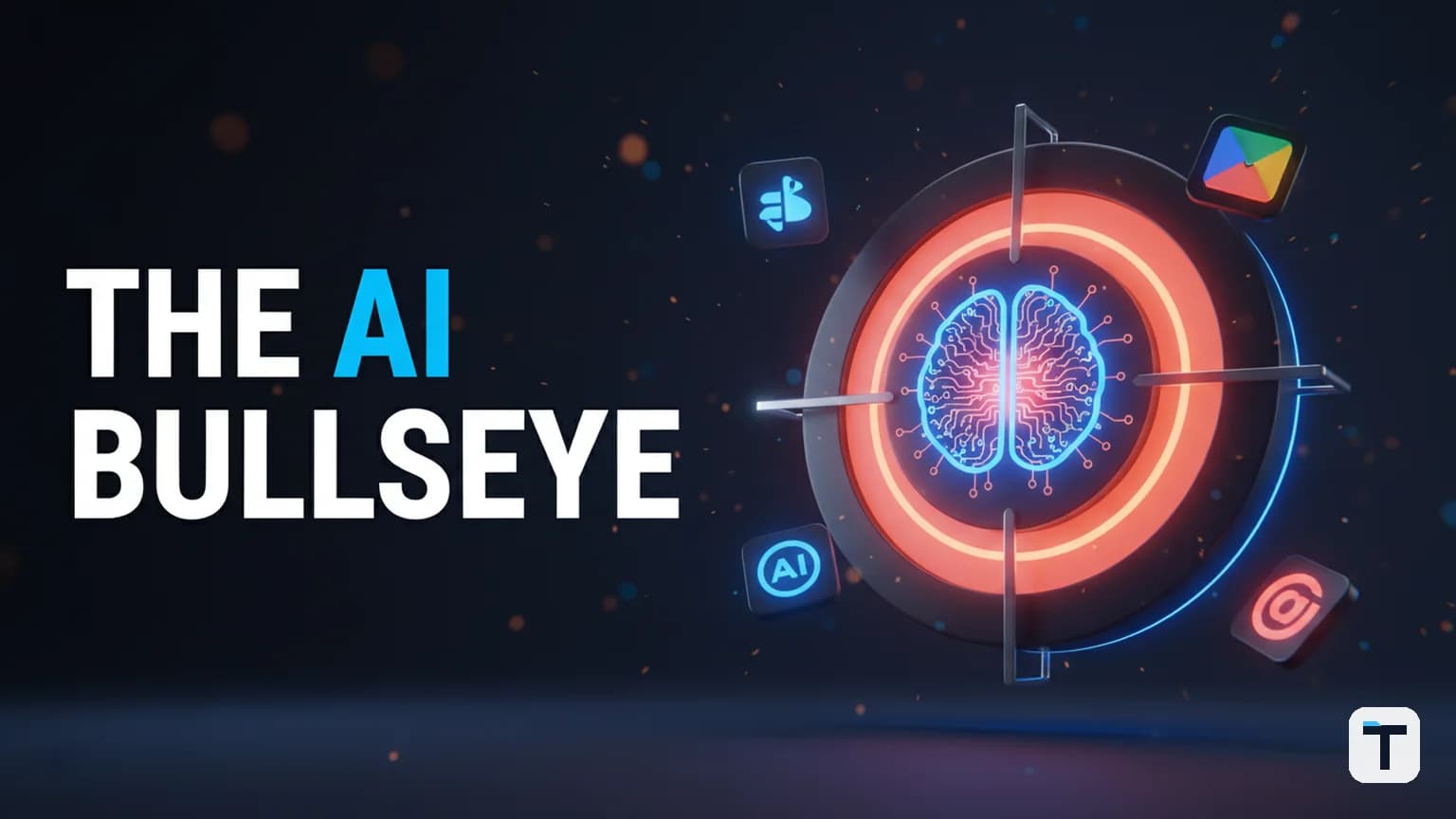
At-a-glance: AI Prioritization Framework
- Last verified: 2026-06-26
- The Bullseye: High-frequency, high-critical-thinking tasks (e.g., proactive sales coaching or complex research synthesis).
- The Trap: High-frequency, low-critical-thinking tasks (e.g., basic email polishing) provide minor time savings but zero strategic moat.
- Key Requirement: Your AI's performance is capped by your "Context Layer"—the unstructured data (emails, docs, Slack) that makes the model specific to your business.
- Strategic Path: Choose the "Growth Path" (more output with same people) over the "Cost Path" to maximize long-term competitiveness.
Which AI path should your business take?
Before you pick a tool, you must pick a direction. In the current era of enterprise AI, organizations generally choose between two distinct strategies: Cost Savings or Accelerated Growth.
The Cost Savings path uses AI to do the same amount of work with fewer people. While this improves the bottom line in the short term, it often leads to organizational contraction. In contrast, the Growth Path uses AI to enable your existing team to produce dramatically more.
For most high-performing companies, the bias is toward growth. When AI removes the bottleneck in sales or marketing productivity, the rational move isn't to cut heads—it is to reinvest those gains to capture more market share.
How do you use the 2x2 AI Prioritization Matrix?
To identify where AI will have the most impact, you can map every task in your business onto two axes: Repeatability (how often it happens) and Critical Thinking (how much expertise it requires).
| Quadrant | Frequency | Complexity | AI Strategy |
|---|---|---|---|
| The Bullseye | High | High | Automate & Augment. This is where transformation happens. |
| The Trap | High | Low | Standardize. Good for minor efficiency, but not a competitive moat. |
| Strategic Help | Low | High | Assist. AI can help, but limited compounding value. |
| The Noise | Low | Low | Ignore. No ROI here. |
The "Bullseye" (Top-Right) includes tasks that take real expertise, happen often, and consume hours from your most expensive people. Examples include continuous customer research synthesis, proactive account health monitoring, or "tribal knowledge" extraction in sales.
Why is "The Trap" so dangerous for business owners?
Most professionals start their AI journey in the bottom-right quadrant: using ChatGPT or Claude to polish an email, summarize a single meeting, or fix grammar. While these tasks are highly repeatable, they require low critical thinking.
The danger is that these "micro-initiatives" create a false sense of progress. You save five minutes here and there, but you haven't rewired your business for the agentic edge. If you only automate the low-complexity tasks, you risk falling into "cognitive debt," where your team loses the ability to perform the high-value work that actually drives the business forward. For more on this risk, see our guide on avoiding AI-driven cognitive debt.
What is the "Context Layer" and why does it matter?
A state-of-the-art LLM without context is effectively an "average" employee with a massive library but no access to your company's files. It knows the public internet, but it doesn't know your brand voice, your internal SOPs, or your specific customer history.
To move an AI agent into the "Bullseye" quadrant, you must build a robust Context Layer. This involves making your unstructured data—emails, Slack threads, meeting recordings, and PDFs—queryable by the AI system. Without this context, AI output remains generic and often misses the nuance required for high-critical-thinking tasks. This is often the root cause of AI persona failures, where the model's behavior feels "off" or generic.
What are the biggest bottlenecks to AI adoption?
In 2026, the primary bottleneck to AI transformation is no longer the technology—it is organizational change management. The underlying models (like Gemini 3.5 or GPT-5) are already capable of delivering more than most teams can absorb.
The "Maturity Gap" is widening: models improve monthly, but human processes change over years. To stay ahead, your team needs "reps"—the experience of working alongside agents and rewiring workflows. Starting small with one "Closed Loop" system (a self-contained process like proactive retention alerts) is better than waiting for a perfect enterprise-wide rollout.
What this means for you
If you are a business owner or operator, your goal is to move beyond "AI as a chatbot" and toward AI as an intelligence layer.
- Audit your workflows: List your top 10 most time-consuming tasks.
- Score them: Rate each on a scale of 1-5 for Frequency and Critical Thinking.
- Build your Context Layer: Start centralizing your unstructured knowledge so agents can actually "know" your business.
- Choose Growth: Reinvest the time saved into higher-output initiatives that scale your impact.
FAQ
Q: Is it better to start with low-hanging fruit or big bets? A: While low-hanging fruit (The Trap) builds quick momentum, it rarely moves the needle on operating income. Aim for at least one "Big Bet" in the top-right quadrant early on to prove the transformational value of AI.
Q: How often should we re-verify our AI priorities? A: We recommend a quarterly review. As AI models gain new capabilities (like native computer use or improved reasoning), tasks that were once "Low Feasibility" may move into the "Bullseye."
Q: Does focusing on Path 2 (Growth) mean we don't save money? A: No. It means your "Cost per Unit of Output" drops dramatically. You are producing more value for every dollar spent on payroll and compute, which is the ultimate form of efficiency.
Q: Can we automate high-critical-thinking tasks if we don't have perfect data? A: No. High-complexity tasks require high-quality context. If your data is scattered and "messy," your AI will hallucinate or provide generic advice. Clean your data before you build the agent.
Q: What is the first "Closed Loop" we should build? A: For most businesses, it is Customer Intelligence. Taking support tickets and sales calls and turning them into real-time product roadmap decisions provides the fastest feedback loop for the organization.
Every claim here is traced to a primary source, dated, and listed under Sources. Research and drafting are AI-assisted; editing, verification and publication are human decisions, and a person is accountable for what appears on this page. How we work →
Discussion
0 comments