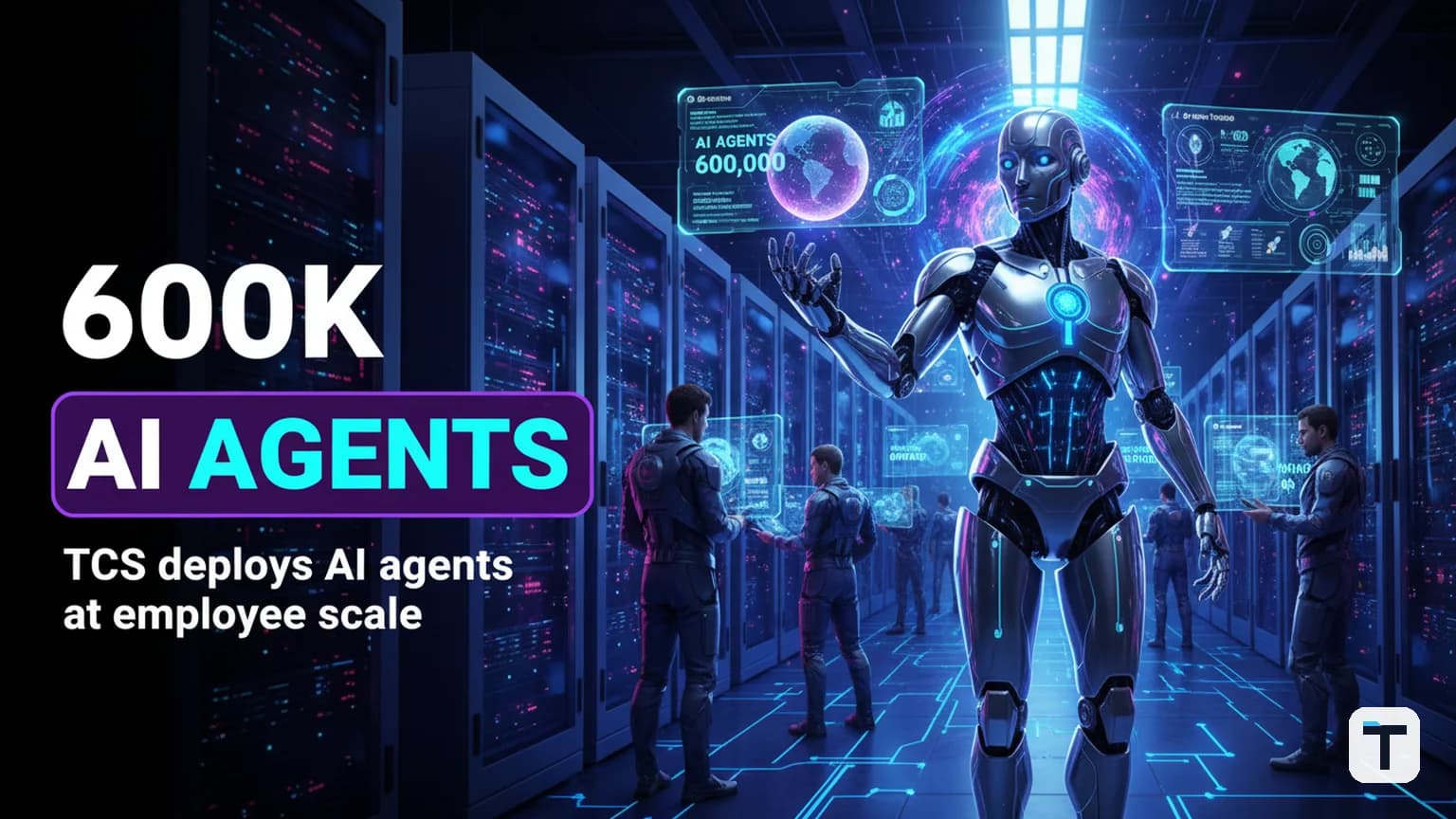

Tata Consultancy Services (TCS), the world's second-largest IT services firm with roughly 600,000 employees, plans to deploy as many AI agents as human workers within three years — and its AI revenue run rate has already crossed $2.6 billion. Chairman N. Chandrasekaran framed the shift not as a layoff strategy but as the biggest opportunity enterprise IT has ever seen, predicting that 100% of the company's revenue will have an AI component before 2030. The question for anyone building with AI is not whether this transition is real — the hiring data and revenue numbers confirm it is — but what it means practically for how work gets done, who gets hired, and where the money flows.
Last verified: 2026-07-31 · Target keyword: AI agents in enterprise IT · Format: news analysis + practical guide TL;DR
- TCS chairman predicts 1:1 AI agents to human employees within 3 years (600,000+ agents).
- AI revenue run rate: $2.6 billion (Q1 FY27), growing 22%+ quarterly.
- India's top 5 IT firms cut nearly 7,000 jobs in FY26 — the first sustained reversal in years, driven by AI-led productivity, not demand collapse.
- Chandrasekaran's framing: AI is infrastructure, not a tool. "The scarcest resource will not be the model. It will be context and trust."
- For builders and small businesses: document your workflows, clean your data, and start with agent governance before agent sprawl. (Pricing/limits change often — re-check quarterly.)
What Did TCS Actually Announce?
At TCS's 31st Annual General Meeting on June 9, 2026, Tata Sons Chairman N. Chandrasekaran told shareholders: "I predict that over the next three years, TCS will have as many AI agents as human employees. [...] The day is not very far when TCS will have an equal number of AI agents or AI workers as their physical workers." The statement, first reported by Reuters and covered across Indian business media, was not a casual remark — it was the centerpiece of a strategic address positioning AI as the company's defining growth driver.
Chandrasekaran was explicit that the prediction does not mean replacing employees. "The company's employees and AI agents will work together, and that will be the future," he said, noting that TCS would slow hiring for new roles rather than conduct mass layoffs. TCS is already investing in AI agents across three areas: internal operations, solution frameworks for clients, and external client-facing work.
The announcement builds on reports that emerged in May 2026 that TCS plans to hire only 25,000 freshers in FY27, down sharply from the 40,000–42,000 range in prior years (per NASSCOM and industry data).
How Big Is TCS's AI Business Right Now?
TCS's AI revenue is no longer experimental. Here is what the primary-source financial disclosures show:
| Metric | Value | Period | Source |
|---|---|---|---|
| Annualized AI revenue run rate | $2.5 billion | Q4 FY26 (Jan–Mar 2026) | TCS 31st AGM address, June 9, 2026 (Reuters, BusinessToday) |
| Annualized AI revenue run rate | $2.6 billion | Q1 FY27 (Apr–Jun 2026) | TCS Q1 FY27 press release, July 9, 2026 |
| Sequential growth in AI revenue | 13.6% QoQ | Q1 FY27 | Financial Express, Moneycontrol, July 2026 |
| Compound quarterly growth rate | 22%+ | Four consecutive quarters | TCS AGM address, confirmed by multiple outlets |
| Total quarterly revenue | ₹72,275 crore (~$7.6 billion) | Q1 FY27 | TCS Q1 FY27 press release |
| Total deal wins | $9.5 billion TCV | Q1 FY27 | TCS Q1 FY27 press release |
The largest single deal anchoring Q1 FY27 was an $800 million AI-led transformation program with SKF, the Swedish industrial group, designed to build an "intelligent digital core" integrating AI across applications, infrastructure, and enterprise data.
TCS also became the first global systems integrator to partner with Mistral's enterprise platform and signed a strategic partnership with Anthropic, launching a dedicated business unit to sell Claude-based enterprise solutions.
What Are the Five Growth Opportunities Chandrasekaran Identified?
Chandrasekaran outlined five specific areas where he sees AI creating new demand for IT services:
- Legacy system modernization. Enterprises have decades of fragmented data locked in outdated infrastructure. AI can accelerate the rewiring of these systems.
- Business process redesign. Using AI to rebuild end-to-end processes — supply chains, customer journeys, HR workflows — not just optimize existing ones.
- AI agent governance. Quoting Chandrasekaran: "AI agents don't stay where they are. They learn, act, drift off course and can even deteriorate. If maintaining applications was the defining annuity of the last era, governing intelligence will be the defining annuity of the next." This is recurring revenue from monitoring, compliance, and correction of deployed agents.
- Sovereign AI. Governments and regulated industries want control over AI infrastructure and data. TCS has launched sovereign AI initiatives in India and Europe, including a SovereignSecure Cloud offering for the European market.
- Physical AI. Extending AI into factories, warehouses, and vehicles — robotics, connected infrastructure, and industrial automation. Chandrasekaran cited a global agribusiness client using a four-legged robot to monitor hazardous warehouse conditions.
He projected the global enterprise IT market, currently valued at approximately $1.6 trillion, will reach $3 trillion over the next decade as AI raises technology ambitions across sectors.
Is AI Actually Cutting IT Jobs in India?
Yes — the data is unambiguous, and it predates Chandrasekaran's announcement. India's top five IT services firms (TCS, Infosys, HCLTech, Wipro, and Tech Mahindra) collectively cut nearly 7,000 jobs in FY26, reversing a net addition of 12,718 in FY25.
TCS drove most of the contraction. Its headcount fell from 607,979 (March 2025) to 584,519 (March 2026) — a net reduction of 23,460 employees. The company openly attributed this to AI-enabled delivery and higher productivity per worker, not to a demand collapse. In fact, TCS revenue grew 13.9% year-on-year in Q1 FY27.
The pattern is structural, not cyclical. As one analyst quoted in Mint put it: "The productivity we are seeing from the new AI-based models requires fewer, not more people." NASSCOM data confirms the sector-wide flattening: India's total tech workforce grew just 2.3% to 5.95 million in FY26 — the slowest expansion in years.
But there is an important nuance the headlines miss. TCS added approximately 9,300 employees in Q1 FY27 — its strongest quarterly hiring in over three years — taking headcount back to 593,798. The hiring is shifting from volume to specialization. The company reported 114,000 employees with "higher order AI skills" and delivered 14.6 million learning hours in FY27 year-to-date.
What Does "Context and Trust" Mean for Enterprise AI?
Chandrasekaran's most quotable line from the AGM was: "In enterprise AI, the scarcest resource will not be the model. It will be context and trust." This is not a throwaway slogan — it is a strategic claim about where the value in enterprise AI will concentrate.
Context refers to the proprietary data, business logic, and institutional knowledge embedded in decades of legacy systems. A frontier model from OpenAI, Anthropic, or Google can write code and answer questions, but it cannot — on its own — know how a specific bank's risk workflow operates, what a manufacturer's supply chain dependencies are, or why a particular HR process was built a certain way. That knowledge lives in the enterprise's data and systems, and wiring AI into that context is precisely the work IT services firms have done for decades.
Trust means compliance, security, audit trails, and governance — the assurance layer that lets a regulated enterprise deploy autonomous agents without unacceptable risk. This is why Chandrasekaran framed agent governance as the next era's annuity revenue stream.
For practical builders, this means the moat is not in building a better model. It is in building the integration, data pipeline, and oversight layer around whatever model you choose — the work that lets an agent operate safely inside a specific business.
The competitive threat from AI vendors themselves is real and growing. In May 2026, OpenAI launched the "OpenAI Deployment Company," a $4 billion venture backed by TPG, Brookfield, and Bain Capital, designed to embed forward-deployed engineers directly inside enterprises. Anthropic followed with a $1.5 billion joint venture with Blackstone, Hellman & Friedman, and Goldman Sachs to build an enterprise AI services arm. These moves target exactly the high-value enterprise integration work that firms like TCS and Infosys have traditionally owned — and they are reshaping what forward-deployed engineering means as a product strategy, not just a sales role.
This is one reason agent governance — the discipline of monitoring, correcting, and securing deployed agents — is becoming a critical skill for anyone building with AI. If you are deploying agents in production, you need an inventory, monitoring, and rollback process before you need a bigger model. (For a practical framework on governing agents at scale, see our AI agent sprawl governance guide.)
How Do TCS's Partnerships Map the Enterprise AI Stack?
TCS's Q1 FY27 results reveal a deliberate strategy to partner across every layer of the enterprise AI stack:
| Partner | Layer | What TCS Is Doing |
|---|---|---|
| Anthropic | Foundation models (Claude) | Dedicated business unit to sell Claude-based enterprise solutions |
| Mistral | Open-weight enterprise models | First global systems integrator on Mistral's enterprise platform |
| Google Cloud | Cloud + Gemini | Expanded partnership for agentic and autonomous AI operating models |
| Microsoft | Cloud + Copilot | Ongoing Azure / OpenAI integration for enterprise clients |
| Oracle | Data platform | India's first Oracle AI Data Platform Lab and Center of Excellence (Kolkata) |
| ServiceNow | Workflow automation | Expanded collaboration for AI-driven IT operations |
| Siemens Energy | Industrial AI / data centers | MoU for digital, IT services, and industrial AI collaboration |
The pattern is clear: TCS is not betting on any single model vendor. It is positioning itself as the integration and delivery layer that works with all of them — the "context and trust" wrapper that Chandrasekaran described. For anyone building their own agent stack, the same principle applies: orchestrate AI agents like a company, not as disconnected tabs.
What Is the Tata Group's Broader AI Infrastructure Bet?
Chandrasekaran framed TCS's agent deployment as one piece of a larger Tata Group strategy to bring down the cost of intelligence itself — spanning chips, data centers, and enterprise software.
Chips: Tata Electronics is building India's first major commercial semiconductor fabrication plant at Dholera, Gujarat, in partnership with Taiwan's Powerchip Semiconductor Manufacturing Corporation (PSMC). The facility represents a ₹91,000 crore ($11 billion) investment and will produce chips on 28nm–55nm process nodes at an initial capacity of 50,000 wafers per month. Construction began in March 2024 and was approximately 50% complete as of April 2026, with first chips targeted for 2026–27. The project is 70% funded by the Government of India under the Modified Semiconductor Fab Scheme.
Data centers: TCS has invested in AI data center infrastructure, including partnerships spanning OpenAI, Microsoft, AWS, and Google Cloud for compute capacity. The company also launched SovereignSecure Cloud in Europe, combining sovereign cloud architecture with AI capabilities for governments and regulated industries.
Enterprise software: Through TCS itself — the delivery and integration layer for AI across global enterprises.
What This Means for You
If you are a small business owner or solo builder:
The TCS announcement is not directly actionable for a 5-person company — but the underlying pattern is. TCS is doing five things that any size of business should consider:
- Audit your repetitive workflows. Before deploying agents, you need to know which processes repeat often enough to automate. TCS calls this legacy modernization; for you, it means documenting how your business actually works. (For concrete examples, see our guide to AI agent workflows that replace repetitive tasks.)
- Clean your data first. Chandrasekaran's "context" point applies at every scale. An AI agent is only as good as the data and rules it can access. If your customer database is messy, your agent will be messy.
- Build governance before scale. Agents drift, make mistakes, and need monitoring. Start with a simple inventory: which agents are running, what they can access, and how you shut them off if something goes wrong.
- Hire for specialization, not volume. The IT sector's shift from mass hiring to targeted AI skills is a leading indicator for every industry. One person who can design and govern an agent workflow may deliver more than three people doing manual data entry. (If you manage a team adopting AI, the AI manager skill framework breaks down how to delegate work to agents instead of doing their jobs for them.)
- Track AI spend as infrastructure, not a experiment. TCS treats AI as infrastructure ("an infrastructure of intelligence"), not a tool. That means budgeting for it as a recurring cost — compute, monitoring, model updates, and governance — not a one-time pilot.
If you work in enterprise IT or technology services:
The hiring data tells the real story. The sector is not collapsing — TCS revenue grew 13.9% YoY in Q1 FY27 — but the workforce model is restructuring. Roles that involve routine coding, testing, and ticket resolution are shrinking. Roles involving agent design, data engineering, AI governance, and client-facing AI transformation are growing. If you are in a role that could be described as "moving data from one system to another," now is the time to move toward designing the system that does that automatically.
FAQ
Q: What does it mean when TCS says it will have "as many AI agents as employees"?
A: TCS chairman N. Chandrasekaran predicted at the company's 31st AGM (June 9, 2026) that within three years, TCS will deploy a number of AI agents roughly equal to its human workforce of approximately 600,000. The agents will work alongside employees across internal operations, client solution frameworks, and external operations — not as replacements but as a parallel digital workforce. AI revenue at TCS has already reached a $2.6 billion annualized run rate as of Q1 FY27.
Q: Will AI agents replace IT workers in India?
A: The data shows a structural shift, not a wholesale replacement. India's top five IT firms cut nearly 7,000 jobs in FY26, and TCS reduced headcount by 23,460. But TCS also added 9,300 employees in Q1 FY27 — its strongest quarterly hiring in three years. The pattern is a shift from volume hiring (mass recruitment of freshers) to targeted hiring of workers with AI skills. TCS reported 114,000 employees with advanced AI capabilities as of mid-2026.
Q: How much revenue is TCS making from AI?
A: TCS's annualized AI revenue run rate reached $2.6 billion in Q1 FY27 (quarter ended June 30, 2026), up from $2.5 billion in the prior quarter and growing at a compound quarterly rate of over 22%. The company won $9.5 billion in total contract value in Q1 FY27, anchored by an $800 million AI-led transformation deal with SKF.
Q: What are the five AI growth opportunities Chandrasekaran identified?
A: Legacy system modernization, AI-driven business process redesign, AI agent governance and monitoring, sovereign AI infrastructure (for governments and regulated industries), and physical AI (robotics and connected infrastructure in factories, warehouses, and vehicles). Chandrasekaran said agent governance specifically will become the "defining annuity" of the next era of IT services.
Q: What does "context and trust" mean in enterprise AI?
A: Chandrasekaran argued that foundation models (from OpenAI, Anthropic, Google, etc.) are becoming commoditized, so the real value in enterprise AI lies in two things: context — the proprietary data, business logic, and institutional knowledge embedded in a company's existing systems — and trust — the compliance, security, and governance layer that lets a regulated enterprise deploy autonomous agents safely. IT services firms like TCS are positioning themselves as the integration layer that provides this context and trust.
Q: How should a small business prepare for AI agents?
A: Start with three steps. First, document your repetitive workflows — you cannot automate what you have not mapped. Second, clean and organize your data so an agent can access it reliably. Third, build a simple governance inventory before deploying agents at scale: track which agents are running, what they can access, and how to shut them off. Treat AI as recurring infrastructure (compute, monitoring, updates), not a one-time experiment.
Discussion
0 comments