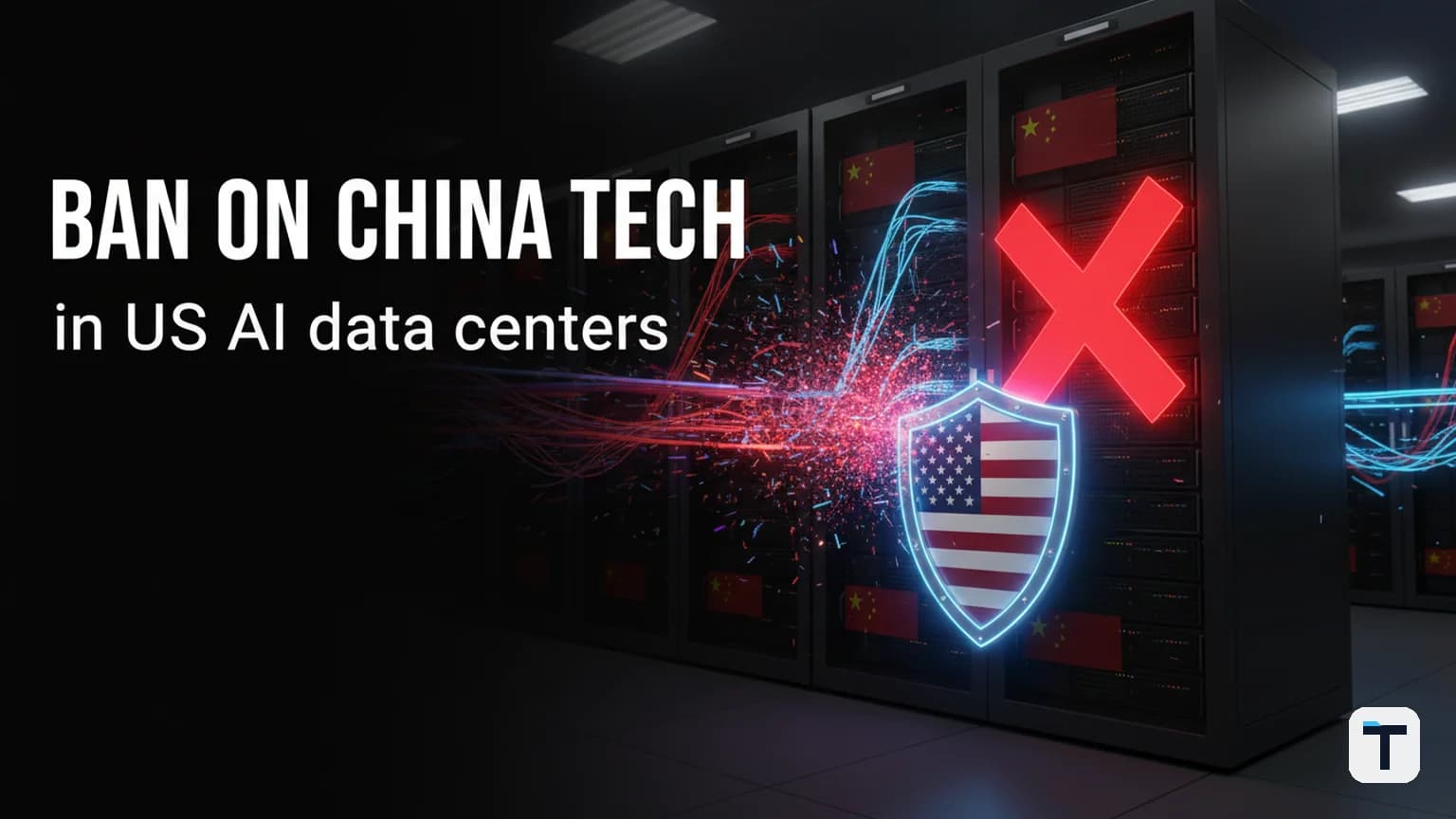

The US Federal Communications Commission is drafting a ban on new Chinese-made optical transceivers — the fiber-optic modules that move data at light speed inside AI data centers — in what officials describe as a national security measure to prevent data theft, malware installation, and service disruption at American AI facilities. According to Reuters reporting from August 4, 2026, four people familiar with the matter said the FCC aims to publish the rule before year-end, though it could still be modified or abandoned entirely. If adopted, it would remove components from companies controlling over 60% of the high-bandwidth 800G+ transceiver market — the tier that matters most for AI clusters — and hand a windfall to US suppliers like Coherent and Lumentum, who nonetheless lack the manufacturing scale to fill the gap on current AI buildout timelines.
TL;DR
- The FCC is drafting a ban on imports of new Chinese optical transceivers for US AI data centers, per a Reuters exclusive published August 4, 2026. No formal rulemaking has been published yet.
- Innolight holds roughly 27% of the global data center transceiver market; together with Eoptolink, the two Chinese firms control over 60% of the 800G+ segment critical for AI workloads.
- Western alternatives face a 12–24 month capacity ramp gap, and every competitive optical laser — including those made by Coherent and Lumentum — depends on indium phosphide (InP), a substrate 70% produced in China that is already under Chinese export licensing controls.
- Since China's InP export controls began in February 2025, the price of a 6-inch InP wafer has surged ~250%, from roughly $1,400 to $5,000.
- Market reaction was swift: Lumentum gained 7–9%, Coherent rose 10–11%, and Applied Optoelectronics jumped ~18% on the Reuters report.
What Are Optical Transceivers and Why Do They Matter for AI?
Optical transceivers are small pluggable modules that convert electrical signals into light and back again, enabling data to travel at the speed of light through fiber-optic cables connecting GPUs, switches, and storage systems inside a data center. At the scale of a modern AI cluster, these components are non-negotiable — you cannot swap in copper at the bandwidth requirements that AI training and inference demand.
A single 1-megawatt AI cluster requires approximately 600–900 optical modules (roughly 120 GPUs × 6 modules per GPU), with unit prices ranging from $800 to $1,500 for 800G-class modules. That puts optical transceiver spending at roughly $0.6–1.4 million per megawatt of cluster capacity — and in scenarios where Innolight dominates the module bill of materials for hyperscaler clusters (especially Google and Meta), the company can capture 40–60% of that optical line item, per analysis compiled from Innolight's financial disclosures.
As AI clusters scale to thousands of GPUs with spine-leaf network architectures, the number of optical interconnects grows faster than compute capacity. A shortage at the transceiver level propagates upward through data center commissioning timelines — directly constraining how quickly hyperscalers can bring new AI capacity online.
How Did We Get Here? The FCC's Escalating Pattern
The proposed transceiver ban is not an isolated action. It is the latest in an accelerating series of FCC restrictions targeting Chinese technology through the Covered List framework established under the Secure Networks Act (47 U.S.C. §§ 1601–1609). The pattern:
| Date | FCC Action | Target |
|---|---|---|
| March 12, 2021 | Huawei added to Covered List | Telecom equipment & video surveillance |
| December 2025 | Foreign drones added | Consumer and enterprise drones (including DJI) |
| March 23, 2026 | Foreign-produced routers added | Consumer networking equipment |
| July 28, 2026 | Power inverters & advanced robotics added | Grid-tied inverters, humanoid robots |
| Late 2026 (draft) | Optical transceivers (reported) | AI data center fiber-optic components |
The FCC's Covered List mechanism works by denying equipment authorization — meaning products on the list cannot be imported, marketed, or sold in the United States. The proposed transceiver ban would apply to new models from Chinese manufacturers; existing authorized hardware would not be retroactively affected.
Officials reportedly pointed to Huawei as a cautionary example, arguing that removing the Chinese telecom giant's equipment from US networks proved slow, costly, and incomplete because the equipment had already become widespread. The transceiver ban's logic is preemptive: act before Chinese optical components become further entrenched in AI data centers, when replacement costs and supply chain dependencies would be even harder to unwind.
Who Dominates the Optical Transceiver Market Today?
The market concentration that makes this ban consequential is well-documented. According to Counterpoint Research data reported by Reuters:
| Company | HQ | Market Position | Key Financials |
|---|---|---|---|
| Innolight (中际旭创, 300308.SZ) | Suzhou, China | ~27% global transceiver market | Q1 2026 revenue ¥19.5B (~$2.85B), +192% YoY. Customers: Alphabet (22% of revenue), Amazon (11%), Meta (6.4%). 90%+ revenue from outside China. |
| Eoptolink (新易盛, 300502.SZ) | Chengdu, China | #2 Chinese module maker; jointly controls 60%+ of 800G+ segment with Innolight | Q1 2026 revenue ~$1.2B, +106% YoY, net margins ~33% |
| Coherent | Saxonburg, PA, USA | Leading Western transceiver supplier | Shares surged 10–11% on ban news |
| Lumentum | San Jose, CA, USA | Leading Western transceiver & EML laser supplier | Shares surged 7–9% on ban news; order book sold out through 2028 |
| Applied Optoelectronics | Sugar Land, TX, USA | US optical component maker | Shares surged ~18% on ban news |
Innolight was added to the Pentagon's list of alleged Chinese military-backed companies in June 2026 and conducted a Hong Kong IPO on July 30, 2026, raising approximately $6.81 billion — just five days before the Reuters report about the transceiver ban landed.
Notably, Innolight's biggest customers are American hyperscalers. Alphabet accounts for 22% of its revenue, Amazon for 11%, and Meta for 6.4%, with over 90% of revenue coming from outside China. This means the ban's direct impact would fall on the very US tech giantsbuilding the AI infrastructure the ban is designed to protect.
Why Can't US Manufacturers Simply Replace Chinese Transceivers?
The core constraint is not assembly capacity — it is the raw material that powers the lasers inside every competitive high-speed transceiver. Every optical transceiver laser, including those made by Coherent and Lumentum, is built on an indium phosphide (InP) substrate. There is no commercially scalable substitute for InP at signaling speeds above 100 gigabits per lane, and silicon photonics offers only a partial alternative for lower-specification interconnect functions.
China controls approximately 70% of global InP production, and Beijing placed InP on its export control list in February 2025, requiring government-issued permits before substrates, wafers, and crystals can be shipped overseas. The consequences have been severe:
- The price of a 6-inch InP wafer has surged approximately 250%, from roughly $1,400 to $5,000, since the controls began, per multiple market analyses.
- AXT Inc., one of the world's largest InP substrate producers (controlling ~80% of global supply with Japan's Sumitomo Electric), did not receive its first export permits until June 2025, creating a four-month gap during which unfulfilled orders accumulated into a significant backlog.
- Lumentum has forward-sold its production capacity through 2028 despite reportedly quadrupling output — a booking horizon that signals structural undersupply.
- Coherent is doubling its InP wafer production capacity at its Texas facility, with another doubling expected by end of 2027, but meaningful alternative supply scale will not arrive before 2027–2028.
- Supplier qualification cycles take 12–24 months, meaning even new InP substrate capacity cannot flow into the supply chain as usable product until qualification is complete.
If China tightens InP export controls further in response to the transceiver ban — as analysts have warned — the Western production ramp the FCC is counting on cannot materialize fast enough to cover the gap. The ban's structural vulnerability is that it targets the transceiver tier of a supply chain whose upstream chokepoint (InP substrates) is already controlled by the country being restricted.
What Is the Security Rationale for the Ban?
The FCC's justification is prospective rather than reactive. No confirmed data-access incident involving Innolight or Eoptolink has been publicly reported. Optical modules are physical hardware rather than data-collection software, and that distinction matters for risk assessment.
However, modern high-speed transceivers are not passive cables. They contain firmware, onboard memory, and management interfaces that represent a theoretical attack surface. Officials fear compromised components could enable data theft, malware installation, or service disruption within US AI data centers.
One legal condition underpins the security argument regardless of any individual company's product design: China's 2017 National Intelligence Law, Article 7, obligates all Chinese organizations to "support, assist, and cooperate with national intelligence work." That obligation is not contingent on a company's stated privacy policy or the physical location of its factories.
"Transceivers definitely pose a risk. As the data center buildout scales up, you want to make sure the data center supply chain is secure from the get-go."
— Divyansh Kaushik, AI policy expert at Beacon Global Strategies, told Reuters
How Have China and Markets Responded?
China's embassy in Washington criticized the proposal, urging the United States to stop what it described as the targeting of Chinese companies and warning that Beijing would respond to measures harming Chinese interests. The Chinese government has already imposed retaliatory export controls — including on drones and related technologies — and has the InP export permit system as its most potent lever.
The timing is diplomatically sensitive: the ban proposal came as officials on both sides were working to stabilize relations ahead of a Xi Jinping visit to the United States expected in September 2026.
Financial markets reacted swiftly on August 4–5, 2026:
| Company | Stock Movement | Position |
|---|---|---|
| Lumentum | +7–9% | US transceiver & EML laser supplier |
| Coherent | +10–11% | US transceiver & InP wafer producer |
| Applied Optoelectronics | +18% | US optical component maker |
| Marvell Technology | +8% | US optical communications / photonics |
| Innolight (Shenzhen) | −14% (before paring) | Chinese transceiver market leader |
| Amazon | −1.7% | Hyperscaler facing higher procurement costs |
Both Innolight and Eoptolink have moved to reduce their tariff exposure by shifting capacity to Thailand. Whether production from those facilities would fall inside or outside the scope of an FCC restriction depends entirely on how the agency defines a "Chinese optical transceiver" — a question whose answer remains unresolved in the draft.
What Does the Ban Mean for AI Infrastructure Costs?
The ban's most immediate consequence would be higher costs for US data center providers — including Amazon Web Services, Google Cloud, and Microsoft Azure — and a forced pivot toward domestic and allied suppliers who currently cannot match Chinese volume.
A useful parallel is Big Tech's $750 billion AI infrastructure spending wave, where the core question is whether this level of capex can generate returns. Adding a supply chain disruption to that equation makes the depreciation math harder, not easier.
For hyperscalers, the cost impact operates on two levels:
- Component pricing: Western transceivers from Coherent and Lumentum command premium pricing, and with order books sold out through 2028, there is little pricing flexibility in the short term. Innolight's products are not just cheaper — they are available at scale today.
- Deployment timelines: If transceiver supply tightens, rack-scale AI cluster deployments slow down. Every month of delay on a large AI training cluster represents lost compute-hours that cannot be recovered — a cost that compounds across the nearly $3 trillion in AI infrastructure commitments Big Tech has made.
The deeper question is whether the ban, by accelerating supply chain diversification, ultimately makes US AI infrastructure more resilient — or whether it creates a vulnerability window where the very AI systems the government wants to protect cannot be built fast enough to maintain America's competitive edge.
What This Means for You
If you operate or build AI infrastructure: Audit your optical transceiver supply chain now. If you depend on Innolight or Eoptolink modules, begin qualifying alternative suppliers (Coherent, Lumentum, Applied Optoelectronics) — but expect 12–24 month qualification cycles. The ban applies to new model imports only, so existing authorized hardware is safe for now, but new cluster buildouts will need non-Chinese sources.
If you invest in AI infrastructure stocks: The market has already priced in the obvious beneficiaries (Coherent, Lumentum, AAOI). The less-obvious trade is the supply chain risk that flows upstream to InP substrates — where China holds 70% of production and has already demonstrated willingness to use export controls as a trade weapon. Watch whether China tightens InP export permits in response to the ban.
If you run a business that depends on cloud AI services: Expect potential cost increases as hyperscalers absorb higher transceiver procurement costs. These may eventually be passed through to cloud compute pricing. For that reason, many platforms will keep utilizing AI agents for small business operations or explore ways they can avail of AI models to improve their infrastructure's defense — while keeping costs low. This is not an immediate threat, but a structural cost pressure layered on top of already-rising AI compute demand.
If you are watching US-China tech competition: The transceiver ban is a signal that the battleground has shifted from software (apps, platforms) to hardware (chips, components, supply chains) — or potentially both. The question is whether semiconductor supply chain strategies in allied countries can fill the gap. This is not just about China — it's about how the US intends to de-risk critical infrastructure across the board.
FAQ
Q: What exactly would the proposed FCC ban on Chinese optical transceivers do?
A: The rule would prohibit imports of new models of Chinese-made optical transceivers — the pluggable fiber-optic modules that convert electrical signals to light and back, enabling high-speed data transfer inside AI data centers. It would work through the FCC's existing Covered List equipment-authorization framework. The ban applies to new models; existing authorized hardware would not be retroactively affected. The FCC aims to publish the rule before year-end 2026, but no formal Notice of Proposed Rulemaking has been issued.
Q: Which companies dominate the optical transceiver market?
A: Innolight (China) holds roughly 27% of the global data center transceiver market, per Counterpoint Research. Together with Eoptolink (also China), the two firms control over 60% of the high-bandwidth 800G+ segment most relevant to AI workloads. Western alternatives include Coherent and Lumentum (US) and Applied Optoelectronics (US), but these firms face a 12–24 month ramp gap before they can replace Chinese volume.
Q: Why can't US manufacturers just replace Chinese transceivers?
A: The bottleneck is not assembly — it is indium phosphide (InP), the substrate material on which every competitive optical laser is built. China controls ~70% of global InP production and has required export permits since February 2025. Since then, 6-inch InP wafers have surged 250% from ~$1,400 to $5,000. Western suppliers like Coherent and Lumentum depend on InP to scale production; if China tightens those controls, the Western ramp cannot happen fast enough to fill the gap.
Q: Is there evidence that Chinese optical transceivers have been used for espionage?
A: No confirmed data-access incident involving Innolight or Eoptolink has been publicly reported. The FCC's rationale is prospective: modern transceivers contain firmware, memory, and management interfaces that represent a theoretical attack surface. The legal underpinning is China's 2017 National Intelligence Law, which obligates all Chinese organizations to cooperate with intelligence work — regardless of the company's stated policies.
Q: How would the ban affect AI infrastructure costs?
A: US data center providers would face higher procurement costs as they shift to Western suppliers who currently lack scale and have order books filled through 2028. Deployment timelines for new AI clusters could slow. For context, a single 1-MW AI cluster requires roughly 600–900 optical modules at $800–$1,500 each. With hyperscalers already navigating $750B+ in AI capex commitments, a transceiver supply disruption adds cost pressure on top of already-stretched budgets.
Q: What happens next with the rule?
A: The proposal remains a draft sourced to anonymous Reuters sources. The FCC has not published an NPRM, docket number, or press release. Watch the FCC docket for a published Notice of Proposed Rulemaking. Until that exists, the rule could be modified or shelved entirely. Additionally, China may retaliate by tightening InP export controls — its most potent lever — which would constrain the Western suppliers the ban is meant to empower.
Every claim here is traced to a primary source, dated, and listed under Sources. Research and drafting are AI-assisted; editing, verification and publication are human decisions, and a person is accountable for what appears on this page. How we work →
Discussion
0 comments