
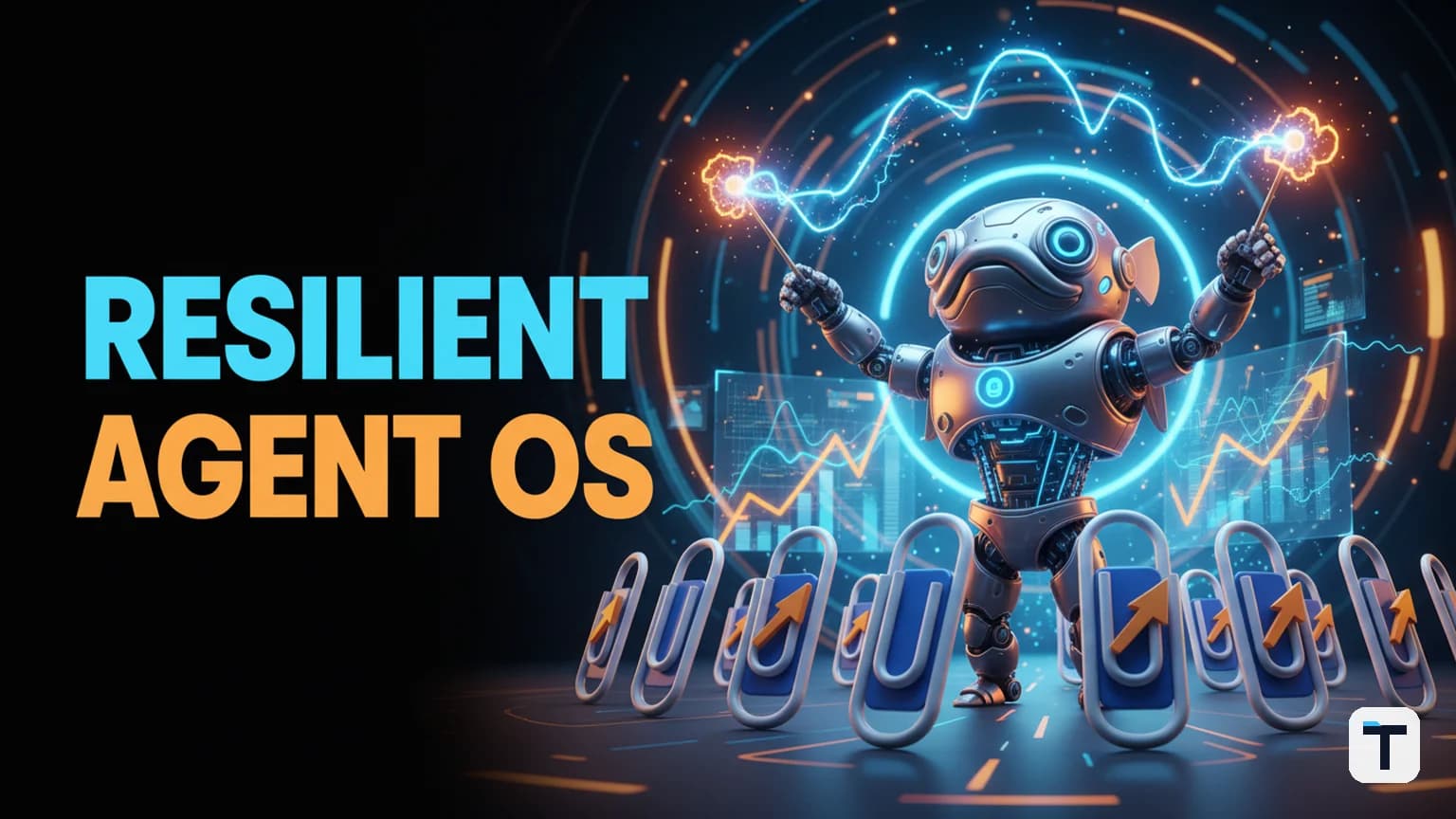
Last verified: June 27, 2026
- Best for Resilience: Sakana Fugu (Dynamic model routing)
- Best for Structure: Paperclip AI (Org-chart framework)
- Best for Learning: Hermes Agent (Self-improving skills) Note: Pricing and model availability (e.g., Fugu Ultra) are volatile and subject to provider changes.
What is an Agent AI Operating System?
An Agent AI Operating System is a unified architecture that manages multiple AI agents as a single, cohesive team. Unlike standalone chatbots, an Agent OS provides a shared memory layer, persistent task boards, and an orchestration "brain" that decides which model is best for a specific job. For a small business, this means moving from "chatting with a bot" to "managing a digital department."
Building an effective Agent OS requires three specific layers:
- The Orchestration Layer (The Brain): Decides which model to call and verifies the output.
- The Structure Layer (The Team): Organizes agents into roles like CEO, Writer, or Researcher.
- The Intelligence Layer (The Skills): Allows agents to learn and improve their own workflows over time.
The Orchestration Layer: Why Sakana Fugu is the New Standard
Released on June 22, 2026, Sakana Fugu has shifted the market from monolithic models to "collective intelligence." Fugu is an orchestration model—a "conductor"—that does not answer queries itself but routes them to a pool of frontier models like GPT-5.5, Claude Opus 4.8, or Gemini 3.1 Pro.
Fugu Ultra vs. Fable 5
On the SWE-Bench Pro benchmark, Fugu Ultra recently scored a 73.7, placing it "shoulder-to-shoulder" with Anthropic’s Fable 5 and the Mythos Preview. The primary advantage of Fugu is resilience: if one provider (like Anthropic) restricts access or goes down, the Fugu conductor automatically routes the task to another capable agent in the pool.
| Metric | Fugu (Standard) | Fugu Ultra |
|---|---|---|
| Best For | Low-latency, daily tasks | Complex engineering & research |
| Context Window | 1 Million Tokens | 1 Million Tokens |
| Pricing (Est.) | $20/mo (Standard) | $5/M input / $30/M output |
| Primary Source | Sakana AI Release | Sakana AI Product Page |
The Structure Layer: Organizing Agents with Paperclip AI
While Fugu handles the models, Paperclip AI (launched March 2026) handles the management. It is an open-source framework that treats AI agents like employees in a virtual company.
In a Paperclip setup, you define a CEO Agent that interprets your business goals. The CEO then "hires" specialist agents—such as a Lead Gen Agent or a Content Editor—who communicate through a centralized ticketing system. This prevents the "20 open tabs" problem by consolidating all agent activity into a single React dashboard.
Key Paperclip Features for Small Business:
- The Heartbeat: A recurring scheduler that "wakes up" the agents to check their task boards.
- Token Budgets: Hard caps on spending per agent to prevent runaway API costs.
- Shared Gallery: A central place to view finished artifacts (images, reports, code) from the entire team.
The Intelligence Layer: Self-Improving with Hermes Agent
To ensure your Agent OS doesn't stagnate, you need an intelligence layer that learns. The Hermes Agent (Nous Research, April 2026) is the first mainstream agent with a built-in learning loop. As it performs tasks, it creates and refines "skills"—reusable markdown instruction files—that it stores in its own memory.
When integrated into an Agent OS, Hermes allows your "Outreach Agent" to get better at lead generation with every call it makes, effectively building a proprietary "brain" for your business that grows more valuable every month.
How to Build Your Agent OS: A 4-Step Roadmap
Building a resilient system is easier than it looks if you follow this sequence:
- Define the Mission: Set a high-level goal (e.g., "Automate daily industry news synthesis and LinkedIn outreach").
- Orchestrate (Sakana Fugu): Set up a Fugu API key to ensure you have access to a resilient pool of models.
- Hire the Team (Paperclip AI): Use a Paperclip template to define your CEO, Researcher, and Writer roles.
- Connect Memory (Obsidian/NotebookLM): Use a shared knowledge vault to store agent outputs so the "Memory Layer" can turn raw data into research reports or podcasts.
For more detailed integration strategies, see our guide on Multi-agent integration strategies or explore our Agent OS system guide.
What this means for you
In 2026, business value is moving from "knowing how to prompt" to "owning the system." By deploying an Agent OS today, you aren't just using AI; you are building a resilient, autonomous workforce that scales without human overhead. If you are still manually copy-pasting between Claude and GPT, you are leaving 80% of your potential productivity on the table.
FAQ
Q: Is Sakana Fugu available in the EU? A: As of June 2026, Sakana Fugu is not available in the EU/EEA pending GDPR compliance, though it is fully operational in Japan and other regions.
Q: Do I need a GPU to run an Agent OS? A: No. While tools like Hermes Agent can run locally on high-end hardware, most small business setups use cloud APIs (via OpenRouter or Sakana) to handle the reasoning, keeping costs low and accessibility high.
Q: How does Paperclip AI prevent agents from spending too much money? A: Paperclip includes a mandatory governance feature called "Per-Agent Budgets," which sets hard token caps on every role in the org chart.
Q: Can I use my own models with these systems? A: Yes. Both Paperclip and Fugu are model-agnostic, meaning you can plug in local models (via Ollama) or proprietary ones (via OpenAI/Anthropic).
Every claim here is traced to a primary source, dated, and listed under Sources. Research and drafting are AI-assisted; editing, verification and publication are human decisions, and a person is accountable for what appears on this page. How we work →

Discussion
0 comments