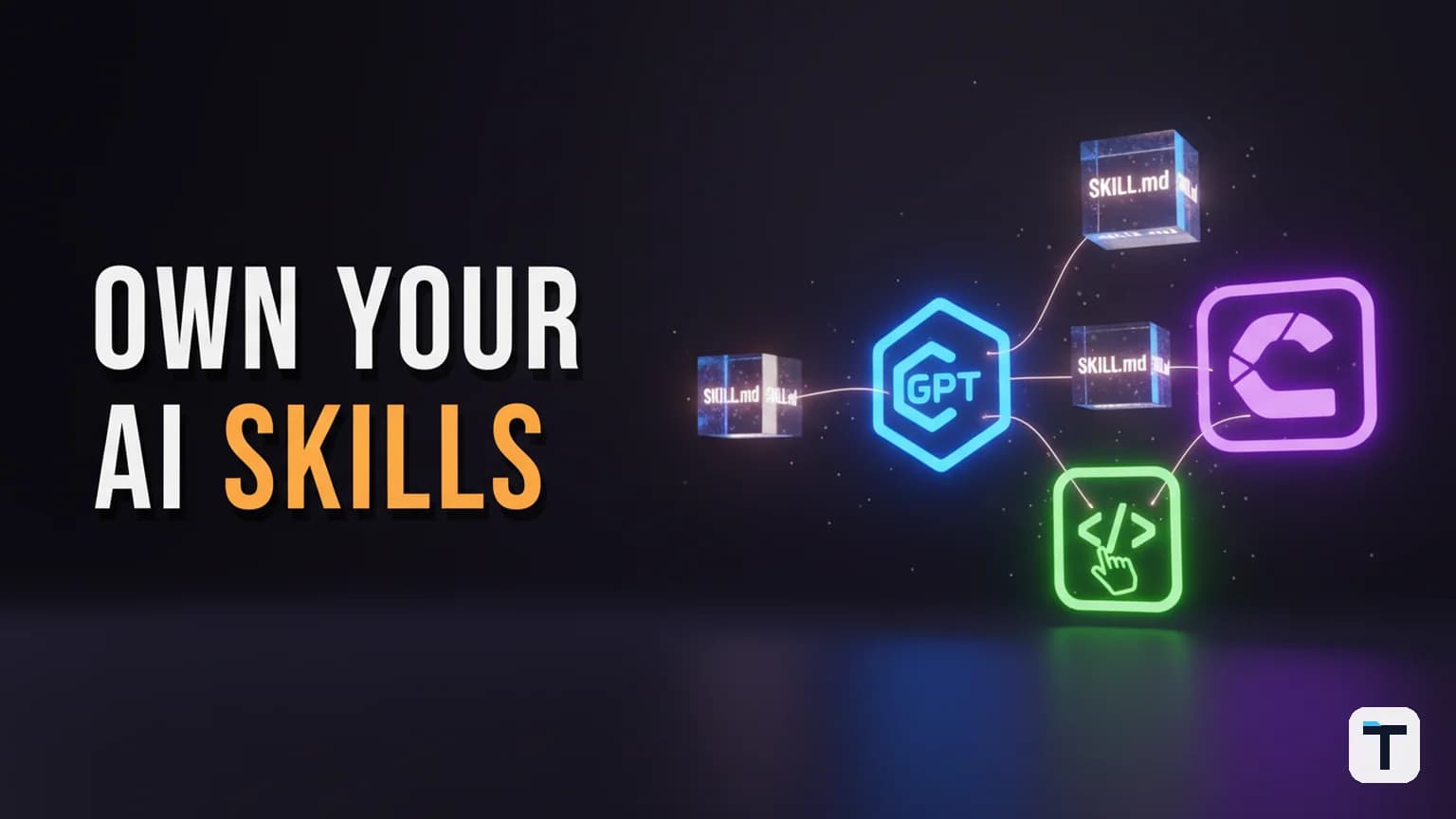

Answer-first verdict: Own your AI skills, don't rent them.
The future of AI agent productivity hinges on portability. As agents become central to our work, the ability to define, manage, and transfer their operational procedures across different tools and platforms is paramount. Without portable "skills" – small, inspectable, and verifiable procedures – businesses risk accumulating significant "procedural debt," leading to duplicated effort, inconsistent outputs, and reduced operational reliability. Implementing a standardized, open approach to AI skills allows organizations to own their agentic workflows, ensuring continuity, auditability, and genuine leverage from AI investments.
TL;DR
- Problem: AI agents are creating "procedural debt" – workflows are trapped in single tools, leading to re-explanation, fragmentation, and unreliable outputs.
- Solution: Portable "Open Skills" – small, reusable, verifiable procedures that agents can load on-demand.
- Benefits: Eliminates prompt bloat, ensures consistent outputs, enables multi-agent composition (runbooks), and scales knowledge across tools.
- Key takeaway: Define procedures, not just prompts. Prioritize verifiability and clear definitions of "done."
What is 'Procedural Debt' in AI Agents?
Procedural debt arises when the operational knowledge for an AI agent is scattered, duplicated, or trapped within specific tools, making it difficult to maintain, transfer, and verify. This contrasts with "memory problems" (solved by shared context) by focusing on how an agent performs a task, rather than just what it knows. Common symptoms include:
- Prompt Bloat: System prompts become unwieldy as users try to encode every rule, preference, and edge case into a single, often contradictory, instruction set. This reduces clarity and performance.
- Re-explanation Tax: Every new agent session, tool switch (e.g., from Cursor to Claude Code), or onboarding of a new team member requires re-explaining fundamental procedures, wasting time and introducing inconsistencies.
- Instruction Fragmentation: Operational guidelines are spread across different tools' rule systems, markdown files, repo notes, and custom instructions, leading to drift and outdated practices.
- Weak Verification: Agents report "done," but without clear, verifiable definitions of completion, humans must still extensively review work for stale data, broken links, untested changes, or misinterpretations, shifting effort from execution to tedious oversight.
This debt transforms AI from a productivity enhancer into a source of management overhead and review bottlenecks.
The Solution: Portable AI Skills and Runbooks
Portable AI skills offer a modular, transferable approach to agent procedures. A "skill" is defined as a small, self-contained unit of operational knowledge that an agent can load and execute. It’s more than a prompt; it's a verifiable procedure. This is the core of Loop Engineering and AI Agent Orchestration, where systems autonomously iterate and verify their work.
Key characteristics of an effective AI skill:
- Trigger Rules: Defines when the skill should (and should not) be used.
- Required Tools: Specifies the external tools or data sources the skill needs access to (e.g., live web search, browser QA, code interpreter).
- Boundaries & Scope: Clearly outlines what the skill owns and what it doesn't.
- Defined Output: Specifies the expected format and content of the skill's result.
- Verification Criteria: Critically, it outlines how to prove the task is "done." This could involve passing tests, capturing screenshots, or citing primary sources.
Skills vs. Prompts: A prompt is a one-time instruction; a skill is a reusable procedure the agent knows how to do from now on. For example, instead of a vague "fact check this," a "Current Information Search" skill would specify using live search for recent claims, comparing sources, separating confirmed facts from inferences, and blocking if verification is uncertain. This matches the Modular AI Agent Design philosophy of building narrow, high-horsepower primitives.
Composing Skills into Runbooks: Just as individual functions compose into larger programs, individual skills can be chained into "runbooks." A runbook defines an end-to-end workflow, orchestrating multiple skills to achieve a complex goal. Examples include:
- Content Creation: Transcription -> Brain Dump Processing -> Personal Voice Draft -> HTML Artifact Builder -> Site Publisher -> Verification.
- Release Day Briefing: Current Information Search -> New Release Briefing Draft -> Image Generation -> Site Publisher -> Stakeholder Update.
How to Build a Portable AI Skill (The SKILL.md Standard)
In 2026, the emerging standard for portable skills is the SKILL.md file, popularized by hubs like Open Agent Skills and skills.sh. A typical skill follows this structure:
# Skill Name: [e.g. Browser-QA]

## When to use
- Use when checking a live URL for rendering errors.
- Use when verifying a user workflow (login, signup).

## Job Description
Owns the end-to-end verification of UI elements and console logs.

## Tools & Files
- browser_use (MCP tool)
- screenshot_tool

## Boundaries
- Do NOT perform security penetration testing.
- Do NOT modify database state.

## Output
- JSON report with 'status', 'errors', and 'evidence_paths'.

## Verification (Definition of Done)
- [ ] Browser opened the target route.
- [ ] Zero 'Error' level console logs detected.
- [ ] Screenshot captured for every failed assertion.
By packaging procedures this way, you can move your "AI knowledge" between Hermes Agent 0.17, Claude Code, and custom harnesses without re-writing a single line of logic. This is how you Scale Your 'A-Players' with the Skills-Evals-Loops Framework by turning individual excellence into scalable, version-controlled workflows.
What this means for you
By adopting a portable AI skills approach, you move from passively renting fragmented AI capabilities to actively owning a robust, adaptable, and verifiable agentic workflow. This reduces the "re-explanation tax" and prompt bloat, increases the reliability of agent outputs, and ultimately transforms AI from a collection of isolated tools into a composable, scalable workforce that truly works for you.
FAQ
Q: What's the main difference between a "prompt" and a "skill"? A: A prompt is a single instruction for a specific task. A skill is a reusable, self-contained procedure an agent knows how to execute, including rules for when to use it, what tools it needs, and how to verify its completion.
Q: Why is "procedural debt" a problem with AI agents? A: Procedural debt makes agents unreliable and inefficient. It leads to inconsistent outputs, constant re-explanation of how tasks should be done, and a fragmentation of operational knowledge across different tools, hindering scalability and trust.
Q: How do portable AI skills improve agent reliability? A: By explicitly defining verification criteria within each skill, agents are instructed on how to prove their work is complete and accurate. This shifts the burden from human review to automated, evidence-based validation.
Q: Can I use portable AI skills across different AI agent platforms? A: Yes, the goal of portable skills (like the Open Skills initiative) is to define procedures in a format that is agent-agnostic (like Markdown/SKILL.md), allowing them to be loaded and interpreted by various AI agent harnesses.
Q: What is a "runbook" in the context of AI skills? A: A runbook is a composition of multiple portable AI skills chained together to automate a complex, end-to-end workflow. It defines the flow and coordination between specialized skills to achieve a larger objective reliably.
Every claim here is traced to a primary source, dated, and listed under Sources. Research and drafting are AI-assisted; editing, verification and publication are human decisions, and a person is accountable for what appears on this page. How we work →
Discussion
0 comments