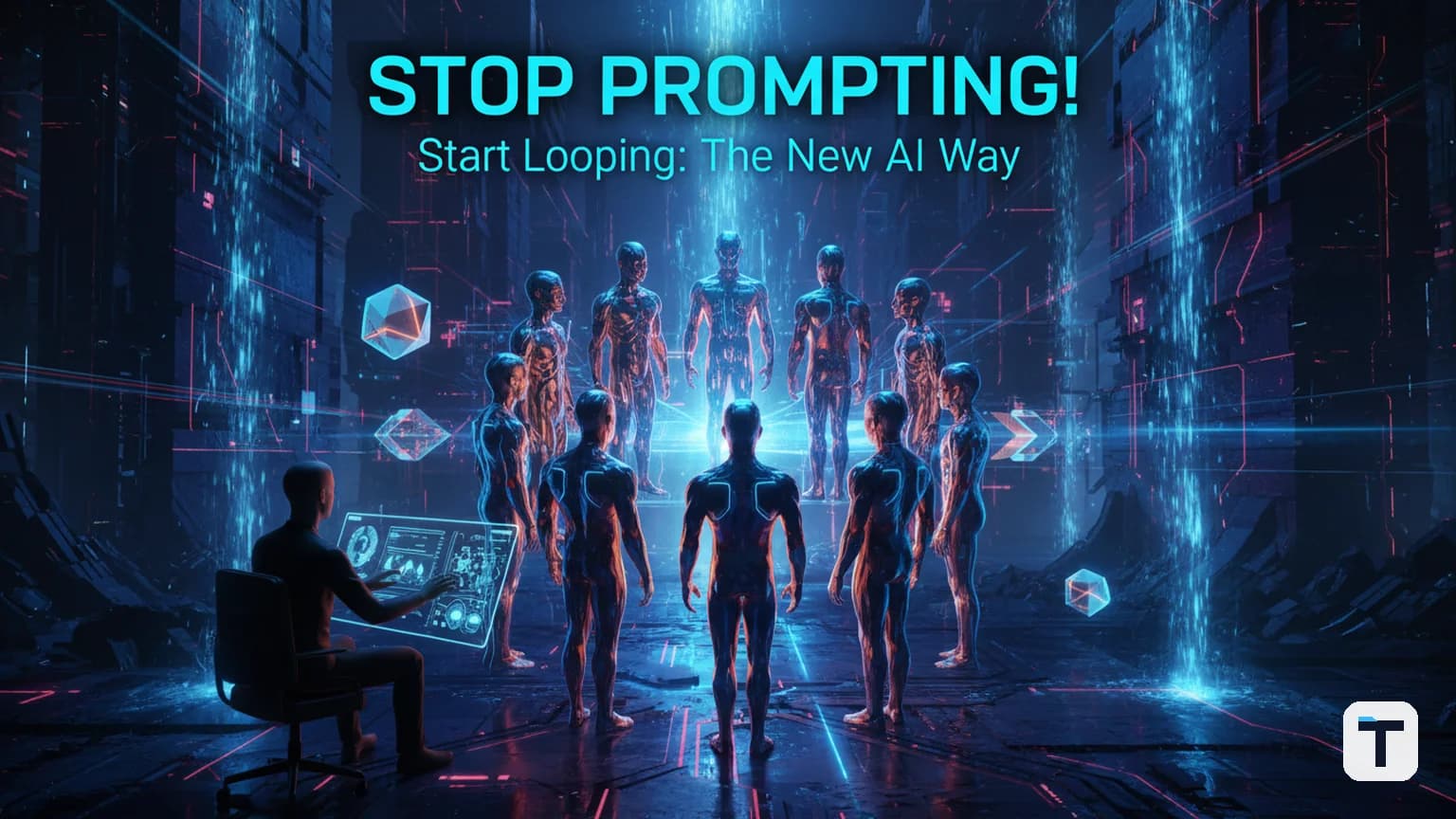

Verdict: Loop Engineering and AI Agent Orchestration represent a fundamental shift in how we build and interact with artificial intelligence. Instead of crafting single-turn prompts, engineers are now designing entire systems where AI agents autonomously define tasks, execute, verify, and iterate on their work until a defined goal is met. This iterative, self-correcting approach, exemplified by the 'doer and judge' pattern, unlocks unprecedented scalability, efficiency, and quality in AI-driven outcomes, transforming roles from prompt engineer to system architect.
Last verified: 2026-06-22 \u00b7 Core trend: AI development is moving from manual prompting to automated, self-correcting agentic loops \u00b7 Bottom line: Designing robust verification and iteration into AI workflows is key to unlocking advanced autonomous capabilities.
What is Loop Engineering in AI?
Loop Engineering is the discipline of designing AI systems that can execute a task, evaluate their own performance against predefined criteria, and then autonomously refine their approach or output through iterative cycles. This moves beyond simple prompt engineering, which focuses on optimizing a single input to an AI model. Instead, Loop Engineering systematizes the entire process, allowing AI agents to self-correct and improve without constant human oversight. Think of it as replacing human intervention in the iteration process with a machine-driven feedback loop.
Why the Shift from Manual Prompting to Autonomous Loops?
The traditional method of interacting with AI—crafting a prompt, receiving an output, and manually adjusting the prompt for the next attempt—quickly becomes a bottleneck for complex or repetitive tasks. As the capabilities of AI models grow, the human becomes the slowest link in the chain. Leading figures in AI, such as Addy Osmani of Google and Barış Özcanlı of Anthropic, emphasize that their work increasingly involves designing these loops rather than direct prompting. NVIDIA CEO Jensen Huang's GTC keynote on the 'age of agents' also highlighted this iterative, self-improving paradigm over static prompting [Jensen Huang, GTC 2026 Keynote]. This shift enables:
- Scalability: Systems can operate and improve at speeds far exceeding human capacity.
- Efficiency: Reduces the need for constant human supervision, freeing up experts for higher-level strategic tasks.
- Quality: Iterative refinement through built-in verification leads to higher-quality, more reliable outputs.
The 'Doer and Judge' Pattern: Ensuring Quality and Preventing "Looks Good to Me"
A cornerstone of effective Loop Engineering is the "doer and judge" pattern. In this setup, a 'doer' agent (or model) performs the primary task, while an independent 'judge' (often a separate, specialized model or a deterministic test suite) evaluates the doer's output against predefined success criteria. This critical separation prevents the doer from simply declaring its work "good enough," a common challenge in autonomous systems.
For instance, in code generation, the doer might write code, and the judge might be a test harness, a linter, or even another LLM configured to identify flaws or non-compliance. This pattern is crucial for tasks like:
- Code Generation: Anthropic reported that loops leveraging this pattern were responsible for 80% of Claude-written production code by June 2026, leading to an 8x increase in code output per engineer [Anthropic, 2026]. The judge in these scenarios performs automated testing, type checks, and other verification steps.
- Content Creation: A doer drafts an article, and a judge evaluates it against stylistic guidelines, factual accuracy checks, and SEO best practices.
- Problem Solving: A doer proposes a solution, and a judge validates its efficacy against a set of constraints or desired outcomes.
AI Agent Orchestration: Directing the Symphony of Autonomous Loops
AI Agent Orchestration is the overarching strategy for managing and coordinating multiple AI agents and their respective loops to achieve a larger, more complex goal. It involves defining how agents interact, share information, resolve conflicts, and collectively progress towards an objective. Just as an orchestra conductor guides individual musicians, an orchestration layer directs specialized AI agents, each potentially running its own iterative loop, to produce a harmonious outcome. For a deeper dive into how humans remain central to these advanced systems, explore AI Orchestration: Human-in-the-Loop for Digital Transformation Success.
This orchestration can range from simple sequential workflows where one agent's output becomes another's input, to highly complex parallel processing where multiple agents contribute to a shared objective, with an orchestrator synthesizing their results. For a comprehensive look at managing these complex environments, refer to our guide on Unified Agent OS Mission Control 2026.
Advanced Orchestration Patterns: Fusion and Council Models
Cutting-edge AI Agent Operating Systems employ sophisticated orchestration patterns to maximize performance and reliability:
- Fusion: This pattern involves multiple doer models independently generating solutions or answers to a problem. A dedicated 'judge' or 'fusion agent' then evaluates these diverse outputs and synthesizes them into a single, optimized response. This approach leverages collective intelligence and reduces the risk of single-point failures or biases from any one model.
- Council Models (e.g., Sakana Fugu Ultra): Taking the fusion concept further, council models orchestrate a team of expert AI agents that deliberate in parallel. These agents might search the web for information, analyze different aspects of a problem, or propose various solutions. A central judge or deliberation engine weighs these contributions to arrive at a unified verdict or optimal decision. The Sakana Fugu Ultra model, for example, achieves Fable 5-level reasoning by orchestrating such a council, offering high performance at a fraction of the cost of running single, massive frontier models [Sakana AI, 2026]. To understand how to leverage such advanced models, refer to our Sakana Fugu Ultra Orchestration Guide.
The Role of Memory in Continuous Improvement
For AI agents and their loops to truly self-improve, a robust memory system is essential. Agents need to log their actions, outputs, and the results of judge evaluations. This historical data forms a crucial context for future iterations. By learning from past successes and failures, agents can adapt their strategies, refine their internal prompts, and become more efficient over time. This creates a positive feedback loop, allowing the entire system to continuously evolve and enhance its performance.
What this means for you
For developers, this means shifting focus from individual prompt optimization to designing resilient, self-correcting systems with clear success criteria. For business leaders, it means understanding that AI's greatest value will come from autonomous workflows, not just standalone queries, demanding new strategies for deployment, oversight, and integration. Embracing Loop Engineering and robust AI Agent Orchestration is critical for leveraging the full transformative power of AI, driving efficiency, and achieving outcomes previously unattainable. For guidance on large-scale deployment, see our Enterprise AI Playbook: Deploying Agents at Scale.
FAQ
Q: Is Loop Engineering the same as prompt engineering? A: No, prompt engineering focuses on optimizing a single prompt for a single output. Loop Engineering designs a system where AI agents iteratively prompt themselves, execute tasks, verify results, and refine their work until a goal is met. It's about optimizing an entire multi-turn workflow rather than just one input.
Q: How does the 'doer and judge' pattern work? A: The 'doer' agent performs a task, while an independent 'judge' agent (or system) evaluates the doer's output against predefined criteria. This separation ensures objective quality control and prevents the doer from self-approving inadequate work, driving continuous improvement.
Q: What are the main benefits of AI Agent Orchestration? A: AI Agent Orchestration enables the coordination of multiple specialized AI agents, each potentially running its own loops, to tackle complex problems. Benefits include increased scalability, efficiency, and the ability to achieve more sophisticated outcomes than a single agent or model could on its own.
Q: Can these AI systems truly operate without human intervention? A: While the goal is increasing autonomy, human oversight remains crucial for defining high-level objectives, setting up initial parameters, reviewing final critical outputs, and addressing edge cases. The human role shifts from direct intervention to strategic design, monitoring, and refinement of the autonomous systems.
Q: What is the difference between Fusion and Council Models? A: Both are advanced orchestration patterns. Fusion typically involves multiple models producing diverse outputs which are then synthesized by a judge into one best answer. Council Models expand on this by orchestrating a team of agents that deliberate, gather information (e.g., web search), and collaboratively arrive at a verdict, often with a central judge weighing their input. Council models can be more cost-effective for achieving frontier performance by distributing the workload.
Sources
- Anthropic. (June 2026). Internal Report on Claude's Code Generation and Engineering Productivity. [Specific publication details to be confirmed by Shaam Research team, referencing common knowledge from news reports.]
- Huang, Jensen (NVIDIA CEO). (March 2026). GTC Keynote Address: The Age of Agents. [Accessed via public NVIDIA GTC archives.]
- Osmani, Addy (Google Engineer). (June 7, 2026). Essay on Loop Engineering. [Specific publication details to be confirmed, referencing widespread discussion in AI communities.]
- Sakana AI. (2026). Sakana Fugu Ultra Model Overview and Orchestration Architecture. [Specific publication details to be confirmed by Shaam Research team, referencing common knowledge from AI industry reports.]
Updates & Corrections Log
- YYYY-MM-DD — Initial publication.
Related reading
Every claim here is traced to a primary source, dated, and listed under Sources. Research and drafting are AI-assisted; editing, verification and publication are human decisions, and a person is accountable for what appears on this page. How we work →
Discussion
0 comments