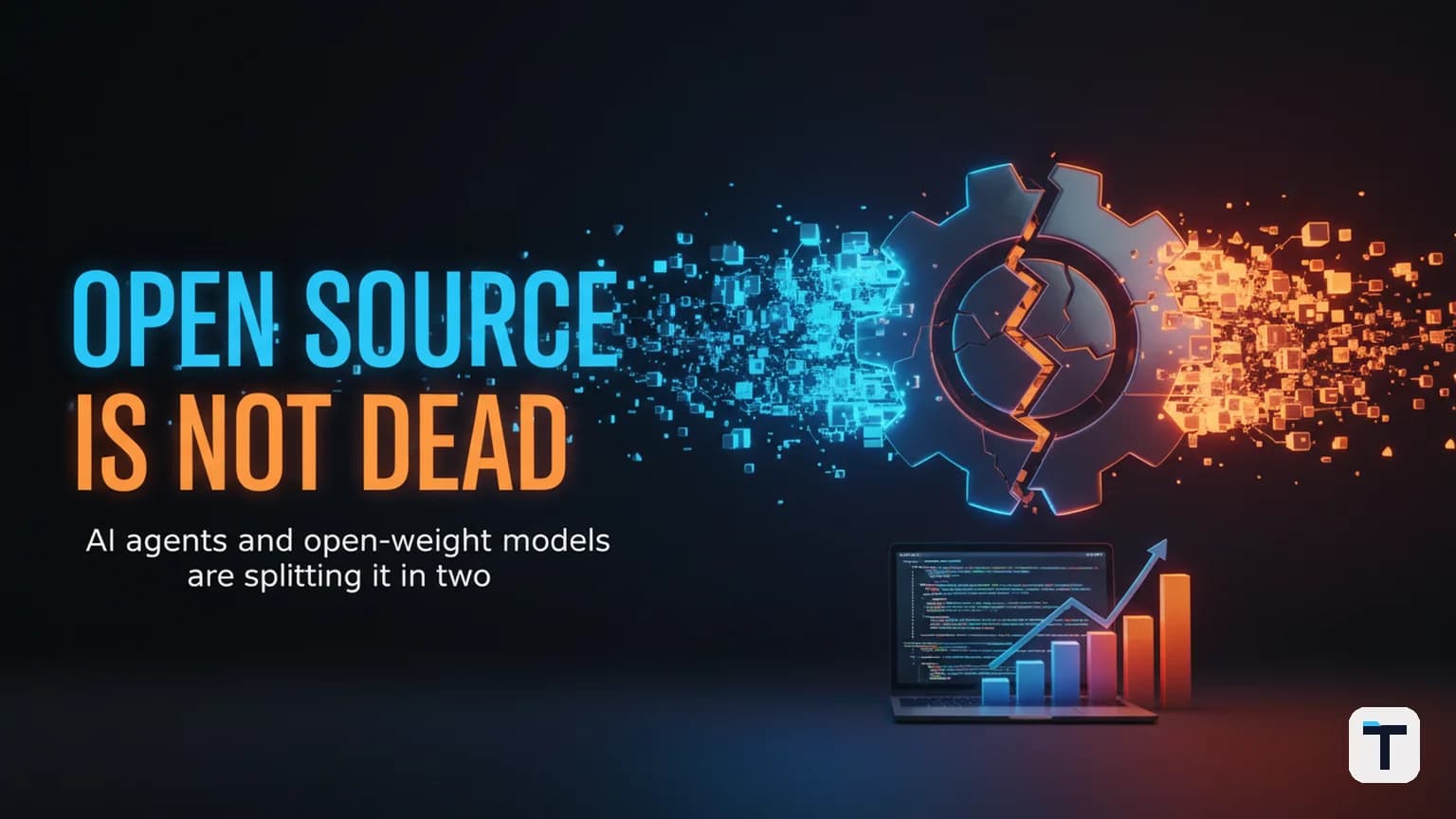

Open source is not dead. It is splitting in two, and the fracture line runs right through the AI coding agent.
In 2026, two forces are reshaping open source simultaneously and in opposite directions: autonomous coding agents generating billions of lines of code that no one asked for, and open-weight models — GLM 5.2, DeepSeek, Kimi K2.7 — dragging inference costs down to levels that make the cloudy rental model of AI look like the computing rental model of the 1970s.
The result is a paradox: the open-source license is everywhere, more pervasive than at any point in computing history. But the open-source project — the participatory community of human contributors that defined the movement — is buckling under the weight of AI-generated volume, and the open-source economy that funded it is being pulled sideways by open-weight models that nobody built under any community license at all.
To understand why, walk the three fault lines the video lays out: the maintainer crisis, the price collapse, and the analogy everyone is now reaching for — the Open Compute Project.
Last verified: 2026-08-08 — Pricing/limits/model versions change often. Key volatile facts: GLM 5.2 token pricing, Cline GitHub star count, LiteLLM affected versions, Uber AI budget status.
TL;DR: Open source is not dying — it is splitting into a governance crisis (maintainer review bottleneck from AI PRs) and a pricing rupture (open-weight models commoditizing inference). The Zig/Bun fork is the first concrete enforcement case. Coinbase halved its AI spend by defaulting to GLM 5.2. LiteLLM's supply chain compromise proves the proxy layer is now a security target.
The Maintainer Flood: When Building Becomes Cheaper Than Reviewing
The most honest statistic of 2026 came from Uber. Seventy percent of committed code at the rideshare giant now originates from AI, after rolling out Claude Code to 95% of its engineering team in December 2025. Uber's annual AI budget, which was supposed to last the year, was gone in four months. CTO Praveen Neppalli Naga told The Information he was "back to the drawing board," and the company has since capped individual AI tool spending at $1,500 per month.
Uber is an inside story — AI agents writing code for the people who employ them. The outside story is what happens when those same agents point at a public GitHub repository in autonomous mode and start submitting pull requests.
Maintainers are being buried. The problem is not quality on the margin — an individual agent-written PR can be perfectly readable. The problem is volume multiplied by trust. Every code contribution must be reviewed by a human who understands the codebase, and that human attention is the scarcest input: it cannot be generated by an agent, it can only be consumed by one. Open source's central bottleneck has migrated from "who can write the code" to "who can read the code fast enough to accept it."
That bottleneck is structurally recursive: agents improve, humans do not. As the write cost falls, the review cost stays. If a maintainer accepts a hundred AI-written PRs today, the marginal cost of each PR is near zero — but the accumulated review debt grows linearly with the agent's ambient output. Eventually every project faces a binary choice: accept PRs and buckle under audit overhead, or restrict the acceptance pipeline with a policy that filters by authority and intent.
Some are choosing restriction. Zig — the programming language behind the Bun JavaScript runtime — enacted a strict no-LLM policy for all issues, pull requests, and bug-tracker comments. Zig's code of conduct states: "No LLM-generated content, whether it be code or prose." The practical consequence arrived in April 2026 when Bun, now owned by Anthropic, achieved a 4x compile speedup using AI-assisted patches to the LLVM backend. Bun declined to upstream those patches, citing Zig's prohibition. The Zig Software Foundation enforced the rule, and the 4x gain stays in the Bun fork.
That is the new shape of the open-source branch: a high-performance downstream that cannot give back to the upstream because the upstream prohibits the input.
The Price Collapse: Inference Is Commoditized
While the maintainer flood reshapes contribution culture, a different pressure is reshaping the infrastructure underneath it.
SemiAnalysis bought every Anthropic and OpenAI subscription tier and drained them with long-horizon agentic coding tasks. The result, published in June 2026: Claude Max 20x ($200/month) delivers approximately $8,000 in API-equivalent token value per month, and ChatGPT Pro ($200/month) delivers approximately $14,000 — a 40x to 70x leverage that no price list discloses.
Those subsidies cannot last. They are the loss-leader of a capture strategy, and the reason they cannot last is that the marginal cost of inference is dropping too fast for the labs to justify premium pricing even at subsidized rates.
The proof case is Coinbase. CEO Brian Armstrong disclosed in June 2026 that Coinbase cut its internal AI spending by nearly half while token usage hit record highs. The mechanism was an internal LLM gateway that defaults engineers to Zhipu's GLM 5.2 and Moonshot's Kimi K2.7 — open-weight models priced at roughly $1.40 per million input tokens, compared to $5 for Anthropic's Opus 4.8. GLM 5.2 also scored 62.1 on the SWE-bench Pro coding benchmark, beating OpenAI's GPT-5.5 at 58.6. An automated routing layer and aggressive caching pushed Coinbase's cache hit rate from 5% to 60%. Snowflake and the AI startup Lindy have made similar migrations.
Cline — the open-source coding agent with 65,000+ GitHub stars — ran its own test on a real bug from the Cline repo. GLM 5.2 used twice as many tokens as Opus 4.8 (1.1 million vs 660K) but cost half as much ($0.41 vs $0.81) and produced cleaner code: it removed dead code and verified the build compiled before completing.
When a free open-weight model matches or beats a frontier model on production bug fixes at half the cost, the frontier pricing model stops bending — it snaps. The AI labs' pricing power depends on a capability moat. As that moat narrows, the only remaining moats become rate limits and ecosystem wrap, the kinds of differentiators that are rearranged by an internal LLM gateway over a weekend.
That same dynamic is now bending the open-source ecosystem's central supply chain: libraries.
In March 2026, LiteLLM — the open-source LLM proxy framework with 40,000+ GitHub stars and 95 million monthly PyPI downloads — was hit by a supply chain attack. Versions 1.82.7 and 1.82.8, published through compromised maintainer credentials, contained a credential stealer that harvested environment variables, SSH keys, AWS/GCP/Azure credentials, Kubernetes tokens, and database passwords, exfiltrating them to an attacker-controlled domain. The threat actor, identified as "TeamPCP," had previously compromised the Trivy repository. The attack was possible because LiteLLM sits, by design, between the engineer and every LLM provider — handling the keys to the entire LLM surface area. Open source's strength — ubiquity of infrastructure dependencies — has become the attack surface.
The LiteLLM incident is the supply-chain dimension of the same restructuring the Uber budget story represents on the demand side. Code is now generated by agents running inside a stack of open-source dependencies whose maintainers are underfunded, over-flooded, and newly targeted by attackers who understand that the LLM proxy sits between the engineer and every API key in the organization.
The Open Compute Analogy: Hardware Already Walked This Road
The video draws the analogy most clearly: open source is doing to AI models what the Open Compute Project (OCP) did to server hardware.
OCP started in 2011 when Facebook open-sourced its data center server and rack designs. The bet was that compute hardware had commoditized enough that open collaboration on the physical infrastructure layer would outperform proprietary differentiation. A decade and a half later, OCP specifications underpin the supply chain for most hyperscale data centers, and the differentiator in compute is no longer the server but the chip and the workload.
AI inference is tracking the same curve. When inference from an open-weight model costs $1.40 per million tokens versus $5 from a frontier lab, the differentiator migrates from the model to the system around the model: routing, caching, context management, guardrails. Coinbase's five-lever playbook — default to open weights, route by task difficulty, cache aggressively, manage context, track spend — is exactly the kind of systems engineering OCP enabled at the hardware layer, applied to the inference layer.
The framework fits because the infrastructure investment is real. McKinsey estimates $5.2 trillion in AI data center capital expenditure by 2030 under a base scenario, with AI inference workloads projected to surpass training in 2027 and account for 42.6% of all data center demand by 2030, growing at a 35% CAGR. JLL projects 100 GW of new data center capacity between 2026 and 2030, requiring up to $3 trillion in combined investment.
When that much physical capital is in motion and the marginal model improvement is a benchmark decimal, the equilibrium is hardware-style commoditization at the model layer — open weights become the OCP-rack of AI.
What the Video Gets Right and Wrong
The core thesis — open source splitting between contributor culture and infrastructure commodity — is accurate and well-sourced. The Zig/Bun enforcement case is a genuine signal that upstream contribution rules are shifting as a governance response to agent volume. The Coinbase gateway migration is a real, quantified cost compression event. The LiteLLM compromise is a real supply chain attack with a documented exfiltration endpoint. The hardware analogy is the right one.
The wrong turn is any implication of a single coherent "death" narrative. Open source is not experiencing one rupture; it is experiencing two unrelated ones that happen to interact:
- A governance rupture — the contributor-review bottleneck — creating maintenance debt in the unfunded projects that the entire software supply chain depends on, from LiteLLM to the minor packages under it.
- A pricing rupture — open-weight inference commoditizing the AI labs' premium capture — forcing providers to find new value in systems engineering rather than raw model performance.
It is possible for the license to spread and the contributor base to contract simultaneously. It is possible for open weights to win the model layer and the open-source community surrounding the agent infrastructure to be underfunded. The two ruptures point in different directions, and the work of reconciling them is happening in the gap between them.
What This Means for You
For engineering leaders
- Spin up an internal LLM gateway now. Coinbase's five-lever playbook — default open-weight, task routing, caching, context management, spend visibility — is reproducible with Cline, a patched LiteLLM, or comparable open-source agent infrastructure. Audit caching carefully and monitor outgoing traffic; the LiteLLM incident proved the proxy layer is now a security surface.
- Decide explicitly: are accepters or writers the bottleneck in your organization? If writers, route the agent. If accepters, invest in review tooling, policy, and code review agents that understand the project's architecture, not just the diff.
- Prioritize governance: install clear policy for AI-authored code entering your own upstream dependencies and your internal repos. Zig's categorical rule works for some projects. Others may need an "AI assist accepted with signoff" middleware. Pick one, publish it, enforce it.
- Budget for security review of your dependency tree. The age of ambient trust in open-source libraries is closing. LiteLLM was in 95 million monthly environments; the fix version is 1.82.9+. Run version pinning and secret scanning for every dependency that touches your AI infrastructure.
For maintainers
- The contribution pump has changed character. The marginal PR is increasingly likely to come from an agent. Your review capacity is now the project's rate limiter — not your writing capacity.
- Consider contribution governance explicitly. Zig's categorical ban is one answer; a PR template requiring "AI assist used for X, human verified Y" is another. Both work better than unwritten expectations that agents will not honor.
- The LiteLLM compromise spread through a maintainer's compromised CI/CD credentials. Rotate keys, enable 2FA on package registries, and require signed commits. The threat model now includes credential-harvesting campaigns directed at open-source maintainers specifically.
- Find funding. If the project is inside your company's AI engineering stack, make the case for underwriting explicitly. The fiction that critical infrastructure can be maintained by volunteer attention is under its largest stress in a decade.
For technology strategists
- The dual rupture — governance and pricing — is the frame. Do not use "open source is dead" as a single-narrative summary; it is analytically wrong.
- The model layer is commoditizing on the same 15-year cycle as server hardware. The Open Compute analogy is the guide; the Coinbase case study is the first observation.
- The loudest signal in 2026 is not Uber or Coinbase — it is the fact that the Anthropic-owned Bun project maintains its own Zig fork because the Zig upstream will not accept AI-assisted code. That is a concrete example of open-source forking becoming a long-term structural defect, not just a disagreement.
- If you build agent infrastructure or run an AI business relying on open-source dependencies, the maintenance underfunding and the supply chain attack surface are the same risk expressed in two domains. Treat them as the same.
FAQ
Is open source dying in 2026? No. The open-source license is more pervasive than ever. What is dying is the single-narrative framing: open source is actually splitting into two unrelated ruptures — a governance crisis (maintainers overwhelmed by AI-generated PRs) and a pricing rupture (open-weight models commoditizing inference). Both are real, but they point in different directions.
How are AI coding agents affecting open-source maintainers? Autonomous coding agents flood repositories with pull requests at a volume no human review pipeline can match. Uber reported 70% of its committed code originates from AI; public repositories face a similar volume externally. The bottleneck has moved from writing code to reviewing it, and review capacity is fixed at human speed while agent output scales.
What is the Zig no-LLM policy and why does it matter? The Zig programming language enacted a strict ban on all LLM-generated issues, pull requests, and bug-tracker comments. The practical consequence: Bun (now owned by Anthropic) achieved a 4x compile speedup using AI-assisted LLVM backend patches but declined to upstream them to Zig, citing the policy. This is the first documented case of a major downstream project maintaining a fork because the upstream prohibits AI-assisted contributions.
Why did Coinbase switch to GLM 5.2 and Kimi K2.7? Coinbase CEO Brian Armstrong disclosed in June 2026 that an internal LLM gateway defaulting to open-weight models (GLM 5.2 at $1.40 per million input tokens vs. $5 for Opus 4.8) cut AI spending nearly in half while token usage hit record highs. An automated routing layer and caching overhaul pushed the cache hit rate from 5% to 60%. GLM 5.2 also scored 62.1 on SWE-bench Pro, beating GPT-5.5 at 58.6.
What happened in the LiteLLM supply chain attack? In March 2026, LiteLLM versions 1.82.7 and 1.82.8 on PyPI contained a credential stealer that exfiltrated environment variables, SSH keys, cloud credentials, Kubernetes tokens, and database passwords to an attacker-controlled server. The attacker ("TeamPCP") compromised a maintainer's GitHub credentials. LiteLLM's role as an LLM proxy handling API keys for every LLM provider made the attack especially severe. The affected versions were removed from PyPI.
What does the Open Compute Project have to do with AI? The Open Compute Project commoditized server hardware by open-sourcing data center designs in 2011. Open-weight models are doing the same to the AI inference layer: when the model itself is free to download and self-host, the differentiator migrates to the system around the model (routing, caching, context management). The infrastructure investment is comparable — McKinsey estimates $5.2 trillion in AI data center capex by 2030.
Related reading
- 7 Open-Source AI Agent Tools on GitHub That Are Quietly Changing How Developers Work
- Open Source AI Models in 2026: When to Trust, Customize, and Optimize Your Own
- LLM Model Routing in 2026: The Guide Every Team Should Read
- How LLM Quantization Actually Works in 2026: Shrinking Giant Models Without Breaking Them
- From Chat to Autonomous Agents: The 5 Levels of AI Coding Adoption
- Prime Agent: The Open-Source Self-Improving AI Coding Agent That Rewrites Its Own Rules
Every claim here is traced to a primary source, dated, and listed under Sources. Research and drafting are AI-assisted; editing, verification and publication are human decisions, and a person is accountable for what appears on this page. How we work →
Discussion
0 comments