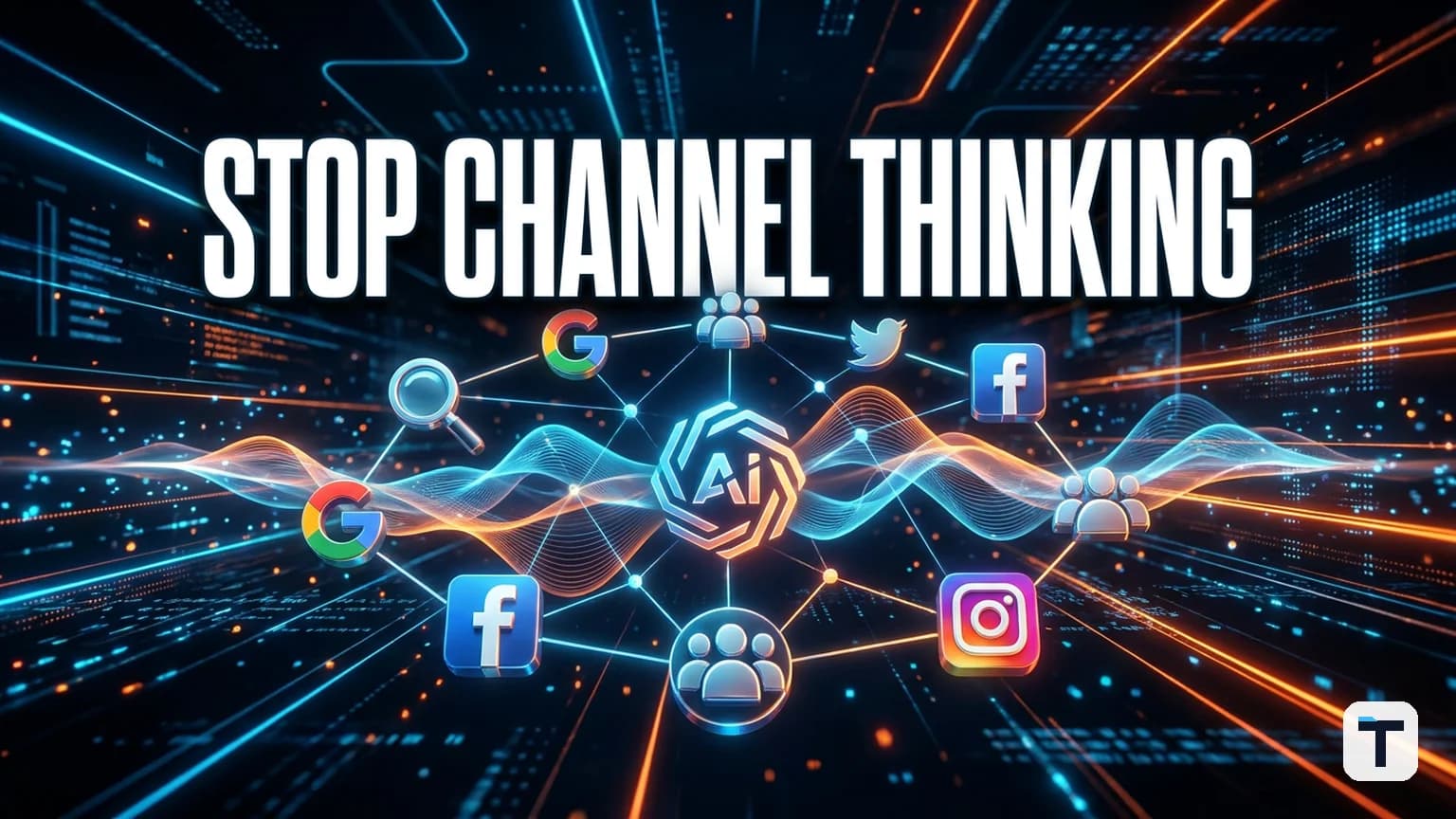

Verdict: The most resilient marketing organizations in 2026 are replacing channel-first planning with an ecosystem-first strategy. They treat website content, social posts, review profiles, community answers, and PR as one coordinated signal — because that is exactly how AI search engines, LLMs, and modern buyers read the web.
If you keep SEO, social, paid, and brand teams in separate rooms with separate briefs and separate KPIs, you will keep sending conflicting messages. The winners are rebuilding around the customer journey and shared impact metrics, not the org chart.
Last verified: 2026-06-17 · TL;DR
- AI Overviews now reach about 2 billion monthly users (Google Q2 2025 earnings), and buyers also discover brands in ChatGPT, Perplexity, Gemini, Reddit, podcasts, and private communities.
- Most teams still manage SEO, social, paid, PR, and community as independent silos — which means most of the buyer journey is invisible to attribution and most of the brand story is fragmented for AI systems.
- The fix is structural: shared briefs, user-journey mapping, cross-functional impact metrics, and a single source of truth for brand positioning.
- Tactics follow structure: consistent entity definitions, schema markup, FAQ content, social proof, review management, and community participation all reinforce the same ecosystem signal.
What changed: search is no longer a channel
For years, search was a discrete channel: you optimized pages, earned rankings, and captured clicks. Social was a separate channel. Paid was a separate channel. PR was a separate channel.
That model is cracking for two reasons.
First, the places where people discover answers have exploded. Google AI Overviews, Gemini, AI Mode, Perplexity, ChatGPT, Reddit, YouTube, TikTok, LinkedIn, newsletters, Slack communities, and podcasts now all sit between a question and a purchase. A customer might:
- Ask ChatGPT for the best CRM for a five-person agency.
- Read a Reddit thread comparing options.
- Search Google for a specific pricing comparison.
- See a LinkedIn post from a founder they follow.
- Only then visit your website — already informed.
That is not a linear funnel. It is an ecosystem of overlapping touchpoints. If your website, social presence, and community footprint tell different stories, the AI layer and the human buyer both get confused.
Second, AI search systems now read across the whole web at once. When someone asks an LLM about your brand, the model does not look at your homepage in isolation. It pulls from your website, review profiles, social posts, community discussions, press mentions, and knowledge graph associations simultaneously. The signals either reinforce each other or cancel each other out.
That is the core shift: marketing is no longer a collection of channels. It is one coordinated song.
Why the silo structure is failing
Most marketing organizations are still built like a 2010 org chart:
- SEO owns rankings and organic traffic.
- Social owns engagement and follower growth.
- Paid owns ROAS and conversion volume.
- PR / brand owns awareness and messaging.
- Community / support owns retention and reviews.
Each team has its own briefs, tools, agencies, and dashboards. Each team is rewarded for its own metrics. Each team can succeed on paper while the brand fails in the market.
The symptoms are predictable:
- Attribution blind spots. A huge share of the buyer journey happens in dark social, private communities, AI chat answers, and word-of-mouth that standard analytics cannot see. Some estimates suggest 70% or more of the B2B buyer journey is invisible to traditional attribution tools.
- Conflicting messaging. SEO writes one headline. Social writes another. Paid runs creative that contradicts the homepage. The brand looks like five different companies.
- Tactic myopia. A team reads a LinkedIn post about “Reddit is the new SEO” and starts spamming Reddit threads. Six months later the tactic is exhausted and the team has built nothing durable.
- Slow decision-making. Every cross-channel campaign requires a committee of people who do not share goals or data.
The root cause is not laziness or bad people. It is structure. Channels were useful buckets when media were separate. They are a liability when media are interconnected.
What a healthy ecosystem team looks like
The teams that are adapting fastest share a few structural patterns. None of them require a rebrand or a massive budget. They require a reorganization of how decisions get made.
1. One shared mission, not channel missions
The best teams we see today have a single sentence that everyone owns: “We need to be the most trusted option for [audience] when they research [problem].”
SEO, social, paid, PR, and community then ask the same question: “What do I contribute to that mission at this stage of the journey?”
Crystal Carter of Wix put this well in a recent panel: the days of the six-month fixed plan are gone. Teams need a clear direction of travel so they can take a bus, a bicycle, or a walk — but they all know where they are going.
2. Briefs are shared, not handed off
Instead of SEO writing a brief and tossing it over the wall to content, the best teams co-write briefs that include:
- The user journey stage.
- The question the content answers.
- The social angle and snippet.
- The community or PR hook.
- The measurement plan across channels.
This prevents the classic failure mode: an SEO-optimized article that is too dry to share, or a viral social post that points to a landing page with no conversion path.
3. KPIs include someone else’s metric
One of the smartest hacks we heard: each team should own at least one metric another channel cares about.
- SEO / content cares about social engagement on the assets they create.
- Social cares about search traffic driven by their posts.
- Paid cares about brand search lift generated by organic work.
- Brand / PR cares about review sentiment and community citations.
This forces collaboration instead of competition. If my bonus depends partly on your metric, I will show up to your stand-up.
4. A single source of truth for facts
AI search systems crave consistency. If your pricing, product description, and value proposition differ across your website, LinkedIn, G2, Capterra, press releases, and community answers, LLMs will either drop you or hedge with phrases like “according to some sources.”
The fix is boring but powerful: a living brand and product facts document that every team uses. It should include:
- Exact product names and categories.
- Pricing and plan limits.
- One-line value proposition.
- Target audience segments.
- Key differentiators.
- Approved proof points and stats.
From that document, teams derive web copy, social captions, ad creative, press boilerplates, and community responses.
5. Shared calendars and shared listening
A weekly combined stand-up for SEO and social is a small change with a large return. Teams review:
- Trending topics from search demand and social conversation.
- Content that is ranking or being shared.
- Performance data for cross-channel campaigns.
- Upcoming PR or product launches that need alignment.
When everyone sees the same inputs, the handoffs become obvious.
What this means for small businesses and builders
You do not need an enterprise CMO to act on this. If you are a founder, freelancer, or small team, the ecosystem approach is actually easier because you have fewer people to convince.
Do a five-minute ecosystem audit
Search for your brand or product category in three places:
- Google (look for AI Overviews and the sources they cite).
- ChatGPT / Perplexity / Gemini (ask “what is the best [category] for [audience]?”).
- Reddit / LinkedIn (search your brand name and key use cases).
If the answers are inconsistent, incomplete, or missing you entirely, that is your roadmap.
Standardize your story
Write one paragraph that answers: “Who is this for, what problem does it solve, and why should someone trust us?” Use that exact paragraph everywhere — homepage, LinkedIn About, G2 profile, press releases, email signature, and community bio.
Pick one shared metric
If you run both content and social, pick a metric both sides influence. Example: “organic assisted conversions from content that was also shared on social.” It is less clean than pure channel metrics, but it is more honest.
Build repeatable bridges
Create small rituals that force collaboration:
- Monday topic review: SEO and social align on what to publish this week.
- Content pre-flight: before publishing, ask where it will be shared and what the CTA is.
- Post-campaign retro: review what worked across channels, not just within one.
Do not chase every new tactic
Reddit spam, AI-generated mass content, and “GEO hacks” come and go. What endures is a consistent, trustworthy, well-structured brand presence across the ecosystem. Invest there first.
The tactical layer: six moves that reinforce the ecosystem signal
Once the structure is right, these tactics compound:
| Tactic | Why it matters | Owner |
|---|---|---|
| Entity consistency | Same names, categories, and claims everywhere help LLMs build a stable knowledge graph. | Brand + product |
| Schema markup | Article, Organization, Product, FAQ, Review, and Breadcrumb schema make your facts machine-readable. | SEO / web |
| Answer-first content | Clear answers + evidence + next steps earn citations in AI Overviews and LLM responses. | Content |
| Social proof distribution | Reviews, testimonials, and case studies should live on your site, G2, Capterra, LinkedIn, and community threads. | Brand + social |
| Community participation | Show up in the forums and groups where your audience already asks questions. Be useful, not promotional. | Community |
| Cross-channel measurement | Track assisted conversions, brand search lift, share of voice, and sentiment — not just last-click. | Analytics |
None of these are new. The difference in 2026 is that they must work together as one signal, not as isolated best practices.
Related reading
FAQ
What is the difference between omnichannel marketing and an ecosystem strategy?
Omnichannel usually means the same campaign appears across channels. An ecosystem strategy means the channels are designed to reinforce each other continuously — socially, technically, and structurally — so that AI systems and buyers encounter a coherent brand story no matter where they look.
Is SEO dead because of AI Overviews?
No. Google AI Overviews reach about 2 billion monthly users, but users still visit websites after being informed by AI. The role of SEO is shifting from “capture the first click” to “be the trusted source AI systems cite and users visit afterward.”
How do I measure something I cannot fully track?
Use directional signals: brand search volume, share of voice in LLM answers, review sentiment, social mentions, assisted conversions, and self-reported attribution (“How did you hear about us?”). Do not let imperfect measurement stop you from investing in the channels you know matter.
Can a small team really run an ecosystem strategy?
Yes. In fact, small teams have an advantage because they can make fast decisions without reorganizing a department. Start with one shared brief template, one shared metric, and one weekly sync.
What is the biggest mistake teams make?
Chasing isolated tactics — like spamming Reddit or buying AI-overview “citation services” — without fixing the underlying structure. Tactics wear out. A coherent ecosystem compounds.
How does AI search change the way I should write content?
Write for the human who has already asked an LLM. Lead with the answer, support it with evidence, include exact names and numbers, and make the next step obvious. This structure is good for humans, good for SEO, and good for AI citations.
What this means for you
If you lead marketing at a small business, start by unifying your story. Pick the one paragraph that defines your brand and make it appear everywhere. If you are a solo builder, choose two channels you can sustain and make them reference each other intentionally. If you run a larger team, change one KPI in each channel to include another channel’s success metric.
The companies winning in 2026 are not the ones with the biggest budgets. They are the ones whose website, social, community, and review signals all point in the same direction.
Discussion
0 comments