
Last verified: 2026-06-26 · Core Framework: RACE (Role, Action, Context, Expectations) · Strategy: Master one tool deeply · Productivity Risk: Task-switching costs up to 40% of efficiency.
Why most AI prompts fail (The 'Autocomplete' Trap)
Most professionals treat AI like a search engine or a magic oracle. When you ask a vague question, the AI uses probability to guess the most likely words that follow. This is the Autocomplete Trap: AI doesn't give you the best answer; it gives you the most predictable one based on its training data.
Because the AI has no idea what your specific business situation is, the quality of the output is dictated entirely by the quality of the input. If your prompt is generic, your result will be generic. To break out of this, you must stop "asking questions" and start "giving jobs."
The RACE Framework: How to give AI a professional 'Job'
The most reliable way to get high-level professional work from an AI is the RACE framework. This formula ensures you provide the four pillars of a successful instruction:
- Role (R): Give the AI a specific character or expertise. Example: "Act as a Senior Operations Manager for a 7-figure e-commerce brand."
- Action (A): The specific task you want completed. Example: "Create a 90-day logistics optimization plan."
- Context (C): The background, constraints, and data. Example: "We ship 500 units/week, use DHL, and our main bottleneck is customs clearance in Mumbai."
- Expectations (E): The exact format and tone of the output. Example: "Deliver this as a prioritized table with 'Impact' and 'Ease of Implementation' columns."
By using RACE, you move from "chatting" to "delegating."
The 'Reset Tax': Why you should master one tool deeply
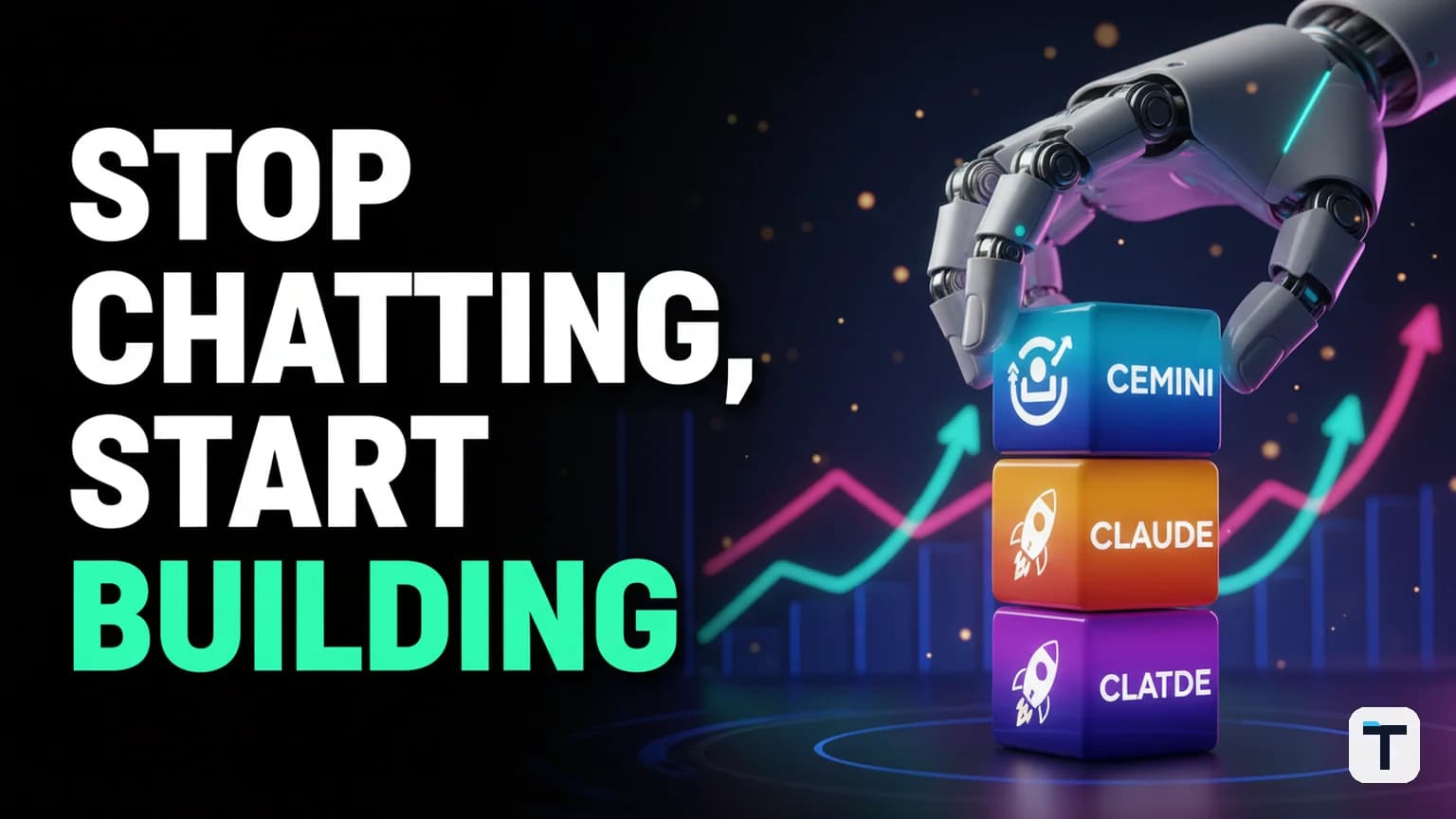
A common mistake is "tool hopping"—switching between ChatGPT, Claude, and Gemini every time a new feature is announced. This triggers a Reset Tax. Research by the American Psychological Association (Rubinstein, Meyer, & Evans, 2001) shows that switching between complex tasks can cost up to 40% of your productive time Switch cost effect.
Every time you switch AI tools, you pay this tax. You never get past the "beginner" stage because you are constantly re-learning the quirks of a new interface. In 2026, the three major ecosystems are distinct:
- Claude: Best for deep context, complex reasoning, and "Skills" Claude Skills vs ChatGPT GPTs.
- ChatGPT: Best for data execution and broad tool integration.
- Gemini: Best for deep Google Workspace integration.
Our recommendation: Pick one, master its advanced features (like Projects or Custom GPTs), and don't switch until you've hit a hard technical limit.
Pull vs. Push: Using the 'Interview Pattern' for perfect context
The biggest frustration with AI is the "back-and-forth" required to get a good result. Most people Push AI—they try to guess every detail the AI might need. This is slow and often misses the mark.
The professional shift is to Pull. Instead of guessing, you provide the goal and ask the AI to interview you.
The Interview Prompt:
"My goal is [X]. Before you start, ask me every question you need to do this job at a world-class level. Ask them one at a time. Once you have all the information, then execute the task."
This pattern ensures the AI extracts exactly what it needs (the "Context" in RACE) rather than you guessing what matters.
The WD-40 Rule: Solving high-value 'Boring' problems
Knowledge without execution is worth exactly zero. Many people waste time building "cool" AI automations that nobody wants to buy. The WD-40 Rule states that value is found in solving boring, persistent problems.
WD-40 is a "boring" product that stops squeaks and loosens bolts. Yet, the company has a market cap of approximately $2.7 Billion (as of April 2026) because it solves a universal pain point Finding High-ROI Problems.
When building with AI, look for the "rusted bolts" in your business:
- Repetitive data entry.
- Inconsistent customer follow-ups.
- Manual report generation.
If you can solve these "boring" problems, you are building a high-value asset, not just a flashy demo.
Killing 'AI Amnesia' with Master Prompts and Projects
Every new chat typically starts with "amnesia"—the AI forgets who you are and how you work. You can kill this in two steps:
- The Master Prompt: Create a "manual about me" that describes your role, goals, and preferred tone.
- Persistent Workspaces: Use Claude Projects or ChatGPT Custom GPTs to store these instructions permanently. This gives the AI "long-term memory" for your specific business context Permanent AI Memory Guide.
What this means for you
The goal is to transition from an AI consumer (someone who watches videos about AI) to an AI builder (someone who uses AI to create revenue or time). Stop collecting tools; start mastering one. Use the RACE framework and the Interview Pattern to solve the "boring" problems that actually move the needle for your business.
Action Step: Identify one recurring task that takes you 2+ hours a week. Use the Interview Prompt today to build a system for it in your primary AI tool.
FAQ
Q: Which AI tool is best for a complete beginner in 2026? A: If you use Google Docs and Gmail, start with Gemini. If you are doing heavy writing or research, Claude is currently the gold standard for reasoning and context. If you need to analyze large spreadsheets, ChatGPT remains the leader in code execution.
Q: Does the RACE framework work for every AI? A: Yes. Whether you are using a frontier model like Claude 3.5 or a local model, the requirements for a Role, Action, Context, and Expectations remain the same for high-quality output.
Q: What is the 'Reset Tax' exactly? A: It is the cognitive cost of switching between different AI tools or platforms. You lose time re-explaining context and learning new UI patterns, which research shows can slash your overall productivity by up to 40%.
Q: How do I know if an automation is 'worth' building? A: Use the "Boring Problem" test. Does it save you at least 3 hours a week, or does it directly prevent a costly error? If yes, it's worth the time to build.
Q: Can I use the Interview Pattern for complex projects? A: Absolutely. It is actually most effective for complex tasks like business planning or software architecture, where the "Context" is too large for you to remember to include in a single prompt.
Every claim here is traced to a primary source, dated, and listed under Sources. Research and drafting are AI-assisted; editing, verification and publication are human decisions, and a person is accountable for what appears on this page. How we work →


Discussion
0 comments