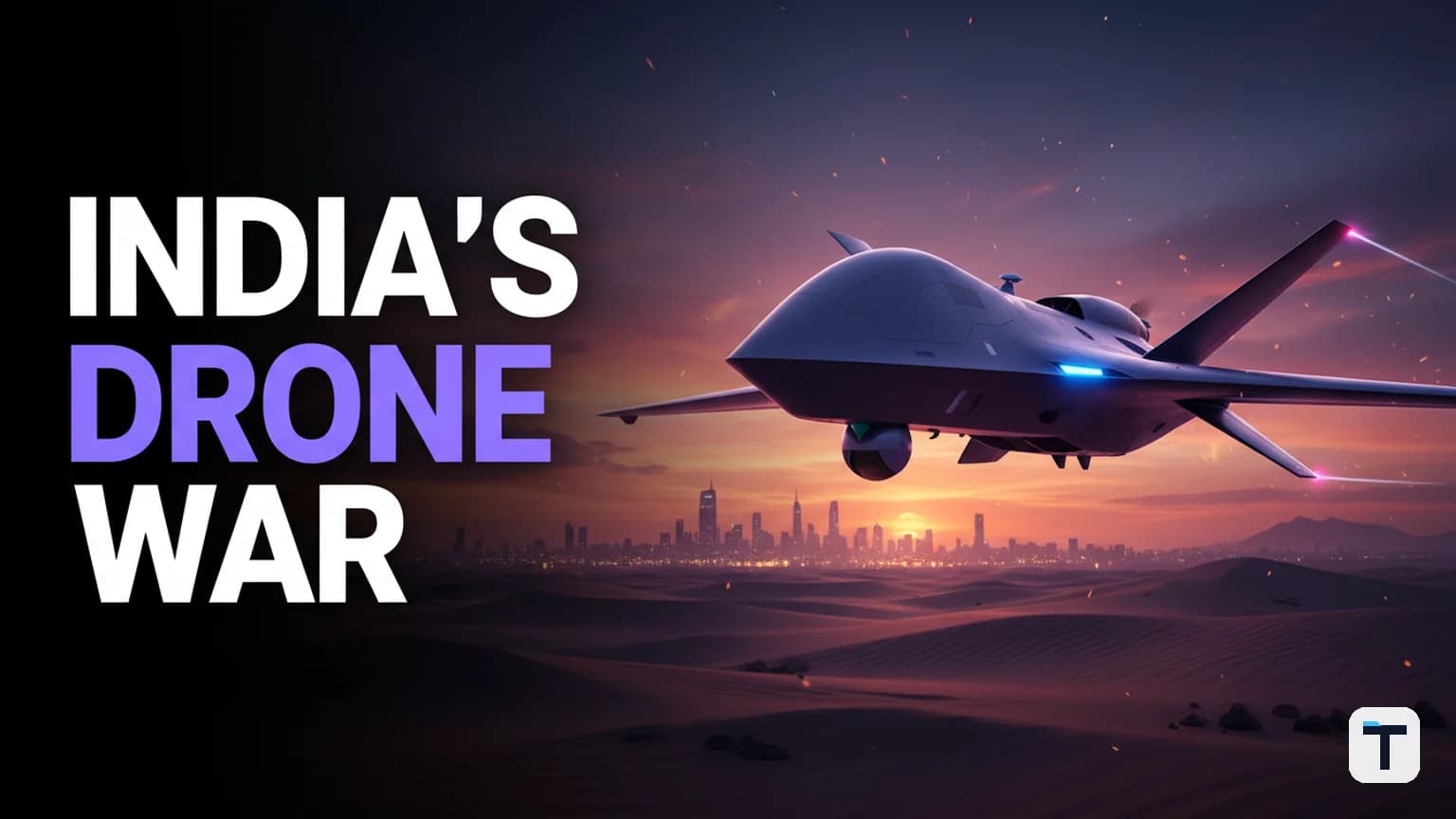

Verdict: India's IG Defence is positioning the KAL — a 1,000 km-range, 50 kg-payload, fully autonomous one-way attack drone — for international export to Gulf and allied nations, pending Indian government approvals. It is India's first indigenous platform in the Shahed-136 class of low-cost loitering munitions that have already rewritten the economics of modern air warfare. If export clearance comes fast enough, KAL gives India a foothold in one of the fastest-growing segments of the global defense market — but the regulatory window is narrow, and competitors are already shipping.
Last verified: 2026-08-05
- KAL: India's first indigenous 1,000 km-class one-way attack drone, built by IG Defence (Noida).
- Specs: 1,000 km range, 7–8 hour endurance, 50 kg warhead, fully autonomous navigation.
- Comparable platforms: Iran's Shahed-136, Russia's Geran-2, US LUCAS (~$35,000/unit).
- India's defense exports hit a record ₹38,424 crore (~$4.6B) in FY 2025–26, up 62.66% YoY.
- Export status: Positioned for the market; subject to Government of India regulatory clearances.
- Pricing and orders: Not publicly disclosed. Volatile facts — re-check monthly.
What is the KAL drone and who makes it?
The KAL is India's first indigenous 1,000 km-class long-range one-way attack drone, designed and built by IG Defence — a Noida-headquartered defense technology company founded in Odisha. CEO Bodhisattwa Sanghapriya unveiled the platform as "Project KAL" in early March 2026 and positioned it for international export in August 2026, subject to Indian government approvals (IDRW, August 2026; Business Standard, August 2026).
IG Defence (formerly IG Drones) has a broader portfolio spanning interceptor drones, FPV combat platforms, counter-UAS systems, AI-enabled swarm technologies, electronic warfare solutions, tactical robotics, and heavy-lift logistics drones (Analytics India Magazine, August 2026). The company has previously secured orders from the Indian Army and Navy for counter-drone systems, and signed an MoU with the Uttar Pradesh government for a defence corridor facility.
Where does the KAL drone fit in the global one-way attack drone market?
The KAL belongs to the Shahed-136 class of long-range one-way attack drones — a category that has fundamentally altered the cost structure of precision strike warfare since 2022. These are not reusable reconnaissance drones; they are single-use munitions engineered to fly hundreds of kilometers into contested airspace and detonate on impact against high-value targets.
| Platform | Country | Range | Warhead | Endurance | Est. Unit Cost | Status |
|---|---|---|---|---|---|---|
| KAL | India (IG Defence) | 1,000 km | 50 kg | 7–8 hrs | Not disclosed | Pending govt. export approval |
| Shahed-136 | Iran (HESA) | 1,000–2,500 km | 30–50 kg | 4–8 hrs | $20,000–$50,000 | In service (Iran, Russia, Houthis) |
| Geran-2 | Russia (license variant) | ~650 km (90 kg warhead) | 90 kg | 4+ hrs | ~$48,000–$80,000 | Mass-produced (~170/day by early 2026) |
| LUCAS | USA (SpektreWorks) | ~1,000 km (est.) | ~40 kg | Classified | ~$35,000 | Deployed to Middle East, Dec 2025 |
Sources: shahed136.com; drone-warfare.com; uav.net; CNBC, March 2026
The KAL's 1,000 km range and 50 kg payload place it squarely alongside the baseline Shahed-136 — the platform that has demonstrated, in Ukraine and across the Middle East, how a sub-$50,000 drone can force an air defense network to expend interceptors costing 8 to 200 times more per shot (Ukraine War Analytics, March 2026).
Why are Gulf nations buying one-way attack drones?
Gulf and Middle Eastern nations are accelerating investments in autonomous strike platforms because recent regional conflicts have demonstrated that low-cost, long-range drones can achieve strategic effects — destroying infrastructure, overwhelming air defenses, and depleting interceptor inventories — at a fraction of what traditional cruise missiles cost.
The economics are stark. A single US LUCAS drone costs approximately $35,000. A Tomahawk cruise missile costs approximately $1.3 million. That is a 37:1 cost advantage — meaning a nation can launch 37 long-range precision strikes with drones for the price of one cruise missile (drone-warfare.com). The entire logic of this drone class is that its expendability enables mass deployment: 50–100 drones launched in a single salvo can saturate radar tracking, electronic warfare bandwidth, and interceptor magazines simultaneously.
For Gulf nations already facing drone-saturation threats from regional adversaries, the question is not whether to acquire one-way attack drones — it is how quickly they can source them from a reliable, affordable, geopolitically acceptable supplier. That is the exact gap IG Defence is targeting with KAL.
How does the KAL drone compare to India's defense export push?
India's defense exports reached a record ₹38,424 crore ($4.6 billion) in FY 2025–26, a 62.66% increase over the previous year (Times Now, April 2026). The government has set a target of ₹50,000 crore ($6 billion) by 2029. Over the past decade, exports have grown roughly 35-fold, with Indian defense products now reaching more than 85 countries (PIB, February 2025; Times of Oman, April 2025).
Key milestones in this trajectory:
- BrahMos missile exports to the Philippines — India's first major weapons export deal, demonstrating that Indian-built systems can meet international combat standards.
- HAL Dhruv helicopter demand — the indigenous Advanced Light Helicopter is being sought by multiple countries.
- Naval vessel exports — Mazagon Dock and GRSE have delivered warships and patrol vessels to the Maldives, Mauritius, and Sri Lanka.
- Defense industrial corridors — Uttar Pradesh and Tamil Nadu corridors with combined investment exceeding ₹91,450 crore, the same kind of state-level industrial push that has driven India's semiconductor packaging buildout in Vizag.
The KAL drone fits directly into the Atmanirbhar Bharat (Self-Reliant India) framework, which has positioned domestic defense manufacturing as both a strategic necessity and an exports engine. India's defense production crossed ₹1.54 lakh crore in 2025, with more than 65% of defense equipment now produced domestically (Organiser, January 2026).
KAL is significant because it represents the first time an Indian private-sector startup has built a platform in the most strategically consequential drone category — one-way attack — and positioned it for the export market previously dominated by Iran and Russia. This mirrors the trajectory of India's private space sector, where companies like Agnikul Cosmos are proving that indigenous deep-tech can compete globally.
What are the KAL drone's technical specifications?
Based on IG Defence's official announcements and verified reporting:
| Specification | Value | Source |
|---|---|---|
| Range | Up to 1,000 km | IG Defence press release (IDRW) |
| Endurance | 7–8 hours continuous flight | Same |
| Warhead payload | 50 kg high-explosive | Same |
| Navigation | Fully autonomous (pre-programmed waypoint) | Same |
| Class | Long-range one-way attack drone (Shahed-136 type) | Same |
| Manufacturer | IG Defence, Noida | Business Standard |
| Export status | Positioned; pending Govt. of India approvals | Same |
| Unit cost | Not publicly disclosed | — |
Note: The earlier March 2026 unveiling reported an endurance of 3–5 hours (IDRW, March 2026). The August 2026 export announcement revised this to 7–8 hours, suggesting design refinements between the initial reveal and the export push. This is flagged as a volatile fact — specifications may shift as the platform matures.
What is the cost asymmetry problem that KAL addresses?
The defining strategic logic of the one-way attack drone category is cost asymmetry — the gap between what the attacker spends and what the defender must spend. This is the framework that makes a platform like KAL valuable to buyer nations:
| Engagement | Attacker cost | Defender interceptor cost | Cost ratio |
|---|---|---|---|
| Shahed-class drone vs. AIM-120 AMRAAM | ~$30,000 | ~$400,000 | 13:1 |
| Shahed-class drone vs. NASAMS interceptor | ~$30,000 | ~$400,000–$600,000 | 15–20:1 |
| Shahed-class drone vs. Patriot PAC-3 MSE | ~$30,000 | ~$4,000,000 | 130:1 |
| LUCAS drone vs. Tomahawk cruise missile | ~$35,000 | ~$1,300,000 | 37:1 |
| Switchblade 300 (tactical) vs. any interceptor | ~$6,000 | varies | varies |
Sources: Ukraine War Analytics; drone-warfare.com; Congressional Research Service, 2024; [IISS, 2025]
The implication: even when a defender intercepts every incoming drone, the attacker wins the economic exchange. A nation that can produce or acquire 100 KAL-class drones for a few million dollars can force a defender to expend hundreds of millions of dollars in interceptors — and that defender's interceptor inventory is finite.
This is why Gulf nations are actively seeking their own sovereign one-way attack drone capabilities. Buying from India, a friendly democracy outside the Iran-Russia axis, solves both the supply problem and the political optics problem — much as India's broader deep-tech partnerships with allied nations have expanded its strategic footprint across defense and technology corridors.
What regulatory hurdles must the KAL drone clear before export?
All KAL export sales remain strictly subject to Indian government regulatory clearances and export controls. This is the single biggest variable in the entire story.
India's defense export framework has been streamlined significantly — the government increased the FDI limit to 74% via the automatic route, simplified export procedures, and established faster clearance mechanisms (Times of Oman, April 2025). However, exporting a 1,000 km-range autonomous strike platform is categorically different from exporting patrol vessels or components. It falls into the highest tier of strategic export controls.
The key question, as framed by CEO Bodhisattwa Sanghapriya: will India's regulatory export framework clear KAL fast enough to capture current Gulf demand — or will international competitors secure those contracts first? Iran, Russia, and the United States (via LUCAS) already have comparable systems deployed or available. Every month of regulatory delay is a month in which competitors are building supplier relationships with the same buyer nations.
What this means for you
If you follow the global defense technology market, AI in defense, or India's evolving role as a tech exporter, the KAL story is a signal in three parts:
For defense industry watchers: The one-way attack drone market is no longer dominated by Iran and Russia. India's startup ecosystem is producing sovereign platforms that can compete — on paper — with the defining systems of modern drone warfare. The bottleneck is not capability; it is regulatory throughput and track record.
For builders and technologists in autonomous systems: The cost asymmetry math (13:1 to 130:1 attacker-to-defender ratios) is the core market thesis. Every nation facing drone-saturation threats needs affordable strike platforms, and every nation with air defenses needs cheaper counter-UAS solutions. Both sides of that equation represent open engineering problems — autonomous navigation hardening, electronic warfare resilience, swarm coordination, and kinetic-vs-non-kinetic interception.
For anyone tracking India's AI and defense exports: KAL is an early data point in India's transition from a defense importer to a defense exporter in autonomous systems. The record ₹38,424 crore export figure for FY 2025–26 is the macro trend; KAL is a specific platform that could widen that funnel into the most strategically valuable drone category — if the government clears it. This convergence of defense manufacturing and autonomous AI is reshaping India's broader technology landscape in ways that parallel the systemic shifts explored in our analysis of how AI is transforming India's IT industry.
FAQ
Q: What is the KAL drone's range and payload? A: The KAL has a maximum operational range of 1,000 km, carries a 50 kg high-explosive warhead, and flies for 7–8 hours on a single mission, according to IG Defence's August 2026 announcement (IDRW).
Q: Is the KAL drone the same as the Shahed-136? A: No. KAL is an indigenous Indian design built by IG Defence, but it belongs to the same class of long-range one-way attack drones as the Iranian Shahed-136, Russian Geran-2, and US LUCAS. All are pre-programmed, single-use, autonomous strike platforms optimized for cost-effective deep penetration.
Q: How much does the KAL drone cost? A: IG Defence has not publicly disclosed the unit cost. Comparable platforms range from $20,000 (estimated Shahed-136 base) to $80,000 (Russian Geran-2 with upgrades) to $35,000 (US LUCAS). KAL's pricing will depend on configuration, order volume, and whether it achieves export scale.
Q: Can the KAL drone be purchased by any country? A: No. All KAL export sales are subject to Government of India regulatory approvals and export controls. India's defense export framework has been streamlined under Atmanirbhar Bharat, but exporting a 1,000 km-range autonomous strike platform requires the highest tier of clearance.
Q: Why are Gulf nations interested in one-way attack drones? A: Recent regional conflicts have demonstrated that low-cost drones can overwhelm expensive air defense networks. Gulf nations face drone-saturation threats from regional adversaries and need sovereign strike capabilities. India, as a geopolitically neutral supplier outside the Iran-Russia axis, is an attractive alternative source.
Q: What other defense drones does IG Defence make? A: IG Defence's portfolio includes interceptor drones, FPV combat platforms, counter-UAS systems, AI-enabled swarm technologies, electronic warfare solutions, tactical robotics, and heavy-lift logistics drones (Analytics India Magazine).
Discussion
0 comments