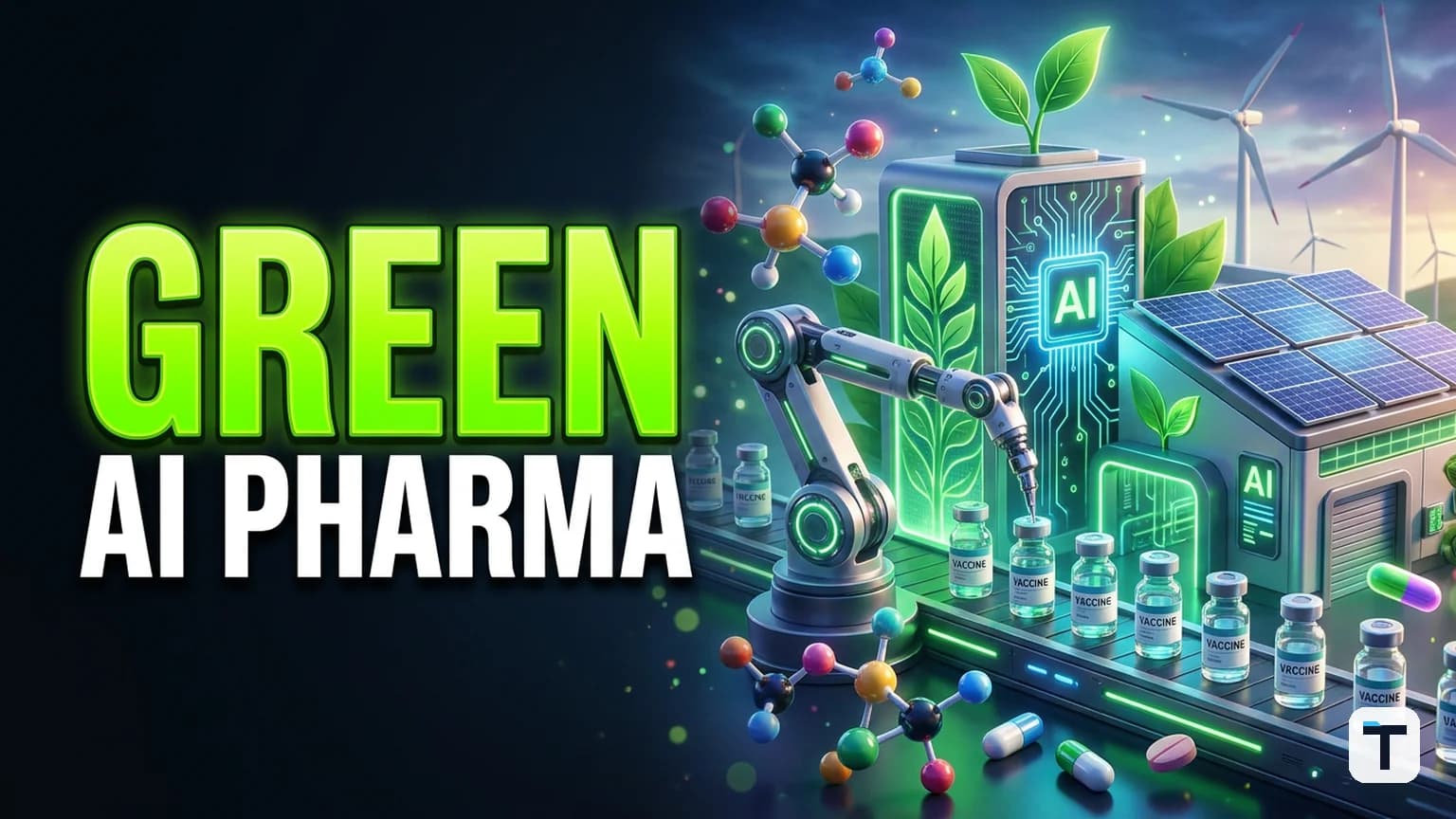

India's first Green Skills and Applied AI Centre of Excellence dedicated to pharmaceutical manufacturing opened in Hyderabad in July 2026, a partnership between the Telangana government, Microsoft India, the 1M1B Foundation (One Million for One Billion), and the MeitY Startup Hub. The facility, expected to be operational by August 2026, will train young people in applied AI, sustainable manufacturing, and emerging green technologies — directly supporting Telangana's ambition to become a global hub for sustainable pharmaceutical manufacturing under its Next-Gen Life Sciences Policy 2026–30.
Verdict: This is not a generic AI skilling bootcamp. It is a targeted intervention at the intersection of two forces reshaping pharma — AI-driven process optimization and green manufacturing — anchored in a state that already produces roughly one-third of the world's vaccines and 40% of India's pharmaceutical output. The center's success or failure will set the template that other Indian states, and potentially other emerging-market pharma hubs, will be measured against.
Last verified: 2026-07-20
- Telangana partnered with Microsoft India, 1M1B Foundation, and MeitY Startup Hub to launch India's first green pharma-focused applied AI CoE in Hyderabad.
- The center is expected to be operational by August 2026.
- It is one of five such centers nationwide; the national program aims to engage 100,000 youth in applied AI and green skills by 2030.
- Telangana's Next-Gen Life Sciences Policy 2026–30 targets $25 billion in investment and 500,000 jobs in the life sciences sector.
- Hyderabad accounts for approximately one-third of global vaccine output and 40% of India's pharmaceutical production.
What Is the Green AI Pharma Centre of Excellence in Hyderabad?
The Green Skills and Applied AI Centre of Excellence (CoE) in Hyderabad is a workforce development and innovation hub where learners apply AI to solve real-world sustainability and industrial challenges in pharmaceutical manufacturing. It was announced on July 16, 2026, with the roadmap presented to Telangana's IT and Industries Minister Duddilla Sridhar Babu at the state secretariat.
The center is being set up through a four-party collaboration:
| Partner | Role |
|---|---|
| Government of Telangana | Policy alignment, hosting, life sciences ecosystem integration |
| Microsoft India | AI technology, curriculum, corporate social responsibility via the Elevate program |
| 1M1B Foundation (One Million for One Billion) | Program design, execution, youth mobilization |
| MeitY Startup Hub | National ecosystem linkage, startup and incubation support |
The facility will feature dedicated learning zones covering Applied AI, Green Pharma, Solar Energy, Electric Vehicles, and Wind Energy. Participants gain hands-on experience through industry-led projects, innovation cohorts, internships, mentorship, incubation support, and career-readiness programs — not just classroom instruction.
How Does the Center Fit Into Telangana's Life Sciences Strategy?
Telangana is not building this center in isolation. It is a direct extension of the state's Next-Gen Life Sciences Policy 2026–30, unveiled by Chief Minister A. Revanth Reddy at the World Economic Forum in Davos in January 2026. That policy targets $25 billion in investments and 500,000 high-quality jobs by 2030, with the explicit goal of ranking among the top five life sciences clusters worldwide.
The policy's implementation is anchored by several infrastructure pillars:
- Green Pharma City — a world-class, sustainable industrial cluster located about 25 km from Hyderabad International Airport, designed with zero liquid discharge, centralized waste management, and energy-efficient systems. The government has signed MoUs with 17 companies including Dr. Reddy's, Bharat Biotech, Laurus Labs, and Sai Life Sciences, totaling investments of over ₹11,100 crore.
- Genome Valley — India's first and largest organized life sciences R&D and clean manufacturing cluster, home to around 500 companies with a scientific workforce of approximately 18,000 professionals.
- 10 Pharma Villages — each spanning 1,000–3,000 acres along the Outer Ring Road, aimed at decentralizing pharmaceutical production across the state.
The AI CoE feeds directly into this pipeline. As Minister Sridhar Babu stated, Telangana's next phase of growth depends on a future-ready workforce capable of leading AI-driven transformation and sustainable innovation in life sciences and advanced manufacturing.
What Are the Five Green Skills and Applied AI Centers Across India?
The Hyderabad center is one of five Green Skills and Applied AI Centres of Excellence being established across India by 1M1B Foundation and Microsoft in collaboration with MeitY Startup Hub. The five-city network spans Bengaluru, Hyderabad, Lucknow, Noida, and Shillong.
| Center | Status | Focus |
|---|---|---|
| Bengaluru | Launched (February 2026) | First CoE; solar, EVs, wind, applied AI |
| Hyderabad | Announced (July 2026), operational by August 2026 | Green Pharma focus; first pharma-specific CoE |
| Lucknow | Launched (July 2026) | Green skills; 5,000+ youth in first year |
| Noida | Planned | Applied AI and green skills |
| Shillong | Planned | Applied AI and green skills |
Nationally, the program aims to engage 100,000 youth in applied AI and green skills by 2030 and create pathways to 50,000 jobs, internships, apprenticeships, and entrepreneurial opportunities. In the first year alone, the initiative targets training 20,000 learners, connecting 10,000 with career opportunities, and developing 50 AI-powered climate innovation use cases.
Why Does AI Matter for Sustainable Pharmaceutical Manufacturing?
Pharmaceutical manufacturing is resource-intensive — it consumes large volumes of water, energy, and solvents, and generates significant waste. AI is becoming a practical tool for reducing this footprint while improving productivity. The key use cases where AI intersects with green pharma include:
- Process optimization — AI models analyze batch data to optimize reaction conditions, reducing solvent use and energy consumption per batch.
- Predictive maintenance — Machine learning predicts equipment failures before they occur, cutting unplanned downtime by up to 60% in some implementations and preventing wasteful batch losses.
- Energy management — AI-driven energy optimization systems monitor and adjust HVAC, cleanroom, and utility consumption in real time, a significant cost center in pharma facilities.
- Quality prediction — Models flag out-of-specification risk before final batch release, reducing the waste associated with failed batches and rework.
- Supply chain optimization — AI enables multi-regional sourcing and demand forecasting, reducing the environmental impact of logistics and cold-chain operations.
A 2025 MIT study found that nearly 95% of enterprise generative AI pilots failed to deliver measurable business impact, most often because systems remained disconnected from real workflows. The Telangana CoE's industry-led project model is designed to avoid this trap — learners work on real manufacturing problems, not sandbox exercises.
What Makes the Green Pharma Focus Unique?
Most AI skilling programs in India are generalist — they teach machine learning fundamentals with no industry-specific context. The Hyderabad center is deliberately different. It targets the intersection of AI, sustainability, and pharmaceutical manufacturing, which means the curriculum and projects are shaped by the specific challenges of the pharma sector:
- Regulatory compliance — Pharmaceutical manufacturing operates under strict GMP (Good Manufacturing Practice) frameworks. AI applications must be designed to support, not bypass, compliance with FDA, EMA, and CDSCO requirements.
- Batch vs. continuous manufacturing — Most pharma production is still batch-based, generating episodic data with strong campaign effects. AI models must account for this operational reality.
- Critical Quality Attributes (CQAs) — AI initiatives that begin as efficiency projects often fail when they don't translate into a defensible control strategy linked to CQAs. The CoE's industry-led projects are designed to bridge this gap.
The focus on Green Pharma also ties into the state's broader sustainability infrastructure. Green Pharma City already follows zero liquid discharge norms and has centralized effluent treatment systems. The CoE's training in sustainable manufacturing practices creates a workforce that can operate in, and improve, this kind of facility.
What Did the Key Stakeholders Say?
The announcement brought together leaders from government, industry, and the nonprofit sector. Their statements reveal the strategic logic behind the initiative:
Duddilla Sridhar Babu, Telangana's IT and Industries Minister, framed the center as integral to the state's future: "We have built one of the world's leading pharmaceutical and vaccine ecosystems. Our next ambition is to make Hyderabad the place where the future of healthcare is imagined, developed, and scaled. That requires more than infrastructure; it requires a future-ready workforce."
Rajiv Kumar, President and Managing Director of Microsoft India Development Centre, positioned AI as the foundation for sustainable industries: "Artificial intelligence is rapidly becoming the operating system for sustainable industries. In life sciences and pharmaceutical manufacturing, AI has the potential to improve productivity, optimise energy use, accelerate research, and enable more sustainable operations."
Manav Subodh, Founder and CEO of 1M1B Foundation, emphasized the human talent dimension: "The defining challenge of the next decade is not building more powerful AI, but building millions of young people who can use AI to solve humanity's greatest challenges. The future of Green Pharma resides at the intersection of AI, sustainability, and human talent."
Can a State-Corporate-Nonprofit Partnership Produce Job-Ready AI Talent at Scale?
This is the central question. The structural design of the Hyderabad CoE addresses several known failure modes of government skilling programs:
- Industry-led projects instead of classroom-only learning means participants build portfolio-worthy experience on real manufacturing problems.
- Dedicated learning zones for specific domains (Green Pharma, solar, EVs, wind) rather than generic ML coursework.
- Incubation and mentorship pathways, not just certificates — participants can launch startups or join existing pharma companies directly.
- Microsoft's technology stack and curriculum provide industry-standard tools, not academic approximations.
However, the real test comes after August 2026 when the center opens. Key metrics to watch:
- How many of the first-year participants secure jobs, internships, or apprenticeships in pharma or related industries
- Whether the 50 AI-powered climate innovation use cases target real manufacturing problems or remain academic exercises
- Whether other states replicate the model and whether their results match Hyderabad's
The national program's Year 1 target — 20,000 learners trained, 10,000 connected to career opportunities — is the first measurable benchmark.
What Does This Mean for You?
If you're in pharmaceutical manufacturing or life sciences: The center signals that AI skills are becoming a hiring priority in the pharma sector, not just in IT. If your team lacks AI literacy, this is the moment to invest in upskilling — either through programs like this CoE or through internal training. The companies that will win the next decade are those that can apply AI to reduce waste, optimize energy, and accelerate R&D.
If you're a young professional or student in India: The five-center national program is creating a direct pipeline into the green economy. The Hyderabad center specifically targets pharma, which is one of India's most globally competitive industries. If you're in Telangana or willing to relocate, this is a concrete pathway — not a vague promise — into an industry that's actively hiring.
If you're a pharma company in Telangana: The CoE is designed to feed your talent pipeline. Engaging with the center — through projects, mentorship, or hiring — is a low-cost way to access AI-trained talent who already understand your regulatory and manufacturing context.
If you're tracking India's AI strategy: This center is a microcosm of India's broader approach to AI — not building frontier models, but building the human talent that can apply existing AI tools to real industrial problems. For more on that strategy, see our analysis of India's sovereign AI push from the last mile to the first mile.
FAQ
Q: When will the Green AI Pharma Centre of Excellence in Hyderabad open? A: The center is expected to become operational by August 2026, according to announcements from the Telangana government and Microsoft India.
Q: Who are the partners behind the Green AI Pharma Centre? A: The Government of Telangana, Microsoft India, the 1M1B Foundation (One Million for One Billion), and the MeitY Startup Hub under the Ministry of Electronics and Information Technology.
Q: How many Green Skills and Applied AI centers are being set up across India? A: Five centers are planned across Bengaluru, Hyderabad, Lucknow, Noida, and Shillong. Bengaluru was the first to launch (February 2026), Hyderabad is the second (announced July 2026), and Lucknow was inaugurated in July 2026.
Q: What is the national target for the Green Skills and Applied AI program? A: The program aims to engage 100,000 youth in applied AI and green skills by 2030 and create pathways to 50,000 jobs, internships, apprenticeships, and entrepreneurial opportunities. In the first year, the target is 20,000 learners trained and 10,000 connected to career opportunities.
Q: How does the center relate to Telangana's Life Sciences Policy 2026–30? A: The center directly supports the Next-Gen Life Sciences Policy 2026–30, which targets $25 billion in investments and 500,000 jobs by 2030. The policy emphasizes advanced technologies, sustainability, and workforce development — all three are core to the CoE's mission.
Q: What is Green Pharma City and how is it connected? A: Green Pharma City is a sustainable industrial cluster about 25 km from Hyderabad International Airport, featuring zero liquid discharge, centralized waste management, and energy-efficient systems. The CoE trains the workforce that will operate in and improve facilities like this, creating a direct link between skilling and infrastructure.
Discussion
0 comments