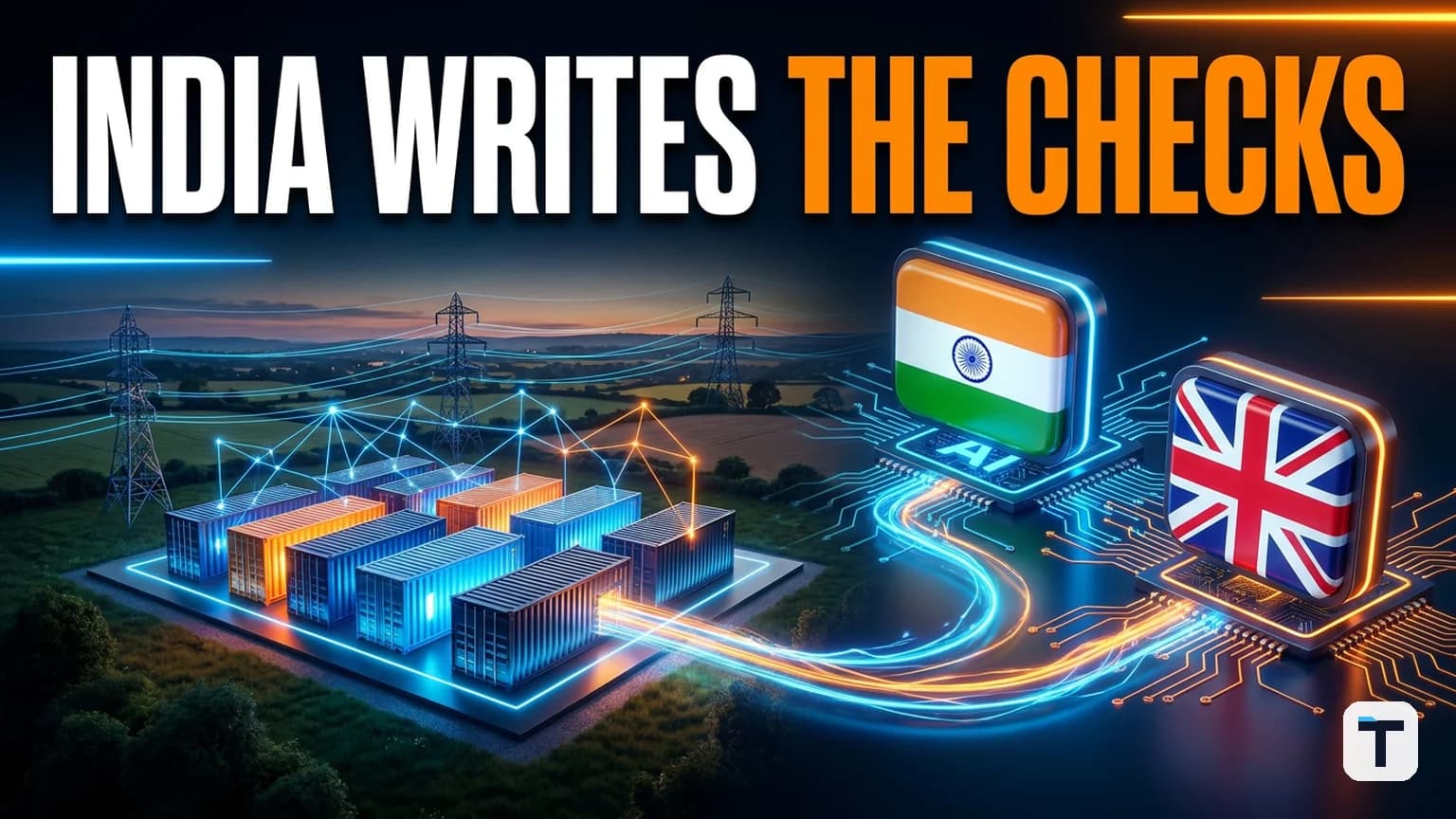

Verdict: The headline is not that Britain secured £1.3 billion at the G7. The headline is that Indian firms are now among the capital exporters building the West's AI infrastructure. Atri Energy Transition and Hexaware Technologies are putting more than £325 million into UK battery storage, AI R&D and quantum computing — a clear signal that energy security, industrial competitiveness and AI capacity are now the same conversation.
Last verified: 17 June 2026 · Primary keyword: India capital exporter G7 energy deal · Reading time: 8 minutes
TL;DR:
- The UK announced £1.3 billion in new investment from French and Indian companies at the G7 summit in Évian, France.
- Indian firms account for at least £325 million of that total: Atri Energy Transition (>£300m) and Hexaware Technologies (£25m).
- More than 1,400 jobs will be created in Manchester, Leeds and Birmingham.
- Battery storage is the quiet foundation of AI growth: data centres and model training need vast, reliable electricity.
- Prime Minister Modi framed the moment as a call for trust-based, equal partnerships rather than donor-recipient relationships.
What exactly was announced at the G7?
On 16 June 2026, UK Prime Minister Keir Starmer announced a £1.3 billion package of fresh investment commitments at the G7 summit in Évian-les-Bains, France. The money comes from French and Indian companies and is directed at clean energy, battery storage, flexible grid infrastructure and AI-related technology expansion GOV.UK, 16 June 2026.
| Investor | Country | Investment | Focus | Jobs |
|---|---|---|---|---|
| InfraVia Capital Partners (via Supernova Power) | France | £1 billion | Battery storage + flexible energy platform | Not disclosed |
| Atri Energy Transition | India | More than £300 million | Large-scale battery storage + advanced manufacturing | More than 100 |
| Hexaware Technologies | India | £25 million | AI, digital services, quantum computing R&D | Around 1,200 over 3–5 years |
Source: GOV.UK press release, 16 June 2026.
Why does Indian money matter in this deal?
For decades the common framework was Western capital flowing into India to build factories and back Indian talent. This announcement flips the direction. Indian companies are now funding critical infrastructure in an advanced economy.
The shift is part of a broader trend. India's outward foreign direct investment surged to $3.2 billion in April 2025 alone, up from $1.2 billion in April 2024, with major flows into electricity, gas, water, financial services and business services Reserve Bank of India, via IBEF, 26 June 2025. Indian groups such as Tata and Adani have expanded overseas, and technology firms including InMobi and OYO have built operations across Europe, the Middle East and North America.
Energy infrastructure is a newer export. Atri Energy Transition's commitment means Indian capital is helping determine how the UK stores and dispatches power at grid scale. That is influence, not just investment.
Why is battery storage suddenly an AI story?
AI runs on electricity. Training and running frontier models requires data centres that draw enormous, continuous power. Renewable generation is intermittent. The missing link between more renewables and reliable compute is large-scale battery storage.
Battery energy storage systems (BESS) store electricity when supply is abundant and release it when demand peaks. That stabilises prices, reduces the risk of blackouts during high-demand periods, and allows grids to host more wind and solar without falling back on fossil fuels UK Government, 16 June 2026.
The G7 announcement treats energy, manufacturing, technology and AI as linked. The UK needs storage to keep the lights on; AI labs need the same storage to keep models training. Countries that control energy infrastructure increasingly shape the next phase of AI growth.
What did Prime Minister Modi say at the summit?
During the G7 Outreach Session on "Forging New Partnerships and Rebuilding International Solidarity," Prime Minister Narendra Modi stressed the importance of trust in international partnerships. According to the Ministry of External Affairs, he argued the world does not suffer from a shortage of resources but from a shortage of trust, and that trade and technology should not be misused for narrow national interests ANI News, 16 June 2026.
He called for moving from a donor-recipient framework to partnerships based on solidarity and equality, and highlighted India-led initiatives: the International Solar Alliance, the Coalition for Disaster Resilient Infrastructure, the Global Biofuel Alliance and Mission LiFE. The framing landed while G7 discussions were focused on AI sovereignty, technology access, critical minerals and secure supply chains.
What this means for you
If you run a small business or build with AI, this deal is useful context rather than an immediate action item:
- Energy costs and AI access are linked. As grids add storage, power prices should become more stable. That matters if you are running AI workloads in the cloud or planning on-premise GPU use.
- Indian IT services are deepening in the UK. Hexaware's R&D centres in Manchester and Leeds will work on AI, quantum computing and citizen-facing digital services. That could expand the local talent pool and partnership options for UK businesses.
- The "sovereign AI" trend is accelerating. Nations are treating energy, chips and data infrastructure as strategic assets. If your business relies on frontier models, diversifying across providers and regions is becoming a resilience exercise, not just a cost exercise. Our earlier guide on sovereign AI strategy walks through the practical implications.
How does this fit the bigger India tech story?
The G7 investment follows a string of India-linked AI and infrastructure moves in 2026: HCLTech's $150 million bet on homegrown lab Sarvam AI, RMZ's $40 billion data-infrastructure pledge, and Wipro's Claude AI Centre of Excellence. Each move points in the same direction: India is trying to own more of the AI value chain — from capital and compute to deployment expertise.
You can read our takes on the broader shift in Why HCLTech Bet $150 Million on Sarvam AI and RMZ's $40 Billion India Data Infrastructure Bet.
FAQ
Q: What is the £1.3 billion G7 investment announced by the UK?
A: At the G7 summit in Évian, France, on 16 June 2026, UK Prime Minister Keir Starmer announced £1.3 billion in new investment commitments from French and Indian companies for UK clean energy and AI projects. The largest chunk is £1 billion from InfraVia, with Indian firms contributing more than £325 million combined GOV.UK.
Q: Which Indian companies are investing in the UK?
A: Atri Energy Transition, an India-based clean energy investor, committed more than £300 million to large-scale battery storage and advanced manufacturing. Hexaware Technologies, an Indian IT services firm, committed £25 million to expand its UK delivery centre in Birmingham and open R&D centres in Manchester and Leeds focused on AI and quantum computing GOV.UK.
Q: How many jobs will the investments create?
A: The package is expected to create more than 1,400 jobs in total. Hexaware alone expects around 1,200 jobs over three to five years across Manchester, Leeds and Birmingham. Atri Energy Transition expects more than 100 jobs from its battery-storage facilities GOV.UK.
Q: Why does battery storage matter for AI?
A: Training and running large AI models requires data centres that consume continuous, large amounts of electricity. Renewable power is intermittent. Battery storage lets grids store surplus renewable energy and release it when demand is high, making both clean power and reliable AI compute possible GOV.UK.
Q: What did PM Modi say about trust at the G7?
A: At the Outreach Session, Modi said the world suffers from a shortage of trust, not resources, and called for international partnerships based on solidarity and equality rather than a donor-recipient model ANI News.
Q: Is India really becoming a capital exporter?
A: Yes. India's outward FDI jumped to $3.2 billion in April 2025 from $1.2 billion in April 2024, with significant flows into energy, financial services and business services. The G7 announcement shows Indian companies are now funding strategic infrastructure in advanced economies, not just receiving foreign investment RBI via IBEF.
Discussion
0 comments