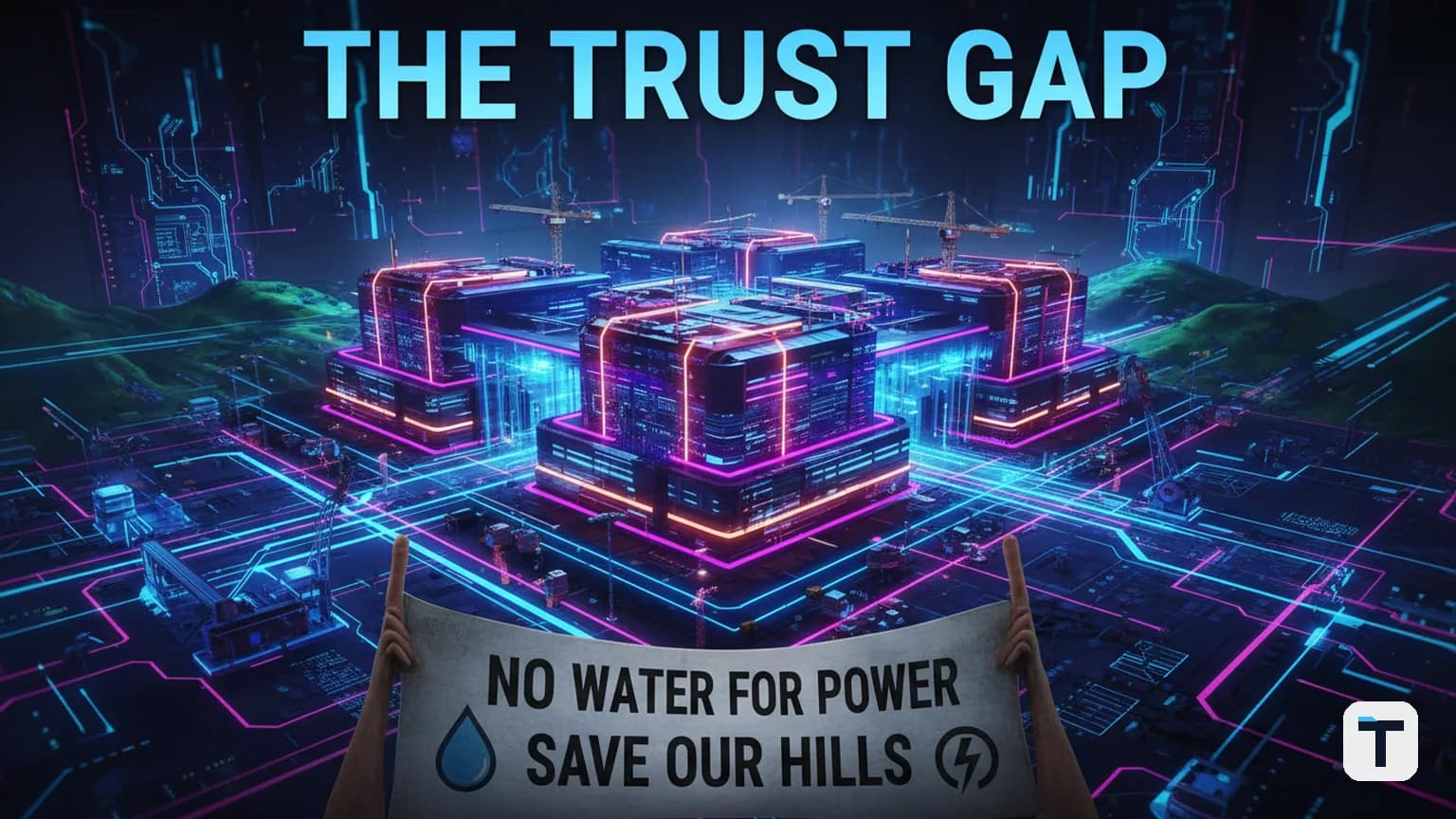

Verdict: While Google’s $15 billion, 1-gigawatt (GW) AI data center hub in Visakhapatnam is a cornerstone for India’s digital sovereignty, its rapid deployment faces localized headwinds. Protests over land acquisition in villages like Tarluvada and deep anxieties regarding the region's existing water and grid stress highlight a growing "trust gap." To achieve its infrastructure goals, the hyperscale tech sector must prioritize absolute community transparency and real resource-sharing over pure engineering metrics.
Last verified: 2026-06-18
- Project Scale: 1 Gigawatt (GW) total compute capacity across three locations in Visakhapatnam.
- Investment Total: $15 Billion over a five-year horizon (2026–2030).
- Key Partners: Developed in coordination with AdaniConnex (and Adani Group's Cemindia Projects) and Nextra by Airtel.
- Policy Edge: First-of-its-kind Deemed Distribution License (DDL) framework allowing private campus DISCOMs.
- Volatile Facts: Infrastructure policies, grid capacity, and renewable energy targets change rapidly. Grid status last updated Q2 2026.
Why is Google building its largest Asian AI hub in Visakhapatnam?
Google broke ground on its Visakhapatnam (Vizag) AI data center hub on April 28, 2026, marking one of the largest Foreign Direct Investments (FDI) in India’s digital sector (The Economic Times, 2026). The site serves as the anchor for a massive technology corridor planned by the Andhra Pradesh government.
Beyond vast real estate, the location serves a vital geographic purpose: the America India Connect initiative will land high-capacity international subsea cables directly on the Vizag coast (Data Center Knowledge, 2025). This establishes a critical eastern gateway, providing network routing diversity to relieve the saturated subsea landing stations in Mumbai and Chennai while slashing latency for AI workloads across the subcontinent.
The facility integrates Google’s proprietary software and hardware innovations designed across its existing research centers in Bengaluru, Hyderabad, and Pune. It links local Indian R&D directly into a global network spanning 12 countries.
What is the friction behind the land acquisition in Vizag?
On the ground, the transition from rural land banks to a hyper-advanced server campus has triggered sharp community pushback. Construction has commenced in areas like Tarluvada, where heavy machinery from Adani Group’s Cemindia Projects is actively clearing hillsides (The Ken, 2026).
The primary flashpoint involves land rights and livelihoods. Local farmers and Dalit families have organized protests, claiming that parts of the acquired plots were allotted to historically marginalized communities decades ago for agricultural sustenance. Activists emphasize that the dispute extends far beyond cash compensation; it represents permanent displacement, loss of generational livelihood, and the scattering of tight-knit rural networks. Transparency concerns have escalated following the restriction of localized investigative footage documenting tenant displacement, drawing intense scrutiny from civil liberties and environmental groups.
Can the local power grid support a 1-Gigawatt AI load?
AI compute workloads demand an unprecedented volume of electricity, acting effectively as private industrial cities. To accommodate this, the Andhra Pradesh Energy Department issued a pioneering policy order establishing Deemed Distribution Licenses (DDL) for strategic data center campuses with a connected load of 300 MW or above (The Hindu Business Line, 2026). This framework enables Google to operate as an independent private DISCOM (distribution company) within its campus, procuring and distributing its own power.
However, severe structural anxieties remain. Andhra Pradesh has promised tech giants a combined 5 GW of data center capacity in Vizag by 2030—more than triple India's total data center capacity built over the last three decades (The Ken, 2026). Neighboring households and farms in the region already face routine power outages, raising fears that hyperscale allocation will cannibalize local consumer supply.
+--------------------------------------------------------------------------+
|                 Andhra Pradesh Data Center Power Contract                |
+------------------------+-------------------------------------------------+
| Minimum DDL Threshold  | 300 MW Connected Load                           |
+------------------------+-------------------------------------------------+
| Clean Energy Mandate   | 51% Minimum Sourced from Renewables             |
+------------------------+-------------------------------------------------+
| State Incentives       | Land discounts, power subsidies, tariff benefits|
+------------------------+-------------------------------------------------+
While the state policy mandates that at least 51% of data center power must come from renewable energy, critics point out that backup generation will inevitably draw heavily from the traditional coal-dominant state grid during peak shortfalls.
How will the Vizag AI hub impact regional water stress?
Cooling massive server clusters requires millions of liters of water daily, a challenge that has already triggered heavy regulatory and community pushback against data centers globally in jurisdictions like Chile, Ireland, and the United States. Visakhapatnam is already classified as a water-stressed region, causing local activists to question the project's long-term ecological footprint.
Activists allege that the project skipped comprehensive public environmental impact assessments and public hearings due to specific industrial classifications. In response, Google has positioned the facility as a "community-first" development project, committing to heavy ecological offsets, including:
- Watershed Management: Deploying regional rainwater harvesting and aquifer recharge systems.
- Water Access: Installing reverse osmosis (RO) purification plants and public "Water ATMs" for local towns.
- Coastal Support: Targeted economic initiatives for local fishing communities and specialized digital skilling programs.
What does this mean for the future of AI infrastructure?
The unfolding situation in Andhra Pradesh serves as a primary warning sign for the global technology sector: AI infrastructure can no longer be treated as ordinary commercial real estate. True digital sovereignty requires more than just capital, fiber optics, and advanced silicon; it requires public confidence and local trust.
For enterprise builders and startups, the Vizag hub represents a massive leap in localized compute potential and low-latency capability. However, if tech conglomerates fail to execute their resource-sharing commitments transparently, social friction on the ground risks delaying the rollout of the very infrastructure the AI era depends on. Growth is unsustainable without community equity.
Frequently Asked Questions (FAQ)
Q: Where exactly is the Google AI data center hub being built?
A: The data center campus is being constructed across three distinct strategic sites in the Visakhapatnam region of Andhra Pradesh, India, with major groundbreaking and grading operations actively centered in the village of Tarluvada.
Q: What is a Deemed Distribution License (DDL) in data center policy?
A: A Deemed Distribution License is a regulatory framework introduced by the Andhra Pradesh government that allows private industrial developers with a load exceeding 300 MW to act as their own independent power distribution companies, bypassing traditional utility monopolies to build and manage private grid networks.
Q: Why are local communities in Visakhapatnam protesting the AI hub?
A: Local farmers and Dalit families are protesting due to the forced acquisition of agricultural land, displacement from ancestral plots originally allocated decades ago, potential threats to regional water security, and a perceived lack of public consultation and environmental transparency.
Q: Who are Google's main infrastructure partners for this project?
A: Google is developing the 1 GW facility in close partnership with AdaniConnex (which handles construction via Cemindia Projects) and Bharti Airtel’s Nextra division, which coordinates the landing of subsea fiber cables.
Q: Does the project have any renewable energy obligations?
A: Yes. Under the Andhra Pradesh Data Center Policy, any strategic hyperscale development receiving state incentives is legally required to source a minimum of 51% of its operational electricity from renewable energy infrastructures.
Discussion
0 comments