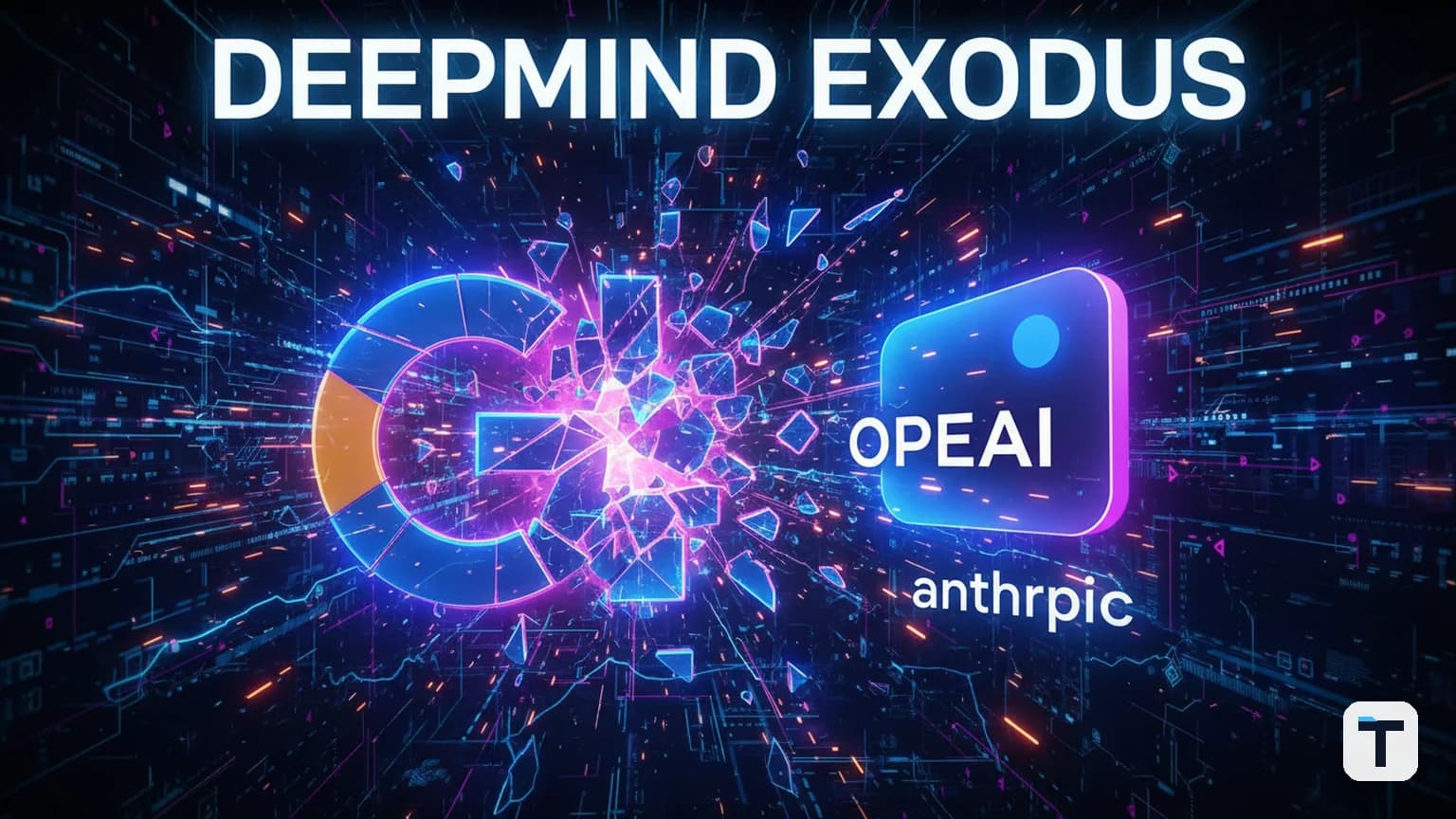

Google DeepMind has lost two of its most consequential researchers in under 48 hours. Noam Shazeer, co-inventor of the Transformer architecture and co-lead of Gemini, has joined OpenAI as Lead for Architecture Research. John Jumper, the 2024 Nobel Laureate in Chemistry who led AlphaFold, has joined Anthropic. Together, these departures represent a structural failure of Google's retention strategy at a moment when the company can least afford it.
TL;DR
- Noam Shazeer left Google DeepMind for OpenAI on 18 June 2026, barely 18 months after Google paid $2.7 billion to bring him back from Character.AI.
- John Jumper, who won the 2024 Nobel Prize for AlphaFold, joined Anthropic on 19 June 2026.
- David Silver, the AlphaGo lead, also departed earlier in 2026 to found a world-models startup.
- The exits coincide with an IPO wave that values OpenAI near $1 trillion and Anthropic at $965 billion.
- Google's acquisition-as-retention model appears broken when researchers leave within months of costly re-hires.
Who Are Shazeer and Jumper, and Why Does This Matter?
Noam Shazeer is one of the eight co-authors of "Attention Is All You Need," the 2017 paper that introduced the Transformer. He spent over a decade at Google before leaving in 2022 to co-found Character.AI. In late 2024, Google struck a $2.7 billion licensing deal to reacquire Character.AI's technology and bring Shazeer back as VP of Engineering and co-lead of the Gemini programme. That deal was widely read as a tacit admission that Google needed Shazeer more than he needed Google.
John Jumper led the AlphaFold 2 and AlphaFold 3 projects, which solved the protein-folding problem that had stumped structural biology for fifty years. He shared the 2024 Nobel Prize in Chemistry for the work. Within Google DeepMind, Jumper was the most visible proof that the lab could produce world-changing science, not merely competitive products.
Losing either would be notable. Losing both in the same week raises questions about what is happening inside the organisation.
What Does the Google DeepMind Talent Exodus Tell Us About Retention?
The pattern is now clear enough to call structural. Google's playbook for retaining elite researchers has relied on two levers: compensation (large equity grants, retention bonuses) and mission (access to compute, data, and publication freedom). Both levers appear to be failing.
On compensation, the problem is straightforward. When OpenAI is approaching a trillion-dollar IPO and Anthropic sits at $965 billion in private valuation, pre-IPO equity at a rival lab can dwarf anything a public company like Alphabet offers. Google stock is liquid but mature. OpenAI and Anthropic stock is illiquid but carries enormous upside if the IPO wave materialises.
On mission, the issue is subtler. Researchers at Google DeepMind reportedly face increasing product pressure — the need to ship features for Google Search, Cloud, and Workspace rather than pursue open-ended research. Shazeer's move to an "Architecture Research" role at OpenAI suggests he wanted to work on foundational model design without the overhead of a product portfolio. Jumper's move to Anthropic, a company that foregrounds alignment and safety research, suggests a desire to apply scientific AI in a setting with fewer commercial constraints.
Why Did Shazeer Choose OpenAI?
Shazeer's role at OpenAI — Lead for Architecture Research — points to what OpenAI likely wants from him: the next generation of model architectures beyond the standard Transformer. Shazeer has a track record of practical architecture innovations (mixture-of-experts scaling, multi-query attention) that translate directly into training efficiency. For OpenAI, which burns capital at an extraordinary rate to maintain its frontier position, efficiency gains in architecture are existential. Shazeer is one of perhaps five people alive who can deliver them.
The fact that he left just 18 months into a $2.7 billion re-hire deal is damning for Google. It implies that money alone was not the constraint, and that something about the working environment or strategic direction pushed him out.
Why Did Jumper Choose Anthropic?
Jumper's choice of Anthropic over OpenAI is itself informative. Anthropic has positioned itself as the safety-first lab, but it has also signalled interest in scientific applications of AI — using large models to accelerate research in biology, chemistry, and materials science. Jumper is the obvious person to lead that effort.
For Anthropic, the hire serves dual purposes: it gains genuine scientific credibility (a Nobel laureate on staff is not merely a recruitment signal, it is a research programme) and it differentiates from OpenAI's consumer-product focus. The competition between frontier labs is no longer just about benchmark scores; it is about which lab can attract the researchers who define the next decade of the field.
What Does This Mean for Google DeepMind Going Forward?
Google DeepMind still employs thousands of talented researchers. It retains Demis Hassabis as CEO, enormous compute resources, and integration with Google's product surface. But the departures of Shazeer, Jumper, and Silver in a single year strip away three of the lab's most iconic figures — the people whose names appeared on the papers that made DeepMind famous.
The risk for Google is not immediate capability loss. It is a signalling cascade. When top researchers leave, mid-career researchers recalculate their own prospects. The broader AI industry is watching closely; if DeepMind cannot hold its stars, it becomes harder to recruit the next generation.
Google will likely respond with larger retention packages and possibly structural changes — more research autonomy, fewer product mandates. Whether that is enough when rivals are offering pre-IPO equity at historic valuations remains to be seen.
Related reading
FAQ
Q: How much did Google pay to bring Shazeer back from Character.AI? A: Google struck a $2.7 billion deal in late 2024 to license Character.AI's technology and re-hire its co-founders, including Shazeer. He departed for OpenAI roughly 18 months later.
Q: What role will John Jumper have at Anthropic? A: Anthropic has not disclosed a specific title, but reporting indicates he will lead efforts to apply large models to scientific discovery, building on his AlphaFold expertise.
Q: Is this part of a broader trend of Google losing AI talent? A: Yes. David Silver, who led the AlphaGo programme, left earlier in 2026 to found a world-models startup. Multiple senior researchers have departed for OpenAI, Anthropic, and independent ventures over the past two years.
Q: Does this affect Google's Gemini programme directly? A: Shazeer co-led Gemini, so his departure removes a key technical leader. Google has deep bench strength, but losing the co-inventor of the Transformer from your flagship model team is not trivial.
Q: Why are researchers choosing startups over Google's resources? A: Pre-IPO equity at companies valued near $1 trillion offers financial upside that mature public-company stock cannot match. Combined with greater research autonomy and fewer product obligations, the pull is significant. The current AI market dynamics make startup equity unusually attractive.
Discussion
0 comments