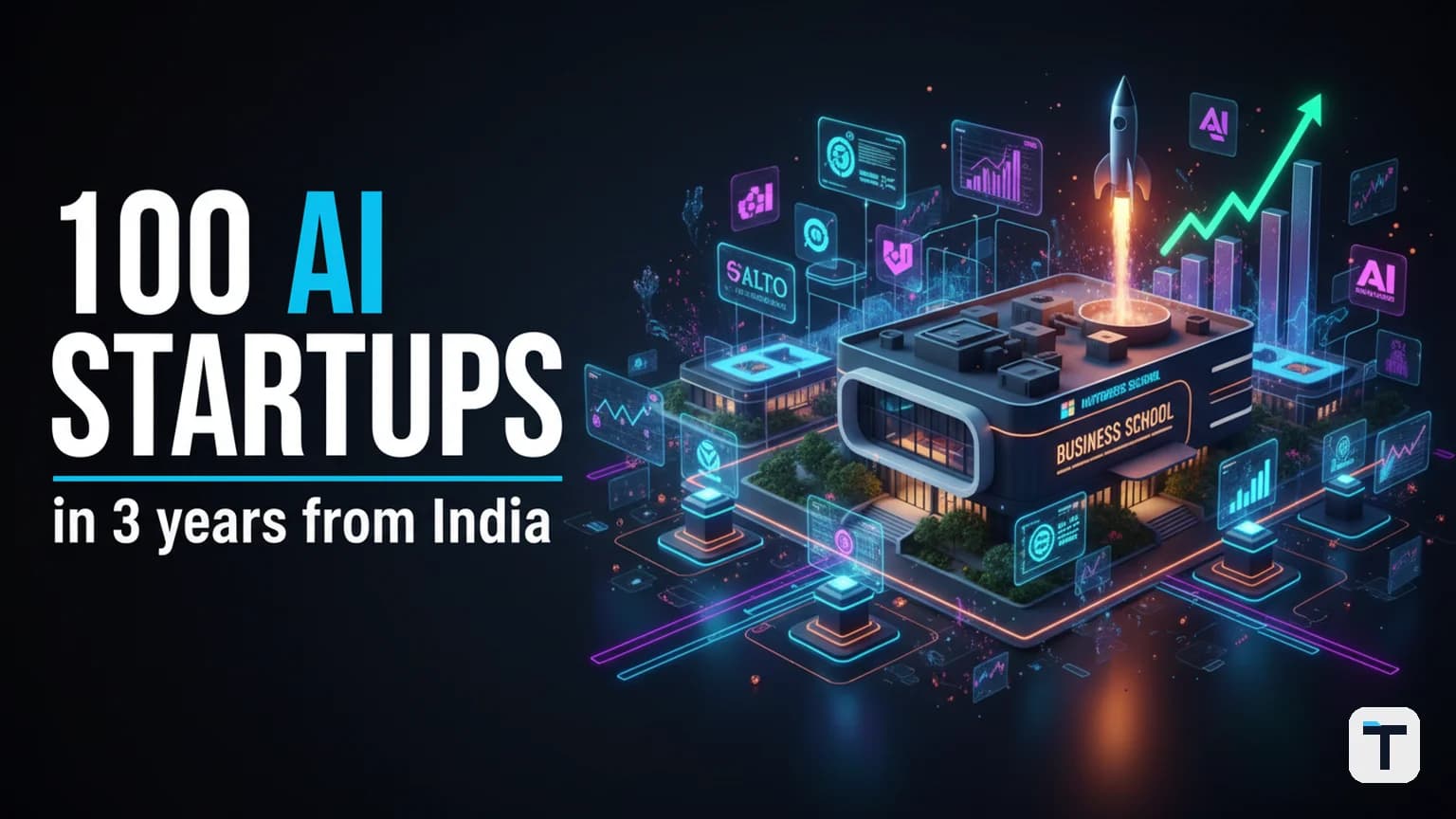

Verdict: India does not have an AI model problem — it has an enterprise-adoption problem. BITSoM Vertex, launched April 2026 by the BITS School of Management in partnership with Silicon Valley's Lenz, is the first Indian B-school incubator explicitly betting that the next 100 global-scale AI startups will be built by solving enterprise workflow problems, not by shipping another consumer wrapper. The thesis is well-supported: 90% of enterprise AI projects stall before production, and the #1 source of resistance is not the technology or end users but Legal, HR, Risk, and Compliance — at 35%. India leads the world in at-scale AI adoption at 80% of enterprises, yet only 23% have formal governance frameworks. Vertex is built to close that exact gap.
Last verified: 2026-08-05 · Programme launches April 2026 · Target: 100 startups in 3 years · 90-day enterprise-validated MVP cycle · Partner: Lenz (Silicon Valley) · Apply by 6 September 2026
TL;DR:
- BITSoM Vertex is a 90-day, enterprise-led AI incubator hosted inside a business school, aiming to graduate 100 global-scale startups in three years.
- The real bottleneck is NOT models — it's enterprise access, governance, and the pilot-to-production gap (90% of enterprise AI projects stall before scaling).
- The biggest source of AI deployment resistance is Legal/HR/Risk/Compliance (35%), ahead of end users (23%) — per the Stanford Enterprise AI Playbook.
- India leads in rapid AI adoption at 80% of enterprises but only 23% have formal governance frameworks, creating enormous demand for startups that can navigate this gap.
- For founders and operators: the opportunity is in implementation, not invention.
What is BITSoM Vertex and why does a business school run an AI incubator?
BITSoM Vertex is a structured AI incubator — officially the "AI Innovation & Venture Programme" — housed inside the BITS School of Management (BITSoM), the management school of BITS Pilani. It launched in April 2026 with a stated goal of graduating 100 enterprise-validated AI startups within three years. The programme was developed in partnership with Lenz, a Silicon Valley AI Innovation Studio, and is led by Arvind Ravishunkar, Managing Director of BITSoM Vertex, who operates from the Bay Area and splits time between Palo Alto and Mumbai.
The reason this lives inside a business school — not an engineering institute — is the core thesis: the bottleneck in AI startups is no longer technical. Models are commoditized for 95% of use cases. What kills startups is the gap between a working demo and an enterprise that will actually pay, deploy, and stay. Vertex's bet is that management-school infrastructure (enterprise CXO relationships, executive education clients, MBA-talent build crews, and inter-disciplinary governance thinking) is better positioned to solve that gap than a pure tech incubator.
The programme focuses on the application layer — OS/APIs and specific or hyper-local AI models rather than general infrastructure. Its vertical tracks include software automation and enterprise/vertical AI, multilingual and language AI, education and workforce AI, healthcare and diagnostics AI, fintech and risk intelligence, agriculture and food systems, and energy and sustainability AI. Applications close 6 September 2026, with the first cohort expected to run the 90-day cycle shortly after.
How does the 90-day enterprise-validated MVP cycle work?
The 90-day cycle is the programme's structural answer to what Dean Saravanan Kesavan describes as the biggest risk: problem identification, not build speed. The cycle has four stages, per the programme's official description:
- Startup selection — Identify industry-led founders with high-potential raw AI ideas who already understand a domain problem.
- Ideation phase — Refine the problem statement and align the AI solution with enterprise needs. The enterprise partner is embedded here, not brought in at the end.
- Iterative build loop — Continuous test cycles paired with design and build sprints. Founders use real-time corporate pilots for immediate validation, domain-specific AI sandboxes for development, and structured MBA-engineering build crews for technical and business support.
- MVP with pilot customer — The cohort ends with an enterprise-validated minimum viable product already deployed with a real paying customer, not a demo video.
The rationale for 90 days being sufficient: AI has dramatically shortened the time to build a working prototype. A founder who understands the problem can ship a functional agent or workflow in days, not months. The slow part — and the part Vertex subsidizes — is finding the right enterprise problem and getting through the legal/HR/compliance review that gates any real deployment. By pre-negotiating enterprise pilots and pre-scoping the problem with the partner, the cycle front-loads the expensive work.
Is 90 days genuinely enough? Dean Kesavan's own answer is that three months is ample for the MVP itself, and that the programme will revise if proves too short. The honest read: 90 days is enough to validate that an enterprise will engage and a solution will work on a constrained pilot scope. It is not enough to prove sustained production deployment at scale — that is the post-programme journey, and Vertex connects graduates to investor networks and enterprise partners for that phase.
Why do most enterprise AI projects fail — and what does Vertex fix?
The single most important data point grounding this whole programme: approximately 90% of enterprise AI projects stall before reaching production, according to analysis from the VIBE50 report and accelerator operators cited by Business Today in 2025. The technology is rarely the failure mode.
The Stanford Digital Economy Lab's Enterprise AI Playbook (Pereira, Graylin, Brynjolfsson, 2026) — based on detailed study of 51 enterprise AI deployments — quantifies the actual sources of resistance:
| Source of resistance | Share of deployments blocked |
|---|---|
| Staff functions (Legal, HR, Risk, Compliance) | 35% |
| Internal end users | 23% |
| External stakeholders and clients | 23% |
| C-level (ROI demands) | 15% |
The most common failure isn't a model that hallucinates — it's a Legal team that won't approve deployment because probabilistic systems violate contractual guarantees, an HR team that won't sign off on workflow changes, or a Risk team that can't quantify regulatory exposure. Equally important: 61% of enterprise AI implementations in the Stanford dataset experienced at least one significant failure before reaching sustained production. The pattern that succeeds is not better AI — it's better sponsors who stay through failure, iterative development that ships working software in weeks, and explicit strategies for bringing the governance functions in as design partners rather than approval gates.
This is exactly the gap Vertex is engineered to close. By embedding MBAtudents and the partner enterprise inside the build crew from day one, and by treating legal/HR/compliance scoping as a first-class workstream, the programme front-loads the governance conversation onto the build timeline rather than letting it surface in week 12 and kill the deal.
For a deeper read on how enterprises are navigating this same problem on their own side, see our analysis of India's sovereign AI partner programme and what it means for enterprises.
How does India's services-to-products shift change the founder mindset?
This is the cultural thesis underpinning Vertex — and it is the part most people underestimate. India's three-decade tech reputation was built on services: executing other people's ideas with world-class project management. The accelerator explicitly bets that AI is the moment to move from services to products and IP ownership.
The shift Dean Kesavan identifies is from a "doer" mindset (give me a task, I will execute it efficiently) to a "builder" mindset (I will take risk, I will fail, and the ones that work will compound). Three concrete differences:
- Risk tolerance. Services orgs optimize for cost minimization and predictable delivery. Product orgs need slack — the acknowledgment that some bets fail and that the slack itself is productive infrastructure, not waste.
- 360-degree ownership. A services vendor talks to the client's IT or product team. A product company owns the entire surface — including HR, Legal, and Compliance — because the client is buying an outcome, not an install.
- R&D investment. This is India's structural weakness. Indian R&D spending crossed 0.83% of GDP in 2021-22 (the first time above 0.8% since 2009-10), with the private sector's share of national R&D rising from 36.4% in 2020-21 to 51.8% in 2023-24, per official data reported by The Hindu. China and the US spend roughly 10x more in absolute terms and a higher share of GDP. Until private industry treats R&D as a productive asset rather than a cost center, Indian startups will keep looking abroad for customers willing to fund frontier work.
For Indian IT services firms navigating this exact pressure, our analysis of the Infosys vs TCS vs HCLtech AI data-center split is directly relevant.
What does the Silicon Valley bridge actually give Indian founders?
Vertex positions itself as a bridge between India's talent and Silicon Valley's customers and capital. The question worth asking directly: what does that bridge give founders they couldn't get by just moving to San Francisco?
Three concrete things, based on the programme structure and the broader market:
- Enterprise pilot access — The biggest friction for an Indian B2B AI founder is not building the product; it's getting an enterprise to run it. Vertex pre-negotiates pilots with its executive-education client base. Sub Sawhney, an Indian startup cannot cold-call a Fortune 500 CIO and get a sandbox. The incubator's embedded enterprise relationship does that work up front.
- US customer validation — Many Indian VCs fund startups that already have US or Western European customers, not Indian ones, because of R&D skepticism and longer sales cycles inside India Inc. Vertex's Lenz partnership is designed to route Indian founders to US enterprise customers without requiring the founder to relocate.
- Talent density without relocation — Stanford research (Strebulaev, Venture Capital Initiative) found that Indian startups are 6.5x more likely to reach unicorn status if they relocate to the US. India-born founders account for 90 of the 1,078 founders across 500 US unicorns studied — the largest non-US-born group, ahead of Israel (52), Canada (42), UK (31), and China (27). The bridge thesis is that you capture the talent-density advantage without forcing the founder to leave.
For more on how this same dynamic is reshaping India's global capability centers, see our GCC strategy and culture-talent playbook.
Why is the application layer the real AI opportunity — not the model layer?
The Stanford Enterprise AI Playbook makes a point that should reorder how founders pick problems: for 42% of the deployments studied, the underlying model was fully interchangeable. The organizations that succeeded did not necessarily have better AI — they had better process and execution. Among routine tasks, 71% of teams treated the model as fully interchangeable and none considered it a critical differentiator.
This is why Vertex explicitly focuses on application-layer startups rather than foundation-model or infrastructure plays. The relative moat in 2026 is workflow integration, vertical domain expertise, and the governance navigation we covered above — not marginal model improvements. A founder who can ship a working finance-ops automation that gets through a bank's compliance review has a more defensible product than one with a marginally better LLM. The incubator's vertical tracks (healthcare AI, fintech and risk intelligence, agriculture and food systems) are chosen because these are domains where the workflow and regulatory integration are the actual product, not bolt-ons.
If you're evaluating this as an operator, the same logic applies to your own business. Our AI business strategy that actually makes money in 2026 breaks down the same pattern for small and mid-sized teams.
What this means for you
If you are an Indian AI founder (or considering becoming one): Apply to Vertex before 6 September 2026 if your idea is enterprise-adjacent. The single highest-leverage asset you cannot build alone is the enterprise pilot — the programme is engineered around that bottleneck. Even if you don't join, internalize the lesson: stop polishing the model and start lining up a partner enterprise who will run a real pilot. The governance conversation (Legal, HR, Risk, Compliance) is not an obstacle to your roadmap; it is your roadmap.
If you run an enterprise in India: Your governance framework is the largest determinant of your AI ROI. Only 23% of Indian enterprises have formal AI governance structures, per Deloitte's 2026 State of AI report — and that gap is the leading reason 90% of AI projects stall. Standing up basic governance (decision authority maps, escalation protocols, output quality SLAs) is cheaper than buying any model, and it is the prerequisite every vendor will need before they can deploy with you.
If you are an investor: The application-layer, enterprise-embedded thesis is the high-probability bet in 2026-2027. Models are commodity; integration and governance navigation are the moat. A startup that closes one enterprise pilot per quarter and ships working software in weeks, not quarters, is producing durable enterprise value at a fraction of the capex of a foundation-model play.
FAQ
Q: When does BITSoM Vertex launch and how do I apply? A: The programme officially launches April 2026 and the first cohort's applications close 6 September 2026. Selected startups enter the 90-day enterprise-validated MVP cycle. The contact and application portal sits at vertex.bitsom.edu.in, and Arvind Ravishunkar (arvind.ravishunkar@bitsom.edu.in) leads the programme.
Q: Is the 90-day MVP timeline realistic for enterprise AI? A: 90 days is realistic for an enterprise-validated MVP at constrained pilot scope — proving the enterprise will engage and the solution works on a narrow, pre-scoped problem. It is not sufficient to prove sustained production deployment at scale; that happens in the post-programme phase via investor networks and enterprise partners. The programme commits to revising the timeline if data from the first cohort shows 90 days is too short.
Q: What makes BITSoM Vertex different from a standard tech incubator? A: It sits inside a business school and embeds an enterprise partner from day one — not at demo day. The build crews pair MBAtudents with technical founders, and the programme treats Legal/HR/Risk/Compliance scoping as a first-class workstream inside the build timeline rather than a downstream approval gate. The original Silicon Valley bridge is through Lenz, giving startups access to US enterprise customers.
Q: Why does India lead in AI adoption but trail in governance? A: Per Deloitte's 2026 State of AI in the enterprise report, 80% of Indian enterprises have at-scale AI adoption — the highest globally — but only 23% have formal AI ethics or governance frameworks. Regulatory and compliance requirements are the top integration challenge for 39% of Indian enterprises. The gap between adoption velocity and accountability is what Vertex (and the broader 2026 Indian AI ecosystem) is betting it can monetize.
Q: Does the model layer still matter — or is the application layer everything? A: For roughly 95% of enterprise use cases, the model is effectively commodity — for 42% of the deployments in the Stanford Enterprise AI Playbook, the model was fully interchangeable. The defensible moat in 2026 is workflow integration, vertical domain expertise, and the ability to navigate the governance review that gates enterprise deployment. Models matter at the bleeding edge, but the application layer is where most durable enterprise value is captured.
Q: What is the most common reason an enterprise AI project fails to reach production? A: Per the Stanford Enterprise AI Playbook, the leading source of deployment resistance is Legal, HR, Risk, and Compliance functions at 35% — ahead of end users at 23% and the C-suite at 15%. The Stanford dataset also found 61% of enterprise AI deployments experienced at least one significant failure before sustained production. The successful pattern is not better AI, but better sponsors who stay through failure and explicit governance built into the deployment design.
Discussion
0 comments