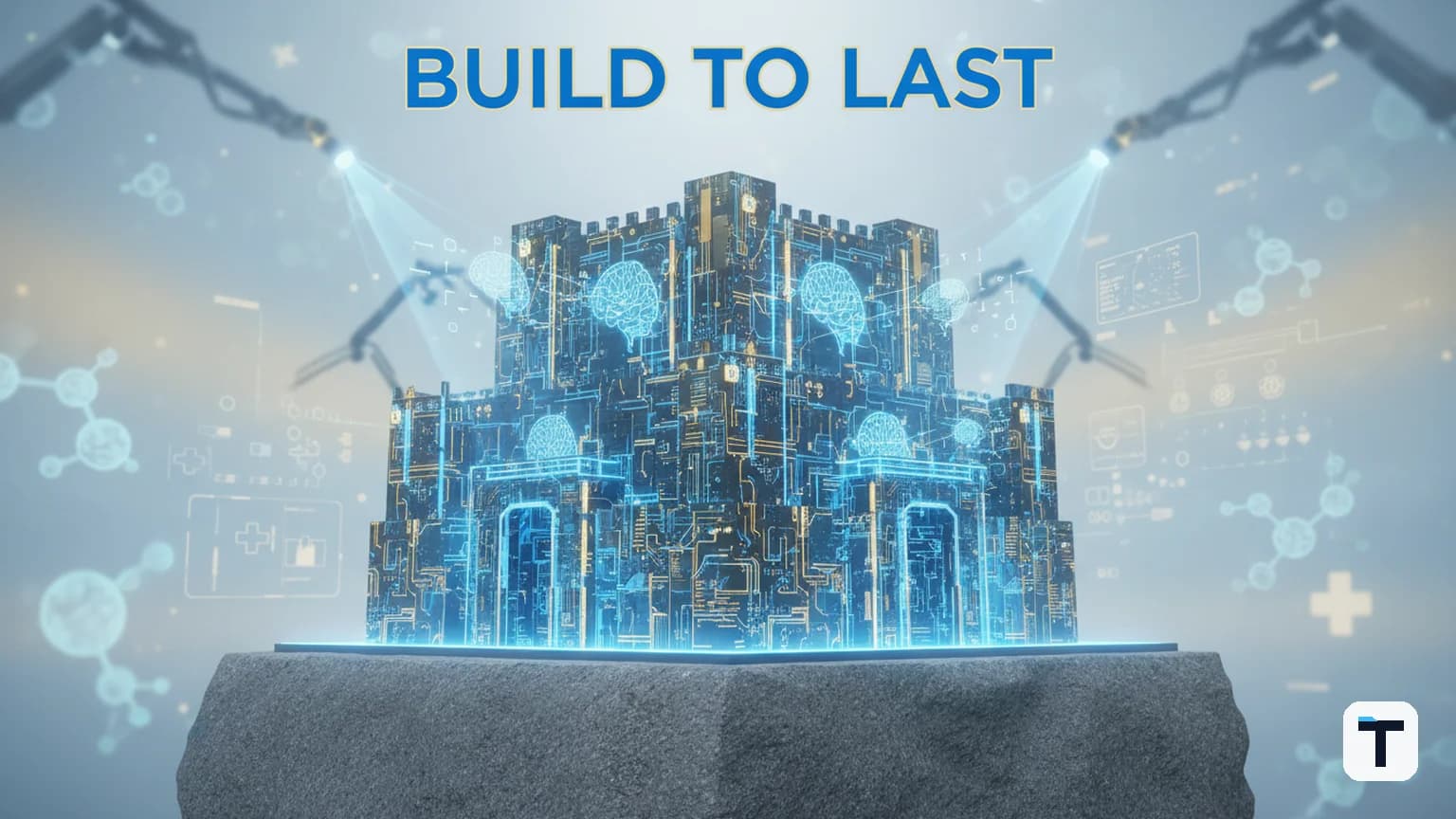

Verdict: To build an AI business that survives the 2026 "agentic transition," you must shift your focus from niches to structural durability. By applying the filters of Phase (workflow vs. hype), Power (structural moats), and Permanence (solving "Lindy" problems), you can build a company that compounds value as models improve, rather than becoming redundant with the next update.
Last verified: 2026-06-20 · Key filters: Phase, Power, Permanence · Best for: Founders, Solo-builders, Agency owners.
Why will most AI businesses fail by 2028?
The "AI wash-out" is a predictable cycle, not a freak accident. According to research by Carlota Perez in Technological Revolutions and Financial Capital, every major technology shift—from steam to the internet—moves through two distinct periods: Installation and Deployment.
We are currently transitioning into the Deployment phase of AI.
- Installation (Hype Phase): Capital floods in, valuations explode, and "rappers" (thin layers on top of models) proliferate. Most of these die when the underlying model updates.
- Deployment (Workflow Phase): Durable businesses get built here. They don't just "use" AI; they embed it into someone's daily infrastructure.
If your tool is a "nice-to-have" feature that summarizes documents, you are building for the installation phase. If your AI agent lives inside a law firm's proprietary workflow and handles junior associate tasks, you are building for deployment. Deployment businesses are model-agnostic; if a better model comes out, your business only gets stronger.
How do you build a structural moat for an AI business?
"Niche" is not a moat. In 2026, a structural advantage is something a competitor cannot replicate just by hiring more people or using a faster API. Hamilton Helmer, author of 7 Powers, identifies three critical "powers" for modern AI builders:
- Switching Costs: Once a customer’s proprietary data and custom agent memories live in your platform, the cost of "ripping and replacing" becomes prohibitive.
- Process Power: This is your proprietary "recipe." It’s a tested, multi-step agentic workflow that produces a measurable result competitors can't match, even if they see the output.
- Cornered Resources: This could be exclusive access to a specific industry's labeled data or a trusted distribution channel (like Nykaa's 2026 partnership with OpenAI).
Q: Can a "wrapper" ever have power? A: Only if it moves faster than the model owners to capture Switching Costs via deep workflow integration before the feature becomes native to the LLM.
Is the problem you are solving "Lindy"?
The Lindy Effect, popularized by Nassim Taleb, suggests that the longer a non-perishable thing has existed, the longer it is likely to continue existing. Apply this to the problems you solve.
If you are solving a problem that was a pain point in 1985—like bookkeeping, HVAC scheduling, or lead follow-up—it will almost certainly be a problem in 2045. AI simply changes how you solve it. If you are solving a problem created by the internet (like "AI-generated spam detection"), your business is inherently more fragile.
What this means for you
Stop chasing the newest model features and start looking for "boring" problems with high switching costs. The goal in 2026 is to build Agentic Infrastructure.
- Audit your idea: Does it pass the Phase, Power, and Permanence filters?
- Embed, don't just assist: Aim to be harder to remove than a full-time employee.
- Own the data loop: Use no-code AI automation to capture workflow data that others can't see.
Related reading
FAQ
Q: Is it too late to start an AI business in 2026? A: No. We are entering the "Deployment" phase where real, durable value is created. The "Installation" hype is ending, which actually makes it easier for serious builders to find talent and focus.
Q: What is the most common mistake for new AI founders? A: Building a feature that model owners (Google, OpenAI, Anthropic) can and will ship natively within 12 months.
Q: Does "Process Power" require a large team? A: No. Many automated AI workflows are built by solo founders who have mastered a specific industry's workflow "recipe."
Q: How do I choose between two durable ideas? A: Pick the one where you have a Cornered Resource, such as a deeper understanding of the niche or an existing audience.
Discussion
0 comments