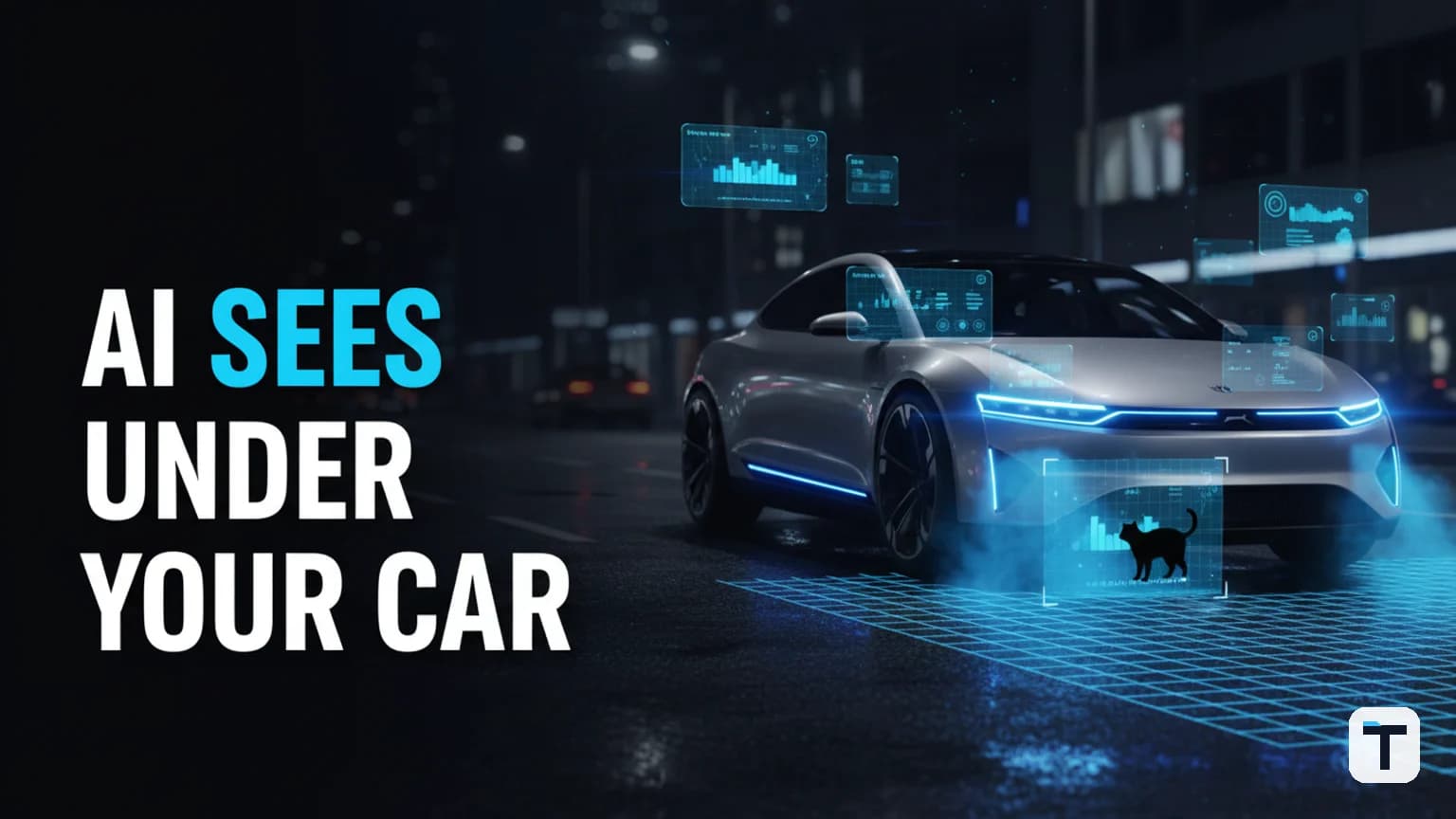

Verdict: BYD has filed a patent (CN122200729A, published June 12, 2026 by China's National Intellectual Property Administration) for an AI-powered underbody vision system that photographs the ground beneath your car when you park, then compares that baseline image to a new one before you drive away — flagging any person, pet, or animal that may have crawled underneath while the vehicle was stationary. It's a genuinely novel approach to a blind spot that almost no car on the road today addresses, and it pairs with a separate radar-based cabin-occupant patent to cover both sides of a deadly problem.
- BYD patent CN122200729A published June 12, 2026 by CNIPA — underbody living-organism detection via baseline image comparison
- Two-stage architecture: (1) change detection from reference, (2) AI classification of what changed
- Companion patent uses radar for forgotten cabin occupants — children or pets left inside
- U.S. frontover incidents kill ~366 and injure ~15,000 per year (NHTSA, 2018); hot-car deaths average 37/year (NoHeatStroke.org)
- Patent publication ≠ production — signals intent, not a shipping feature
What Problem Does an Underbody Camera Actually Solve?
The space directly underneath a parked vehicle is one of the last true blind spots in automotive safety. Standard backup cameras show what's behind you. Surround-view systems show the perimeter. But neither can see someone lying flat beneath your battery pack, axle, or floor pan — exactly where a child playing hide-and-seek, a cat seeking engine warmth, or a person resting against a wheel might end up.
According to Kids and Car Safety, frontover incidents — where a driver slowly moves forward and strikes someone they cannot see — are responsible for approximately 366 deaths and 15,000 injuries per year in the United States alone (NHTSA, April 2018 report, DOT HS 812515). About 75% of frontovers involve larger vehicles (trucks, vans, SUVs), and 93% of victims are age 6 or under. In 61% of known cases, the driver is a parent or someone who knows the child. The front blind zone of a large SUV can extend up to 15 feet from the bumper — meaning a toddler standing directly in front of the vehicle is completely invisible to the driver.
BYD's patent targets the underneath dimension of this same problem: not the front blind zone, but the underbody blind zone that no existing camera system covers.
How Does BYD's Underbody Detection System Work?
The system uses a two-stage detection pipeline described in patent application CN122200729A, titled "Method for Detecting Living Organisms Under a Vehicle, Computer Program Product, Electronic Device, and Vehicle." Here's how it works step by step:
Step 1: Capture a Baseline Image When Parked
When the vehicle is powered down and parked, an underbody camera captures a reference image of the ground beneath the car. This image is stored in memory as the "clean" state — no people, no pets, no unexpected objects. This is essentially a custom environmental map for each specific vehicle at each specific parking location.
Step 2: Compare a Fresh Image Before Driving
Before the vehicle moves, the system snaps a new image of the underbody and compares it against the stored baseline. Instead of analyzing every pixel of the entire underbody in real time (which is computationally expensive and error-prone), the system first identifies only the regions that differ between the two images. Static components — suspension parts, battery enclosures, aerodynamic panels, structural members — remain unchanged between scans and are simply ignored.
Step 3: AI Classification of Changed Regions
Only the changed regions are passed to a recognition algorithm that extracts visual features and determines whether the change represents:
- A person (e.g., a child who crawled under the car)
- An animal (e.g., a cat seeking shade or warmth)
- Debris or environmental noise (e.g., wind-blown leaves, dirt, shifting shadows)
This two-stage architecture is the key innovation. By filtering out unchanged regions first and running classification only on the deltas, the system concentrates computational resources where they matter and dramatically reduces false positives from environmental noise — the exact weakness that plagues conventional motion-detection systems deployed in messy underbody environments.
Why the Underbody Is Uniquely Hard for Computer Vision
The space beneath a vehicle is a brutal environment for any camera system:
| Challenge | Why It Matters |
|---|---|
| Variable lighting | Underbody goes from bright sunlight to deep shadow depending on sun angle and parking location |
| Dirt and grime | Road debris accumulates on lenses and surfaces, degrading image quality |
| Changing ground surfaces | Concrete, asphalt, gravel, grass, dirt — the background is never consistent |
| Shadows from moving parts | Suspension components, exhaust, and underbody panels cast shifting shadows as light changes |
| Weather exposure | Rain, snow, and condensation affect camera performance |
BYD's baseline-comparison approach sidesteps these challenges by creating a personalized reference for each parked vehicle. Rather than trying to detect living organisms from scratch against an unknown background, the system only needs to answer: what changed since I parked here?
What Is the Companion Radar Patent for Cabin Occupants?
BYD filed a separate patent — titled "Method for Detecting Occupants Left in a Vehicle" — that uses radar to detect children or pets accidentally left inside the cabin. The system obtains radar channel impulse responses, then extracts frequency-domain features and angle-of-arrival data to determine whether any occupants remain inside the vehicle after the driver has left.
Together, the two patents cover both ends of the same deadly problem:
| Patent | What It Detects | Where | Technology |
|---|---|---|---|
| CN122200729A (underbody) | People, pets, animals | Under the parked vehicle | Camera + baseline image comparison + AI classification |
| Cabin occupant detection | Children, pets left behind | Inside the cabin | Radar channel impulse response + frequency analysis + angle-of-arrival |
The cabin-side problem is severe in its own right. According to NHTSA and NoHeatStroke.org, more than 1,000 children have died from pediatric vehicular heatstroke (PVH) in the U.S. since 1998 — an average of 37 per year. In 2024, 39 children died; in 2025, 33. In more than half of all cases (52.9%), the child was forgotten by a parent or caregiver. A radar system that detects a remaining occupant and alerts the driver could prevent a significant portion of these tragedies — a concern that extends to how AI tools are increasingly used to safeguard children, as we explored in our Meta StoryKit AI bedtime stories review.
How Does This Fit Into BYD's Broader Sensor Strategy?
BYD is not building these systems in isolation. The underbody and cabin-occupant patents are pieces of a much larger sensing ecosystem that the company has been assembling around its vehicles through its DiPilot advanced driver assistance system (ADAS), marketed as God's Eye.
God's Eye ships in three hardware tiers:
| Tier | Name | Sensors | Models | Compute |
|---|---|---|---|---|
| DiPilot 100 | God's Eye C | 12 cameras, 5 mm-wave radars, 12 ultrasonic — no LiDAR | Seagull, Dolphin, Seal, Song, Han (entry) | 100 TOPS |
| DiPilot 300 | God's Eye B | Adds 1 LiDAR unit | Denza models, higher BYD trims | 300 TOPS |
| DiPilot 600 | God's Eye A | 3 ultra-long-range LiDARs + cameras + radars | Yangwang U8, U9, U7 | 600 TOPS |
BYD stated in February 2024 that it had more than 90,000 R&D engineers and had filed more than 48,000 patents worldwide, with over 30,000 granted. Industry tracking pegs BYD's current filing rate at 30–45 new patents per day in China. The company has said that over 3 million vehicles were running God's Eye as of May 2026 across 60+ models spanning its BYD, Denza, Fang Cheng Bao, and Yangwang brands. This scale of AI deployment across a vehicle fleet makes BYD's sensor strategy worth watching — and as we've seen with AI slop detection across platforms, the sheer volume of AI-generated output (whether content or sensor data) raises both capability and trust questions.
The underbody patent fits naturally into this sensor-fusion architecture. A car that already has 12 cameras, 5 radars, and 12 ultrasonic sensors for driving assistance can plausibly add an underbody camera as one more perception input — feeding into the same compute pipeline that already handles parking, lane-keeping, and obstacle avoidance.
Has Any Other Automaker Done Something Similar?
Most existing under-vehicle safety approaches are mechanical or proximity-based — not vision-based. Some commercial fleet operators and parking facilities use ground-mounted sensors or pressure mats. A handful of aftermarket products add under-vehicle cameras for inspection purposes (primarily for security checkpoints, not daily parking safety).
What makes BYD's approach different is the baseline-image comparison method. Instead of trying to train a model to recognize "person under car" in an unconstrained environment, BYD creates a custom reference for each parking event and detects changes from that reference. This is methodologically closer to security-camera change detection than to object classification — and it sidesteps the fundamental challenge of training a classifier to work across the wildly variable underbody environment.
No major Western automaker (Tesla, Ford, GM, Stellantis) has filed a comparable patent for underbody living-organism detection as of July 2026, based on public patent databases. Tesla's Sentry Mode and camera suite focus on the vehicle's exterior perimeter and cabin, not the underbody — though the broader question of how autonomous systems and AI agents interact with the physical world is one we've covered in the defender playbook for autonomous AI agent attacks, which examines the security implications of AI systems acting on sensor-fed decisions without human verification.
Is This Technology Available in Cars Today?
No. Patent publication does not equal production deployment. A published patent application signals that a company is researching and protecting a specific technical approach — not that the feature will ship in any particular model or timeline.
As of July 2026, BYD has not announced which vehicles (if any) will receive underbody detection, when it might ship, or whether it will be included in any God's Eye tier. The same caveat applies to the companion cabin-occupant radar patent.
However, BYD's track record of moving patents to production is strong — the company has moved from ADAS concept to standard equipment across 60+ models in roughly 18 months. If the underbody system does ship, it would most plausibly appear first on higher-tier Yangwang or Denza models (which have the most compute headroom and sensor density) before cascading to mass-market BYD vehicles.
What Does This Mean for Vehicle Owners and Parents?
| If You Are... | What This Means |
|---|---|
| A parent of young children | This patent signals a future where cars may automatically check underneath before you drive — protecting toddlers who crawl under vehicles seeking shade or while playing |
| A pet owner | Animals (especially cats) frequently seek warmth under engines and shade beneath vehicles; an AI underbody check could prevent accidental injuries |
| A fleet operator | Commercial vehicles in dense urban environments could benefit most — delivery vans and trucks have the largest underbody blind zones |
| An automotive engineer | The baseline-comparison technique is transferable to other structured-imaging problems with noisy, variable backgrounds |
| A BYD vehicle owner | Nothing changes today; this is a patent, not a shipping feature. Watch for God's Eye update announcements. |
Practical Steps You Can Take Right Now
Since this technology is not yet available, here's what works today — based on guidance from NHTSA and Kids and Car Safety:
The Circle of Safety walk-around. Before you start your car, walk all the way around it — especially if it has been parked for more than a few minutes. Look under, in front, and behind. This takes 10 seconds and is the single most effective prevention habit.
Check the back seat every time. Place a purse, briefcase, or phone in the back seat so you're forced to look there before you lock up. Over 50% of pediatric vehicular heatstroke deaths happen because a parent forgot the child was in the back.
Never let children play in or around parked cars. Teach kids from a young age that the driveway and parking area are for vehicles, not play.
Lock your car at home. Children can climb into unlocked vehicles and become trapped. Over 230 children have died from vehicular heatstroke since 1998 because they gained access to an unlocked vehicle on their own.
If you see a child alone in a vehicle, call 911 immediately. A child's body temperature rises three to five times faster than an adult's, and heatstroke can begin at a core body temperature of 104°F — death occurs at 107°F.
What This Means for You
BYD's underbody AI patent is a signal that automotive safety is expanding past the cabin and the visible perimeter into genuinely overlooked spaces. If — and when — this technology reaches production, it could close one of the last remaining blind spots in vehicle safety, particularly for families with young children and pet owners in urban environments. But a patent is a promise of intent, not a product. Until then, the 10-second walk-around remains the most effective safety feature available — and it's free.
FAQ
Q: What is BYD's underbody AI camera patent?
A: BYD filed patent CN122200729A (published June 12, 2026 by China's National Intellectual Property Administration) for a system that captures a reference image of the ground beneath a parked vehicle, then compares a fresh image before driving and uses AI to classify any changes as a person, animal, or debris.
Q: How does the two-stage detection system work?
A: Stage 1 compares a real-time underbody image against a stored baseline from when the car was parked, identifying only the regions that changed. Stage 2 applies AI classification exclusively to those changed regions to determine whether the change represents a living organism or environmental noise like leaves, shadows, or dirt.
Q: Is this technology available in cars you can buy today?
A: No. As of July 2026, BYD has not announced production plans for the underbody detection system. A published patent signals research intent, not a shipping feature. BYD has not stated which models would receive it or on what timeline.
Q: What is the companion radar patent for the cabin?
A: BYD also filed a separate patent for radar-based detection of occupants (children or pets) accidentally left inside a vehicle. It uses radar channel impulse responses, frequency-domain features, and angle-of-arrival analysis to identify forgotten occupants — addressing the hot-car death problem, which kills an average of 37 children per year in the U.S.
Q: How common are under-vehicle and frontover accidents?
A: Frontover incidents cause approximately 366 deaths and 15,000 injuries per year in the United States (NHTSA, 2018). About 93% of frontover victims are age 6 or under, and 75% involve larger vehicles like SUVs and trucks. No comprehensive statistics exist specifically for under-vehicle incidents, but the underbody blind zone is a recognized category of risk.
Q: Which BYD vehicles have underbody cameras?
A: None currently. The patent was published on June 12, 2026, but BYD has not announced which models — if any — will receive the system. If it does ship, it would most plausibly appear first on Yangwang or Denza models with the highest sensor density and compute capacity (DiPilot 300 or DiPilot 600 tiers).
Discussion
0 comments