
Why traditional tone prompting fails on "Turn 21"
The "Turn 21" problem occurs when a user asks a question you didn't anticipate. At this point, the model has no specific example to follow. Because the instructions are lumped together, the model prioritizes being helpful or confident over being brand-compliant. It produces a response that is technically correct but "socially catastrophic"—offering a refund it isn't authorized to give, or pretending it has a physical body when it doesn't.
To solve this, you must stop treating AI as a programmable robot and start managing it like a brilliant intern with high IQ but zero EQ. You don't just give them a handbook; you build a structure that checks their work before it reaches the customer.
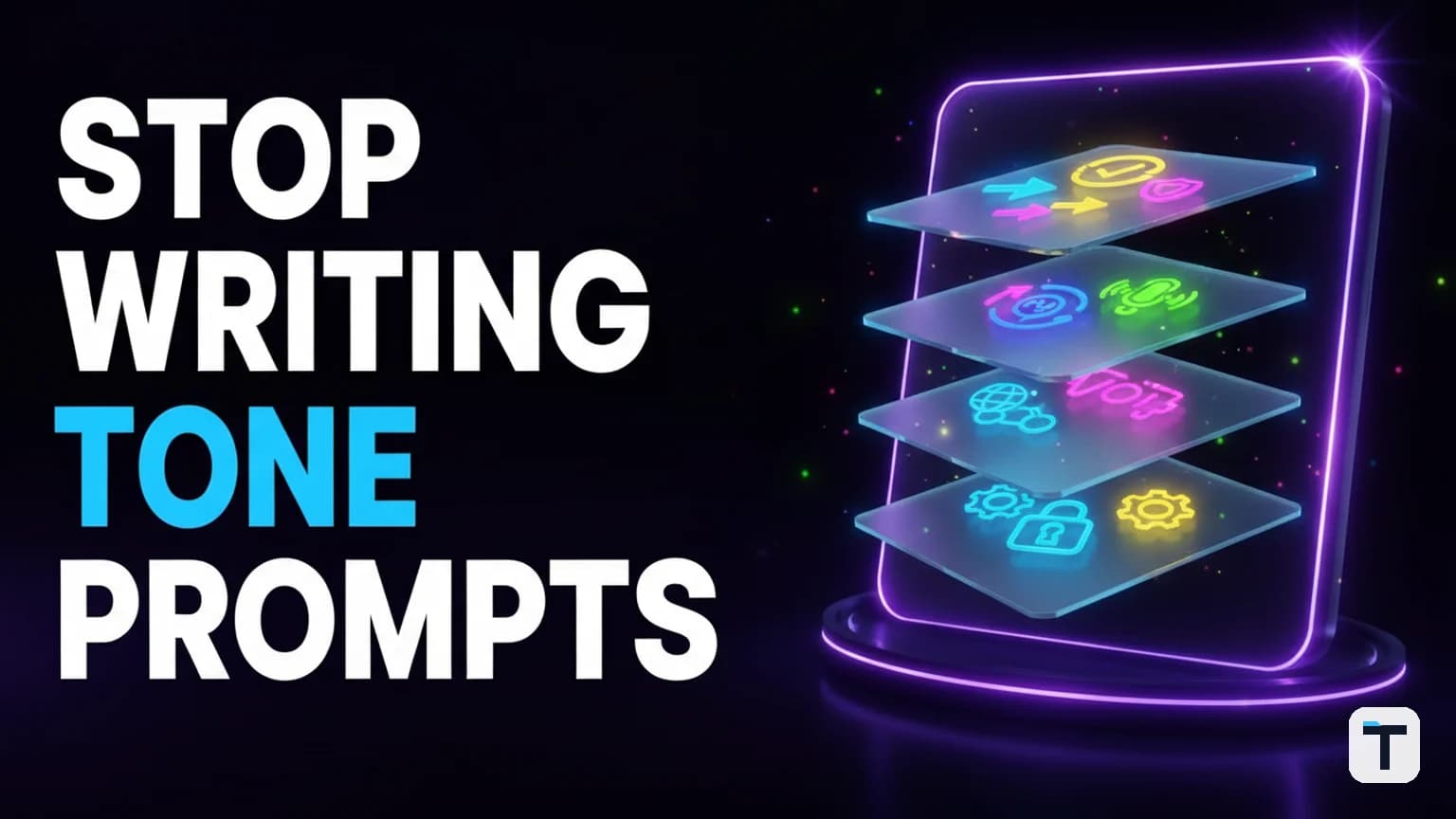
The 4-Layer Prompt Architecture
The 2026 standard for reliable AI voice is a layered stack where order is load-bearing. Constraints must be loaded before preferences, and validation must happen after generation.
Layer 1: Immutable Identity (The Constraints)
This layer contains the rules that are true regardless of the situation. These are not preferences; they are hard boundaries that the AI structurally cannot cross.
- Examples: "I am an AI, not a human," "I cannot physically meet you," or "Never use the word 'guaranteed' for delivery dates."
- Why it works: By placing these at the top of the stack, they anchor the model's identity before it starts trying to be "warm" or "expressive."
Layer 2: Situational Mode (The Read)
This layer adjusts the prompt based on real-time signals: who the user is and what they are currently experiencing.
- Role-based: Is this a VIP customer or a new lead?
- Soft Context: If the system knows a user is dealing with a delayed shipment or a personal crisis, Layer 2 injects "patience" and "gentleness" into the instructions.
- Internal Link: This works best when paired with a permanent AI agent memory system.
Layer 3: Example-Anchored Voice (The Expression)
This is where most teams start and stop. It includes your tone dials (e.g., Professional: 8/10, Warmth: 6/10) and a list of "phrase samples."
- The Flaw: This layer is probabilistic. It tells the model what "good" looks like, but it cannot guarantee that the model won't hallucinate a fact to maintain its confident tone.
Layer 4: The Post-Generation Veto (The Permission)
The most critical layer isn't a prompt at all—it's Systems Engineering. Layer 4 is a deterministic check that reads the output before it ships.
- The Honesty Inspector: A script (regex or a small, fast classifier) that checks for forbidden words, privacy violations, or "hallucinated numbers."
- Hard Reject: If the AI offers a Saturday tour but the calendar shows Saturday is booked, Layer 4 rejects the output and triggers a retry or a human handoff.
| Layer | Type | Responsibility | Tooling |
|---|---|---|---|
| 1. Identity | Instruction | Hard Constraints | System Prompt (Top) |
| 2. Mode | Instruction | Contextual Read | RAG / Dynamic Injection |
| 3. Voice | Instruction | Style & Tone | Few-Shot / Dials |
| 4. Veto | Permission | Deterministic Check | Guardrails AI / Regex |
How to implement the stack in your business
If you are building autonomous AI agents, you cannot rely on a single system prompt. Follow these steps to audit your current setup:
- Extract your "Must Nevers": Identify 3-5 things your AI should never say (e.g., offering discounts, claiming human status). Move these to a "Layer 1" block.
- Separate Context from Tone: Ensure your user data (Layer 2) is injected before your voice examples (Layer 3). Models commit to the first framing they read.
- Build a "Permission Gate": Implement a basic output filter. If you are using Python, tools like
InstructororGuardrails AIcan enforce schema and value checks. - Adopt a "Veto-First" mindset: In reliable agentic systems, the prompt is a request, but the Veto is the permission. Never ship a response that hasn't passed Layer 4.
What this means for you
For the small business owner, the 4-Layer Stack turns your AI from a liability into a brand asset. It allows you to deliver high-touch service at scale without the fear of a "Turn 21" disaster. If your brand voice is your product, you cannot afford to leave it to probability.
FAQ
Q: Is the Layer 4 Veto just another prompt? A: No. Ideally, it is a deterministic check (like a regular expression or a database look-up). While you can use a "critic" LLM as a soft flag, a hard veto should be based on real data (e.g., "Does this date exist in my calendar?").
Q: Does this make the AI slower? A: Layer 4 adds a small amount of latency (milliseconds for regex, more for a critic LLM), but it prevents the "48-hour disappointment" caused by correcting a hallucinated promise later.
Q: Can one architecture serve multiple brands? A: Yes. By using the Log as the System pattern, you can keep Layer 1 identical across your business while swapping Layers 2 and 3 for different sub-brands or departments.
Q: Why does Layer 1 have to be at the top? A: LLMs exhibit "primacy bias"—they weigh instructions at the beginning of a prompt more heavily. Constraints belong at the top to ensure they anchor everything that follows.
Every claim here is traced to a primary source, dated, and listed under Sources. Research and drafting are AI-assisted; editing, verification and publication are human decisions, and a person is accountable for what appears on this page. How we work →






Discussion
0 comments