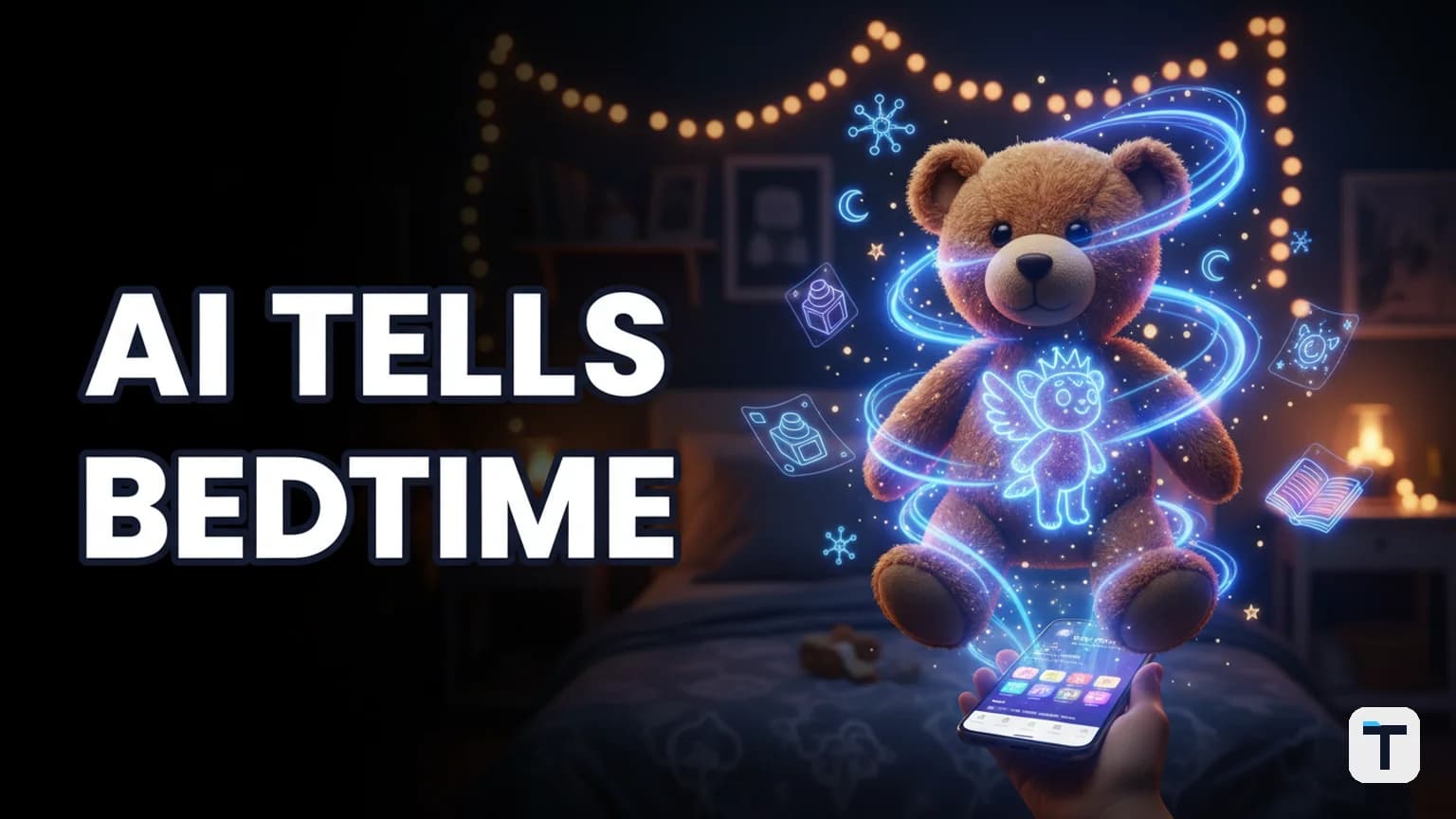

Verdict: AI-generated bedtime stories for children are a legitimate convenience tool for exhausted parents, but the decision isn't about whether the technology works — it's about which parts of parenting you're comfortable automating. Meta's StoryKit, powered by the Muse Spark model from Meta Superintelligence Labs, generates illustrated, narrated, and scored children's stories from a photo of a toy, a setting, and a moral lesson. It is currently in a limited pilot in Mexico (TechCrunch, July 21, 2026). The app works. The real question is whether the convenience of instant, personalized stories is worth trading the imaginative bond you build with your child at bedtime — and what happens to the photos you upload to get there.
Last verified: 2026-07-29 · Meta StoryKit: pilot in Mexico, iOS only · Powered by Muse Spark (not "Mu Spark" — the transcript got the name wrong) · Free during pilot, no pricing announced · 18+ accounts only, no social features · App Store privacy label confirms collection of user content (photos), contacts, usage data, and identifiers · COPPA's amended rules (effective April 22, 2026) require separate parental consent before children's data is used for AI training
What is Meta StoryKit and how does it work?
StoryKit is an AI storytelling app from Meta that creates personalized children's stories from three parental inputs: a character (described or photographed), a setting (e.g., an enchanted forest or distant galaxy), and a moral lesson (kindness, courage, empathy). The app generates a full storybook with illustrations, narration, and an original musical score — in four output formats: a swipeable picture book, a screen-free audiobook, a read-aloud text mode, and a printable PDF (9to5Mac, July 21, 2026).
The App Store listing is blunt: "You don't need to write a single word." Meta confirmed to TechCrunch that the app is in a limited pilot in select countries — specifically, Mexico's App Store — with no announced timeline for wider rollout. A Meta spokesperson said StoryKit includes AI safety filters, has no social features, and is restricted to users 18 and older (TechCrunch).
What model runs StoryKit?
StoryKit is powered by Muse Spark, the first model from Meta Superintelligence Labs (MSL), the division led by Chief AI Officer Alexandr Wang. Meta announced Muse Spark on April 8, 2026, as a natively multimodal reasoning model with tool-use, visual chain of thought, and multi-agent orchestration capability (Meta's official announcement, April 8, 2026). Muse Spark replaced the Llama model series as Meta's primary consumer AI model in early 2026 and now powers features across WhatsApp, Instagram, Facebook, Messenger, and Ray-Ban Meta AI glasses.
Correction note: Several early reports mistranscribed the model name as "Mu Spark." The correct name is "Muse Spark," confirmed by Meta's own press materials and the Meta AI developer portal (developer.meta.com/ai/models/muse-spark).
How the three-step creation flow works
- Character — You create a character from scratch or photograph your child's favorite toy or person. Meta's AI transforms the photo into an illustrated storybook hero.
- Setting — You describe the world: an enchanted forest, an underwater kingdom, a distant planet.
- Lesson — You pick a value — kindness, courage, empathy — and the app weaves it into the story without "feeling like a lecture."
The output includes illustrations, narration, and original music in every format. The whole process takes minutes, and the app sends a push notification when the story is ready (9to5Mac; TechCrunch).
What are the privacy implications of uploading your child's photo to an AI storytelling app?
This is the most important question, and it's the one Meta has not answered publicly. The App Store privacy label for StoryKit confirms the app collects "user content" (photos and videos), "contact info" (names, email addresses), "identifiers" (device IDs), and "usage data" (app analytics and diagnostics) — all linked to your identity, not anonymized (Apple App Store listing, via 9to5Mac).
The listing does not explain:
- How long uploaded photos are retained
- Whether photos are used to train Meta's AI models
- Whether images of children's faces or toys are stored after the story is generated
- What data deletion options exist for parents
This is not speculation about a hypothetical risk. In July 2026, Meta removed a feature from Instagram that let users generate AI images from public Instagram posts after backlash over privacy concerns (9to5Mac). StoryKit asks parents to upload photos of a more sensitive category than a post: children's toys, children's faces, and family members.
What COPPA's 2026 amendments change
On April 22, 2026, amended COPPA (Children's Online Privacy Protection Act) rules went into effect, requiring separate verifiable parental consent before children's personal data can be used for AI model training (TrustArc, 2026 regulatory guide; ratedwithai.com COPPA guide, 2026).
The amended rules now cover:
- Voice recordings and voice prints
- AI-generated avatars derived from children's images
- Prompts, personalization data, and chat logs used for model improvement
- A requirement for algorithmic transparency from developers who market to families
StoryKit sidesteps some of this because it restricts the app to adults 18 and older — the parent is the user, not the child. But the content generated from uploaded photos is aimed at children, and COPPA's definition of "personal data" extends to photos that identify a child. The gap between "the app is for adults" and "the content is for children" is exactly where regulatory and parental questions live. For a deeper dive into how these rules apply to AI tools more broadly, see our guide on redacting sensitive data before sending it to AI.
How does StoryKit compare to other AI storytelling apps?
Meta's StoryKit is a new entry in a crowded field. Here's how it stacks up against established alternatives, based on publicly available information as of July 2026:
| Feature | Meta StoryKit | Established Storytelling Apps |
|---|---|---|
| Platform | iOS only (Mexico pilot) | iOS, Android, Web |
| AI model | Muse Spark (Meta proprietary) | Varies (OpenAI, custom models) |
| Character creation | Photo of toy/person + AI illustration | Text prompts or template characters |
| Output formats | Picture book, audiobook, read-aloud, printable PDF | Varies by app (typically 1-2 formats) |
| Music/Score | Original musical score included | Rarely included; most use stock audio |
| Pricing | Free during pilot (no long-term pricing announced) | $5-$20/month subscription typically |
| Safety features | AI safety filters, 18+ account gate, no social features | Varied — COPPA compliance varies widely |
| Privacy | Collects photos, contacts, identifiers, usage data (per App Store label) | Varies — few publish comprehensive privacy policies |
| Continuity (story continuity across nights) | Not confirmed in pilot | Some apps (e.g., Tucknightly) offer recurring companion characters |
What Meta gets right: The four-format output (picture book, audiobook, read-aloud, printable PDF) is notably richer than most competitors. The audioobook and read-aloud formats are screen-free — meaning a parent can generate a story and tell it themselves. That is a meaningful design choice that respects the parent's role as storyteller. And the printable PDF creates a physical artifact, not just another screen experience.
What Meta will not tell you: The privacy architecture of how photos are handled, whether images train the model, and what deletion controls exist — none of this appears in the App Store listing or the company's public comments. For parents, this is the due-diligence gap that matters more than the story quality.
Is automating bedtime stories good for your child? What the debate is really about
The debate is not about technology. It is about which parts of parenting you are comfortable outsourcing to a machine.
On one side: many exhausted parents run out of new bedtime stories long before their children run out of demand for them. A tool that generates something fresh and personalized in seconds solves an actual nightly problem. The children's bedtime ritual is, for many families, a source of stress rather than wonder — not because parents don't care, but because they are tired, working, and depleted. For them, a tool that produces a gentle story with a moral lesson and original music is a real liberation.
On the other side: critics — including TechCrunch's headline calling it "an AI bedtime story app for people with no imagination" — argue that the improvised bedtime tale is one of the oldest and cheapest of human rituals. No parent needs software to invent a story about a turtle and a hedgehog on a space adventure. The act of inventing the story together in the dark is the point: it is how children learn that adults are paying attention to their ideas, how parents discover what their child is thinking about, and how imagination is co-constructed between parent and child.
The actual battleground, as 9to5Mac's Zac Hall put it, is that StoryKit "sounds like a perfectly reasonable app that would be well-received if it were from almost anyone but Meta" (9to5Mac). Parents already read their children stories written by strangers — that is what a bookshelf is. The concern is less about story quality and more about the company behind the app, and specifically about whether uploading your child's photo to Meta's servers is a trade you want to make.
The framework we'd use: three questions before automating anything at bedtime
- Does the automation replace connection or does it enable it? If the AI app means you still read, but from a generated story, that is connection enabled. If the AI app means you skip bedtime entirely, that is connection replaced.
- Do you control the output? StoryKit's "read-aloud" format hands the text to the parent to tell. The audiobook format does not. Which you choose determines whether the app is a tool or a replacement.
- What happens to the data afterward? If the app collects photos of your child and you cannot verify how they are stored, used, or deleted, the convenience does not justify the risk. The same principles apply to whether you blindly trust AI outputs in other contexts — our analysis of the AI guardrail asymmetry problem explores how even safety systems fail when users don't understand the trade-offs.
What this means for you
If you are a parent, a builder, or someone deciding whether to bring AI tools into family routines:
For parents: StoryKit is not available outside Mexico yet, and the privacy questions are more important than the story quality. If it becomes available in your country, ask three questions before downloading: Can you opt out of model training? Can you permanently delete uploaded photos? Is there a children's privacy policy, or just a general one? If the answer to any of those is "no" or "we don't know," skip it. For now, read your children a book — or make up a story about a turtle and a hedgehog. It costs nothing.
For builders and small businesses: The signal from StoryKit is how Meta is packaging generative AI — not as a chatbot but as a family ritual tool. Personalized, template-driven content generation (character + setting + lesson → a complete artifact) is a product pattern that works beyond children's stories. If you build tools for any audience, think about how to apply that three-input framework: user picks A, user picks B, user picks a value, and the system generates a complete, personalized output. But build the privacy architecture first, not last. For more on building privacy-focused AI products, see how offline grammar checkers never see your data as a model.
For anyone concerned about AI slop and quality: The fact that StoryKit produces original music, multiple output formats, and moral lessons woven into narrative raises the bar for what "AI-generated content" means. It also raises the stakes of detection. Our deep dive on the AI slop problem covers how to spot low-quality AI content across platforms — the same discernment applies when evaluating whether a tool like StoryKit produces stories worth telling.
FAQ
Q: Is Meta StoryKit available in the US or UK? A: No. As of July 2026, StoryKit is only available on Apple's App Store in Mexico. Meta confirmed to TechCrunch that it is a limited pilot in select countries, with no announced timeline for wider availability (TechCrunch, July 21, 2026).
Q: What AI model powers StoryKit? A: StoryKit runs on Muse Spark, the first model from Meta Superintelligence Labs, launched April 8, 2026. Muse Spark is a natively multimodal reasoning model that replaced the Llama series as Meta's primary consumer AI model. Some early reports incorrectly transcribed the name as "Mu Spark" — the correct name is "Muse Spark" (Meta official announcement).
Q: Does StoryKit use my child's photos to train Meta's AI? A: Meta has not publicly stated whether uploaded photos are used for AI model training. The App Store privacy label confirms the app collects user content (photos and videos), contacts, identifiers, and usage data, all linked to your identity. This is the most important unanswered question for parents, and it is one to verify before the app launches in your region.
Q: Can children download and use StoryKit? A: No. StoryKit is restricted to users 18 and older. A Meta spokesperson confirmed the app includes AI safety filters, has no social features, and is positioned as a tool for parents, not an app designed for children to use independently (TechCrunch).
Q: Is StoryKit free? A: StoryKit is free during the pilot in Mexico. No pricing has been announced for broader availability. Meta has not disclosed any subscription, freemium, or one-time purchase model.
Q: What does COPPA say about AI storytelling apps for children? A: Amended COPPA rules effective April 22, 2026 require separate verifiable parental consent before children's personal data — including voice recordings, AI-generated avatars, and personalization data — is used for AI model training. StoryKit sidesteps some COPPA provisions by restricting the app to adults, but the content is designed for children, creating a regulatory gray area (TrustArc regulatory guide).
Q: Should I worry about AI-generated content quality in bedtime stories? A: StoryKit's story quality cannot be independently verified during its Mexico-only pilot. The broader concern is not about story quality but about whether AI-generated stories, even good ones, replace the co-creative bond of inventing stories together. The "read-aloud" format — which gives the parent the full text to read — is the most connection-preserving option in StoryKit. The audiobook format, where the AI narrates, is the most replacement-oriented.
Discussion
0 comments