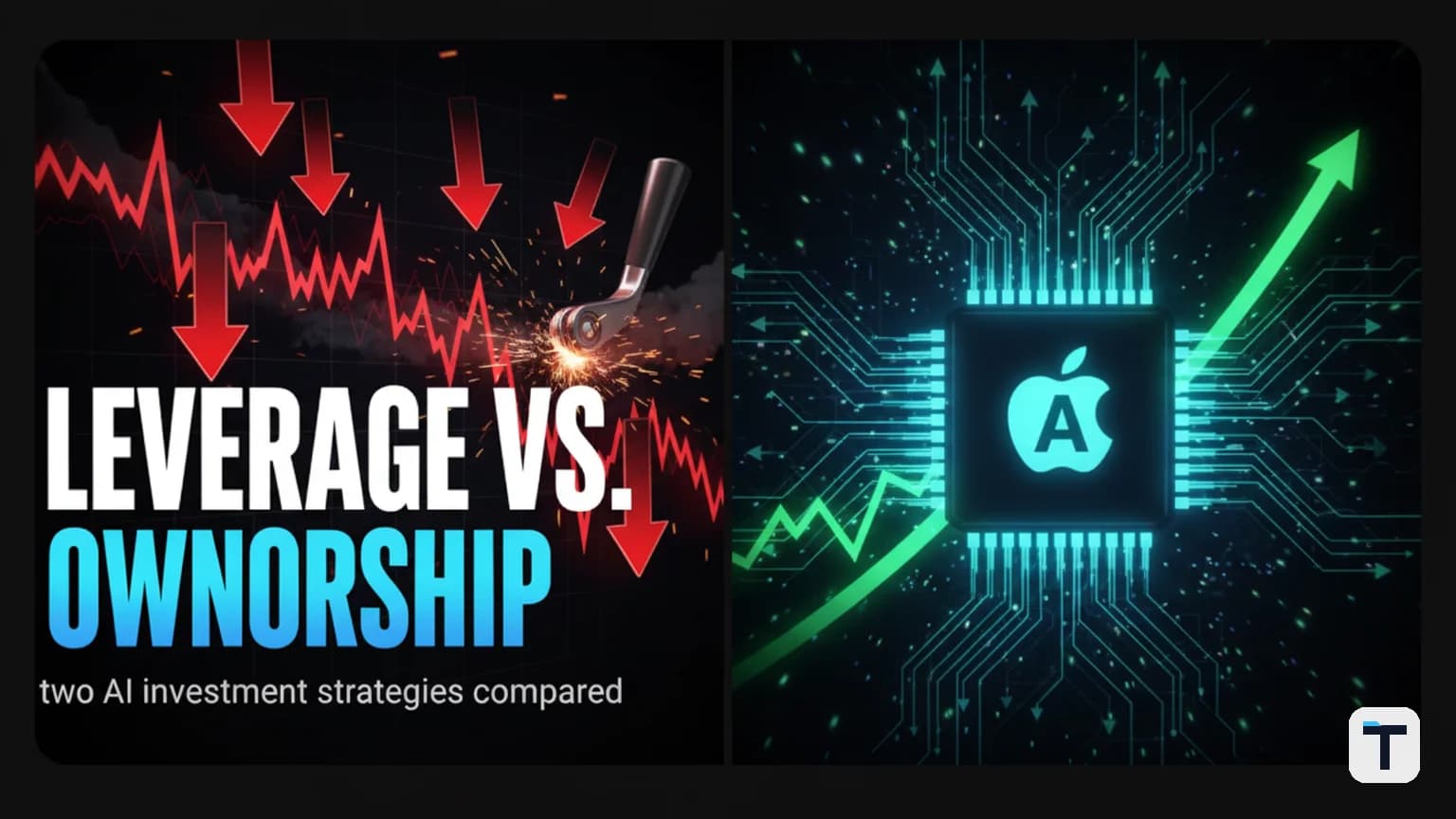

The two most instructive AI strategy stories of 2026 are not about models or benchmarks — they are about how you position yourself to capture value from AI over time. One approach used leverage and a compute-thesis to produce 2,000%+ returns before a margin call unraveled it in days. The other owns the silicon layer that every AI workload runs on and thinks in 20-year horizons. Both can teach you something about how to think about your own position in the AI economy, whether you are an investor, a builder, or a small business owner deciding where to spend your technology budget.
Last verified: 2026-08-03 — Key facts in this article (fund performance, leverage ratios, Apple's Gemini deal, SK Hynix IPO) are volatile and were checked against primary sources on this date.
TL;DR:
- Leopold Aschenbrenner's Situational Awareness LP returned roughly +2,065% in 2025 and was up over +400% through June 2026 before a July selloff triggered margin calls and a forced sale of its public equities book to Citadel.
- Apple spends only $13–14 billion annually on AI capex (vs. rivals' $650B+ combined) yet owns the silicon that every on-device AI workload depends on — a position it built over 15 years and reinforced by appointing hardware chief John Ternus as CEO.
- The lesson for builders and businesses: owning a layer of the stack beats renting exposure to it, and time horizon determines how much leverage you can safely carry.
What Happened to the Situational Awareness Fund in July 2026?
Leopold Aschenbrenner's hedge fund, Situational Awareness LP, collapsed from approximately $45 billion in assets to roughly $10 billion in a matter of days in late July 2026, after prime brokers Goldman Sachs and JPMorgan Chase issued margin calls against its leveraged AI infrastructure positions. The fund, which had produced a reported +2,065% return in 2025 and was up over +400% after fees through June 2026, was forced into a fire sale of its publicly traded holdings, which Citadel purchased in their entirety.
The fund's core thesis was that you could predict the AI supply chain by reasoning backward from compute requirements — investing in the infrastructure bottlenecks rather than the headline AI names. Its 13F filings showed positions in AI infrastructure companies including CoreWeave, Nebius Group, and Bloom Energy, alongside an $8.46 billion semiconductor put options book. Approximately two-thirds of the portfolio was in public equities, with the remaining third in private stakes, including a multibillion-dollar position in Anthropic.
The strategy worked extraordinarily well — until it didn't. Here's what went wrong.
How Does Leverage Amplify Both Gains and Losses in AI Investing?
Leverage — borrowing money to invest — magnifies returns in both directions. When AI infrastructure stocks rise, a leveraged fund outpaces the market by multiples. When those same stocks decline, the fund's equity shrinks faster, and prime brokers issue margin calls demanding additional collateral to maintain existing borrowing levels.
Situational Awareness LP reportedly employed leverage ratios of up to 400%, meaning for every dollar of investor capital, the fund borrowed four more. This is not unusual on Wall Street — many hedge funds use leverage — but it becomes dangerous when combined with concentrated, theme-specific positions that all move in the same direction during a sector-wide selloff.
The July 2026 trigger sequence:
SK Hynix IPO pressure (July 10, 2026): SK Hynix, the world's dominant HBM supplier with ~50% market share, completed the largest U.S. listing by a foreign company — a $26.5 billion ADR offering on Nasdaq under the ticker SKHY at $149/share. After opening at $170 (up 14%), it sagged, putting early pressure on AI memory and semiconductor names.
Broad AI stock selloff (mid-to-late July): Oracle and AMD each declined approximately 20%. Nebius, Bloom Energy, and CoreWeave experienced sharper drops. Asian AI markets were weak.
Citadel's Fed rate note (late July): Citadel released an investor note suggesting the Federal Reserve might raise rates, making capital more expensive. This is standard analyst commentary — completely legal and routine — but it added selling pressure to already-weak AI stocks.
Margin calls cascade (July 24–31): Prime brokers at Goldman Sachs and JPMorgan Chase mandated additional collateral. With 400% leverage and falling positions, Situational Awareness was forced to sell assets into a declining market — the classic forced-selling feedback loop that amplifies drawdowns rather than absorbing them.
Citadel acquires the public book (July 31): Citadel, led by Ken Griffin, purchased Situational Awareness's entire public equities portfolio. From Citadel's perspective, they entered high-conviction AI positions at a discount, and the market's confidence in Citadel's reputation reportedly generated $3–4 billion in gains on the day the acquisition was announced. The fund's private investments, including the Anthropic stake, remain under Aschenbrenner's management.
What Is Situational Awareness LP's Investment Thesis?
The fund's name comes from Aschenbrenner's June 2024 essay, "Situational Awareness: The Decade Ahead," which argued that AGI could arrive by 2027–2028 and that the entire industrial base of the Western economy would restructure to support it. The essay outlined a "Counting the OOMs" (orders of magnitude) framework across three vectors: compute, algorithmic efficiency, and "unhobbling" (reducing constraints on model deployment).
The financial expression of this thesis was to invest in the bottlenecks, not the headlines. Instead of buying obvious names like Nvidia or Microsoft, the fund concentrated capital on:
- Power generation (Bloom Energy — fuel cells for AI data centers)
- AI memory/storage (SanDisk, SK Hynix — NAND flash and HBM)
- GPU cloud infrastructure (CoreWeave, Nebius)
- AI compute bottlenecks via put options on semiconductor ETFs and individual chip stocks
This is a legitimate framework — identifying where the constraint binds and investing accordingly. The problem was not the thesis. The problem was that the thesis was combined with extreme leverage, and the public equities portion of the portfolio was subject to short-term market volatility that private holdings are insulated from.
How Does Apple's AI Strategy Differ From a Hedge Fund Approach?
Apple's approach to AI is the opposite of a leveraged, short-term trade. It is a 20-year hardware and silicon strategy that positions the company as the default infrastructure layer for on-device AI inference — no matter which AI model wins the foundation model race.
Here is the core difference made concrete:
| Dimension | Situational Awareness LP (Leverage) | Apple (Long-Horizon Hardware) |
|---|---|---|
| Time horizon | Months to 1–2 years | 20–30 years |
| Investment method | Leveraged public + private equities | Custom silicon, ecosystem lock-in |
| Annual AI spend | Fund AUM swings with positions | $13–14B capex (2026) vs. rivals' $650B+ |
| What it owns | Exposure to infrastructure stocks | The chips that run every inference |
| Risk mechanism | Margin calls, forced selling | Supply chain, memory pricing |
| Who depends on it | Investors and LPs | Every developer using a Mac for AI |
Apple does not try to build the most powerful foundation model. It does not need to. Every AI model — whether it comes from OpenAI, Anthropic, Google, or the open-source community — ultimately generates tokens on hardware. Apple owns the most efficient consumer hardware for that generation.
Why Is Apple's Silicon Strategy Called the "Default Winner" Position?
Apple's M-series chips (currently the M5 generation, shipping since October 2025) are unusually well-suited for local AI inference — running models directly on the device rather than in the cloud. The M5's Fusion Architecture embeds Neural Accelerators directly into each GPU core, delivering 153 GB/s memory bandwidth and enabling 70-billion-parameter models to run locally on a MacBook Pro at interactive speeds.
This matters because it makes Apple infrastructure, not just a product company. Startups across Silicon Valley use Macs as their primary AI development machines. Developers are running 70B and even 120B parameter models locally on Apple Silicon, often offline and without cloud API costs. When you own the hardware that runs the inference, you win regardless of which software model sits on top.
Apple reinforced this strategic direction in April 2026 by appointing John Ternus — a 25-year Apple veteran and Senior VP of Hardware Engineering who oversaw the transition to Apple Silicon — as its next CEO, effective September 1, 2026. Ternus replaces Tim Cook, who transitions to executive chairman. The message from the board: Apple's future runs through its chips.
Can Apple Afford to Underinvest in Foundation Models?
Apple's 2026 AI capital expenditure of $13–14 billion is modest compared to the combined $650B+ spend from Microsoft, Google, Meta, Amazon, and xAI. Critics call this underinvestment. Apple calls it a calculated hedge.
Instead of training frontier models from scratch, Apple licenses them. In January 2026, Apple and Google announced a multi-year partnership valued at approximately $1 billion per year (estimated by Bloomberg's Mark Gurman), making Google's Gemini the foundation for a rebuilt Siri and Apple Intelligence features. The deal is non-exclusive — Apple retains the right to integrate models from other providers, including the existing ChatGPT integration.
But the deeper layer of the deal is what Apple does with the models it licenses. Apple has negotiated the right to run Gemini inside its own data centers and to use knowledge distillation — a technique where a large "teacher" model's outputs become training data for a smaller, faster "student" model. The student model inherits the teacher's capabilities on targeted tasks while being small enough to run entirely on-device, with no cloud round-trip and no per-token API cost.
This is the strategy: let Google and OpenAI spend billions training enormous models. Apple distills their intelligence into compact models that run on its own silicon, offline, privately, and for free. The $1 billion annual Gemini licensing fee is rounding error against Apple's $100B+ services business.
What Does the Aschenbrenner vs. Apple Contrast Teach Builders and Small Businesses?
You do not need to be a hedge fund manager or a trillion-dollar company to apply these lessons. The contrast between leveraged exposure and owned infrastructure maps directly to decisions you make about your own AI stack.
Lesson 1: Own a layer of the stack.
Situational Awareness LP rented exposure to AI infrastructure through leveraged stock positions. If the stocks fell, the exposure evaporated. Apple owns the silicon layer. If any model wins, Apple benefits because the model runs on Apple chips.
For a small business, this means: do not build your entire AI capability on a rented API where the provider can change pricing, deprecate features, or rate-limit you overnight. If you are using AI as load-bearing infrastructure, you need to own something — whether that is fine-tuned local models running on your own hardware, your own data pipelines, or proprietary workflows that compound value regardless of which API provider you use.
Lesson 2: Your time horizon determines how much risk you can carry.
Aschenbrenner's thesis may still prove correct — AGI by 2027, massive re-pricing of AI infrastructure. But with 400% leverage, he could not survive the short-term volatility to find out. Apple thinks in 20-year horizons, which means it can absorb years of being called "behind on AI" while it builds a position that compounds.
For builders: if your AI strategy depends on a specific model maintaining its current pricing or capability lead for the next 6 months, you are carrying the equivalent of leveraged risk. Extend your time horizon by building modular, model-agnostic architectures that can swap providers without breaking your product.
Lesson 3: Leverage is not just financial — it is architectural.
A fund uses financial leverage (borrowed capital). A software team uses architectural leverage (dependency on a single provider, a single model, a single framework). Both amplify gains and both create existential risk when the thing you are leveraged against moves against you.
The developer who builds exclusively on one cloud API is making the same bet as a fund with 400% leverage on one sector — just in a different domain. The mitigation is the same: diversify your dependencies, keep optionality, and ensure your core value is in the layer you control.
What This Means for You
If you are building with AI in 2026, ask yourself the question that these two strategies answer differently: are you renting exposure to AI, or are you owning a position in it?
If you are a developer, owning means investing in local inference capability (models that run on your own machine), proprietary data pipelines, and frameworks that survive provider changes. For a practical framework on how to do this at scale, see our guide to scaling forward-deployed engineering with AI agents.
If you are a small business, owning means building AI workflows that capture institutional knowledge — customer patterns, operational rhythms, domain expertise — rather than depending on a generic cloud service that any competitor can also rent. Our AI follow-up system guide for small businesses shows this pattern in action.
If you are making technology investments, the contrast between a 400%-leverage fund that collapsed in days and a $4T hardware company that thinks in decades is a reminder that the most durable AI positions are the ones where you own the layer that does not change every quarter.
If you are evaluating AI strategies for your team or company, the developer skills gap in 2026 is partly an AI investment strategy question: the builders who own systems thinking thrive, while those who only rent AI tooling get displaced when the tools change.
Will Aschenbrenner's Thesis Still Prove Correct?
This is the hardest part of the story: both strategies can be right. Aschenbrenner's AGI-by-2027 thesis may prove correct AND his fund may still have been the wrong vehicle to express it, because leverage made the trade's survival conditional on short-term market liquidity. Apple's on-device-silicon thesis may prove correct AND Apple may still be undermonetizing its position by not fully realizing how impactful AI will be across its customer base.
Jim Cramer of CNBC called the Situational Awareness collapse "a clearing event" — potentially signaling a bottom for the AI trade. Aschenbrenner himself, in a July 24 investor letter, framed the drawdown as "the best buying opportunity since early 2025" and pointed to a potential Anthropic IPO as the next catalyst. He is still managing billions in private startup investments.
The long race is not over. The lesson is that being right about the direction of AI and being positioned to survive the volatility of getting there are two different things — and the second one matters more.
FAQ
Q: What was the Situational Awareness LP hedge fund? A: Situational Awareness LP was a hedge fund founded by Leopold Aschenbrenner, a former OpenAI researcher, that launched in late 2024. Its investment thesis was that you could predict the AI supply chain by reasoning backward from compute requirements, investing in infrastructure bottlenecks (power, memory, GPU cloud) rather than headline AI names. It grew from $254 million to over $20 billion in AUM before collapsing in July 2026.
Q: How much leverage did the Situational Awareness fund use? A: Reports indicate the fund employed leverage ratios of up to 400%, meaning for every dollar of investor capital, it borrowed four more to amplify its bets. When AI infrastructure stocks declined in July 2026, this leverage caused the fund's equity to shrink rapidly, triggering margin calls from prime brokers Goldman Sachs and JPMorgan Chase.
Q: What did Citadel buy from Situational Awareness? A: Citadel, led by Ken Griffin, purchased Situational Awareness LP's entire publicly traded equities portfolio in late July 2026 after margin calls forced a distressed sale. This gave Citadel entry into high-conviction AI positions at a discount. Aschenbrenner retains management of the fund's private investments, including its stake in Anthropic.
Q: How does Apple's AI spending compare to other big tech companies? A: Apple planned $13–14 billion in AI-related capital expenditure for 2026, while the combined spend from Microsoft, Google, Meta, Amazon, and xAI exceeds $650 billion. Apple's strategy is to spend less on training frontier models and more on owning the silicon that runs inference: the M5 chip, the Neural Engine, and the unified memory architecture that enables on-device AI.
Q: Why is Apple's on-device AI strategy considered a "default winner" position? A: Apple owns the most efficient consumer hardware for AI inference — the M-series chips. Every AI model, regardless of who trained it, ultimately generates tokens on hardware. By owning the silicon that runs the inference and controlling the ecosystem that delivers it, Apple wins no matter which foundation model lab (OpenAI, Google, Anthropic, or open-source) produces the best model.
Q: What is knowledge distillation and why does it matter for Apple's strategy? A: Knowledge distillation is a machine learning technique where a large "teacher" model generates high-quality outputs that become training data for a smaller "student" model. The student inherits the teacher's capabilities on targeted tasks while being small enough to run on-device. Apple uses this to distill Google Gemini's intelligence into compact models that run locally on Apple Silicon — no cloud round-trip, no per-token cost, full privacy.
Discussion
0 comments