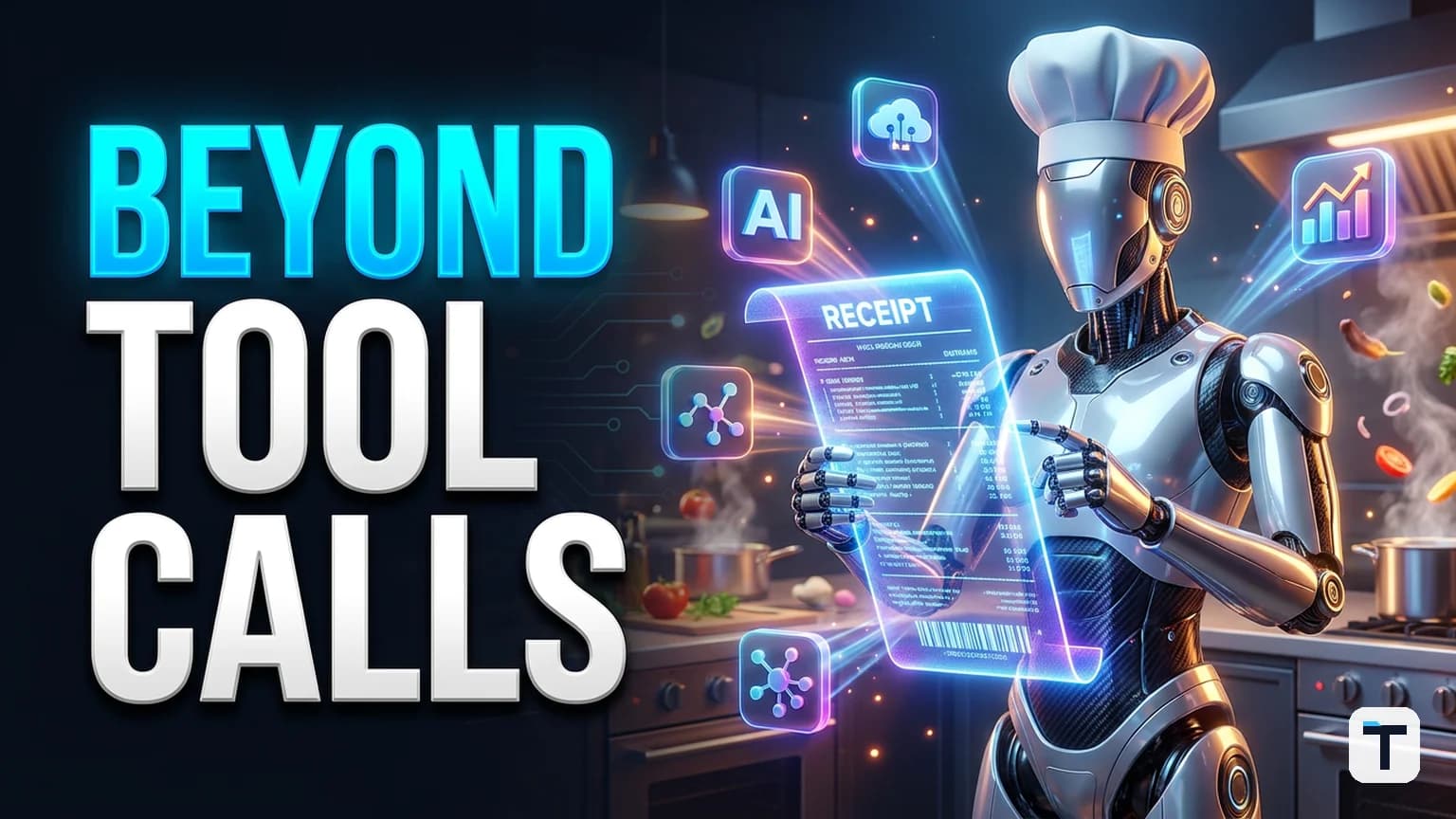

Verdict: For AI agents to move from local "tool-calling" to a global "agentic economy," we must standardize the verifiable receipt, not just the integration. While the Model Context Protocol (MCP) solves how agents talk to tools, the Froglet Protocol solves how agents trust, transact, and prove execution across organizational boundaries.
Last verified: 2026-07-20
Key Insight: Local tool-calling is "cooking alone"; true agentic collaboration is "running a Michelin-star restaurant" with an external supply chain.
Core Solution: Cryptographically signed receipt chains (offer -> quote -> deal -> receipt) that make cheating more expensive than honesty.
The Michelin-Star Problem: Why Tool-Calling Alone Fails
In 2025, the focus was on giving agents more tools. We saw the rise of the Model Context Protocol (MCP) and various harness engineering frameworks. These are excellent for "local" efficiency—improving how one agent works in its own kitchen.
However, complex work (like scientific research or enterprise supply chains) isn't a solo act. It relies on a distributed network of specialized providers, data silos, and external services.
If you give a cook a better knife, they work faster. But a Michelin-star restaurant depends on the supply chain: the quality of ingredients from external vendors, the verifiable record of delivery, and the ability to scale quality across boundaries. Today’s AI agents are great cooks with better knives, but they lack the "delivery receipts" needed to trust an external supplier.
What is the Froglet Protocol?
The Froglet Protocol is an open-source (Apache-2.0) middleware layer designed for the AI agent economy. It isn't another agent or a simple marketplace; it is a set of rules for how agents discover, transact with, and receive proof from other agents.
The Three Pillars of Agentic Commerce
- Identity: Every actor in the network runs a homogeneous node with a unique cryptographic key pair for signing.
- Execution: Work is requested and executed directly between requester and provider, removing the need for a central middleman once discovery is complete.
- Settlement: Every step—from the initial service descriptor to the final result—is signed and chained. This creates a verifiable receipt that proves the work happened as agreed.
| Feature | Local Tool-Calling (MCP) | Agentic Commerce (Froglet) |
|---|---|---|
| Trust Model | Assumed (Internal) | Cryptographic (Cross-Org) |
| Scope | Single Environment | Distributed Supply Chain |
| Budgeting | Tokens per Task | Real Budgets for Services |
| Evidence | Logs (Mutable) | Signed Receipts (Immutable) |
From Token Budgets to Service Budgets
We are moving beyond simple "token limits." In a mature agentic workflow, organizations will allocate financial budgets to their agents.
Imagine an "Executive Chef" agent. It doesn't just call a search_database tool. It:
- Discovers a specialized data provider in the marketplace.
- Negotiates a deal (Offer -> Quote).
- Pays for the work using standardized rails (like Lightning or Stripe).
- Verifies the result against a cryptographically signed receipt.
This allows agents to manage their own "kitchen," hiring external "suppliers" for data, compute, or specialized analysis in minutes rather than months of enterprise legal review.
Trust through Math: The Game Theory of Receipts
How do you prevent a provider from taking the money and returning a fake result? Froglet uses a simple game-theory threshold: Stake / Deal Value > 2.0.
- Honest Move: Provider signs the deal, executes correctly, and receives the fee. Their stake remains intact.
- Cheating Move: Provider returns a bad result. The requester publishes the signed deal and the mismatched result. The provider's stake is slashed and their identity is "burned."
By making the cost of cheating (the stake) twice as high as the potential profit (the deal), the protocol ensures that honesty is the most profitable path.
What This Means for You
For small business owners and developers, this represents a massive reduction in "collaboration friction." Today, a cross-organizational project can cost millions in legal fees and take years to set up. With a verifiable receipt protocol, an agent can discover a resource, verify its terms, and receive proof of work in minutes for a few thousand tokens.
If you are building your own Agentic OS, you need to look beyond the prompt. You need to architect for accountability.
Q: Is Froglet a new type of AI model? A: No. It is a protocol/interface that sits between agents, payment rails (like Lightning), and execution environments. It works with existing models like Claude, GPT-4o, and Llama 3.
Q: Why do I need receipts if I have logs? A: Logs are local and can be edited. A verifiable receipt is cryptographically signed by the provider and chained to the original offer, making it tamper-evident and usable as proof in a cross-organizational setting.
Q: Does this replace the Model Context Protocol (MCP)? A: No. MCP is great for local tool-to-agent communication. Froglet sits "above" MCP, handling the discovery and transaction layers when those tools live in different organizations.
Q: What payment methods are supported? A: Currently, the protocol integrates with Lightning (Bolt11), Stripe (test/staging), and x402 (standardized HTTP 402 payments).
Q: Is there a cost to using the protocol? A: The protocol itself is Apache-2.0 open source. Costs are determined by the providers in the marketplace and the transaction fees of the chosen payment rail.
Discussion
0 comments