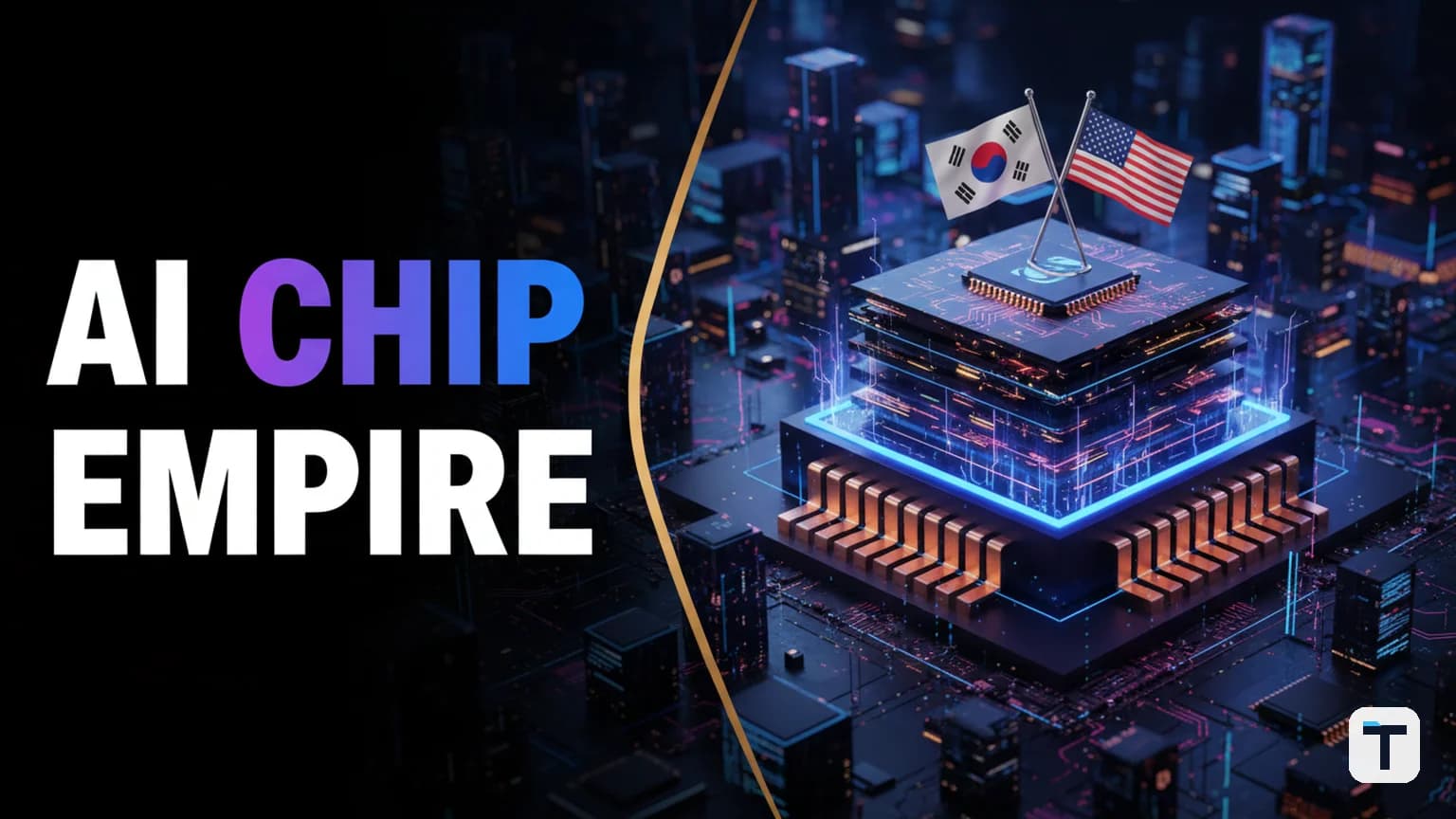

Verdict: South Korea has staked nearly $1 trillion on becoming the indispensable hardware backbone of the global AI economy — and the bet is already paying off. In July 2026, President Lee Jae-myung brokered $950 billion in deals pairing Korean semiconductor giants Samsung Electronics and SK Group with Nvidia, Broadcom, OpenAI, and Anthropic. The agreements lock in memory supply, foundry capacity, and advanced packaging for the next five years — guaranteeing that Korean fabs run at full capacity while the rest of the world scrambles for access to the chips that make AI possible.
Last verified: 2026-07-30
- South Korea announced $950B in AI deals at a San Francisco summit on July 24–25, 2026 (Reuters, Nvidia press release)
- SK Group signed $750B including a $500B+ partnership with Nvidia for AI factories and HBM4 memory
- Samsung signed a $200B MOU with Broadcom covering HBM4/HBM4E, sub-2nm foundry, and advanced packaging through 2030
- This sits on top of Lee's June 2026 domestic plan: $576B for semiconductor clusters, physical AI, and data centers
- The deals are letters of intent / MOUs — not yet binding contracts — so figures represent ceilings, not committed spend
Why Is South Korea Betting $950 Billion on AI Hardware?
South Korea is betting nearly $1 trillion because it has identified a once-in-a-generation opportunity: the global AI chip shortage has made Korean memory and foundry capacity existentially valuable, and locking in long-term agreements now guarantees decades of full-capacity production while shutting out competitors. The deal-making is statecraft as much as corporate strategy — President Lee personally hosted an AI summit in San Francisco on July 24, 2026, bringing together Jensen Huang (Nvidia), Sam Altman (OpenAI), and Dario Amodei (Anthropic) alongside Samsung chairman Lee Jae-yong and SK Group chairman Chey Tae-won to sign the package of agreements (Source: Yonhap News, July 25, 2026; Reuters, July 24, 2026).
The shortage driving this is real: SK Group chairman Chey Tae-won said industry leaders including Nvidia, Broadcom, Anthropic, and OpenAI are demanding significantly more memory capacity than anyone originally forecast, and the current supply chain cannot keep up (Source: Reuters via The Edge Malaysia, July 30, 2026). Samsung and SK Hynix together control an estimated 80–90% of global high-bandwidth memory (HBM) production — the critical component inside every AI accelerator (Source: Straits Times, July 3, 2026). When the world needs more AI memory, it needs Korea.
The July summit deals layer on top of Lee's earlier domestic strategy. In June 2026, he unveiled a $576 billion national plan anchored by Samsung and SK Hynix to build semiconductor fabrication clusters, physical AI ecosystems, and AI data centers in South Korea's southwest — a deliberate push to decentralize tech industry beyond the Seoul metro area (Source: Reuters, June 29, 2026; Rappler, June 29, 2026). Combined, the domestic and international commitments exceed $1.5 trillion when fully realized.
What Are the Major Deals and Who Signed Them?
The $950 billion package breaks down into three major agreements, each covering a different layer of the AI chip supply chain:
| Deal | Partners | Value | Scope | Timeframe | Status |
|---|---|---|---|---|---|
| AI factories + memory | SK Group ↔ Nvidia | $500B+ | 2GW AI data center, HBM4 co-development | 2027 first phase | Letters of intent |
| Foundry + memory + packaging | Samsung ↔ Broadcom | $200B | HBM4/HBM4E supply, sub-2nm foundry, advanced packaging | Through 2030 | MOU |
| AI memory + ecosystem | Samsung + SK Hynix ↔ OpenAI, Anthropic | Part of $750B SK total | Supply agreements, potential custom chips | Ongoing | Signed deals |
The SK-Nvidia deal ($500B+) is the single largest component. SK Telecom will build a 2-gigawatt "AI factory" in South Korea powered by Nvidia's upcoming VeraRubin DSX computing platform, with the first phase targeted to come online in 2027. Separately, SK Hynix and Nvidia will co-develop next-generation HBM4 high-bandwidth memory — the chips that sit inside AI training accelerators (Source: Nvidia press release, July 24, 2026; Data Center Dynamics, July 27, 2026).
The Samsung-Broadcom deal ($200B) covers supply of next-generation HBM4 and HBM4E memory chips, manufacturing services using Samsung's sub-2-nanometer process at its Pyeongtaek campus, and advanced packaging that integrates memory and logic more tightly for Broadcom's AI accelerators. The MOU runs for five years through 2030 (Source: Reuters, July 25, 2026; Samsung Newsroom, July 2026). For Broadcom — which designs custom AI chips for hyperscalers like Google and Meta — this diversifies its supply chain beyond TSMC, which controls over 90% of leading-edge chip production (Source: The Next Web, July 25, 2026).
The OpenAI and Anthropic agreements are less quantified but strategically significant. OpenAI pressed SK Group for direct chip supplies to handle its massive compute loads. Anthropic — which raised funding in May 2026 at a $965 billion valuation naming Samsung, SK Hynix, and Micron as critical partners — signed supply deals with both Korean chipmakers and is reportedly exploring designing its own chips to diversify its infrastructure (Source: The Edge Malaysia, July 30, 2026).
For a deeper look at the Nvidia-SK component specifically, see our earlier analysis of what that deal means for AI compute costs: NVIDIA's $500 Billion SK Group Deal Explained.
How Does This Fit South Korea's Broader Semiconductor Strategy?
The July summit deals are the international layer of a three-part national strategy that President Lee calls the "triple axis": semiconductors, physical AI, and data centers. The domestic layer was announced on June 29, 2026, when Lee unveiled a $576 billion plan — Samsung and SK Hynix committed 800 trillion won (~$518 billion) to build new fabrication plants in the southwest region, with additional government investment for supporting infrastructure and a chip-packaging cluster near Seoul (Source: Reuters, June 29, 2026). A prior Bloomberg report in late June described an even larger $880 billion orchestration of Samsung and SK Hynix investments over 10 years (Source: Bloomberg, June 28, 2026).
The geographic strategy is deliberate. Existing semiconductor sites around Yongin and Pyeongtaek have reached capacity limits. Lee's plan builds new clusters in Gwangju and South Jeolla province — southwestern regions that are traditional liberal strongholds but also have untapped power and land resources. This is industrial policy targeting both the AI race and regional economic rebalancing.
The third layer is national AI infrastructure: Science Minister Bae Kyung-hoon outlined plans for a 10-gigawatt AI data center network backed by 550 trillion won (~$356 billion) from SK Group, GS Group, and Naver, targeting full deployment by 2035.
What Does South Korea's AI Hardware Dominance Mean for the Global Supply Chain?
The deal package entrenches a division of labor in AI infrastructure: U.S. companies dominate software and chip design (Nvidia's GPUs, OpenAI's models, Broadcom's custom ASICs), while South Korea owns the physical production of the memory and increasingly the foundry and packaging that make those designs real. This is not accidental — Samsung and SK Hynix needed to lock down their status as the indispensable hardware backbone before alternative supply chains (U.S. CHIPS Act fabs, Japanese Rapidus, or Chinese domestic memory) could scale.
The signal to other countries is stark. As one analysis noted, nations without equivalent chip manufacturing or data center infrastructure "may find themselves increasingly dependent on infrastructure built and controlled by others" (Source: NationPress, July 29, 2026). India, for example, is pursuing its own semiconductor push but faces a different trajectory — see our analysis of India's Semiconductor Revolution.
For context on how this fits the broader landscape of AI infrastructure investment and the companies driving it, our breakdown of Jensen Huang's open-weights manifesto covers Nvidia's parallel push to dominate the software side of AI.
Are These Deals Actually Binding?
No — and this is the most important caveat. Both the SK-Nvidia and Samsung-Broadcom agreements are letters of intent (LOIs) and memoranda of understanding (MOUs), not binding contracts. An LOU typically sets out initial terms and is non-binding; the $500 billion and $200 billion figures represent ceilings on the scope of the partnerships rather than confirmed construction budgets (Source: RealtyWire, July 27, 2026; The Next Web, July 25, 2026).
The deals still need:
- Site selection and land acquisition — neither Nvidia's 2GW data center nor Samsung's expanded foundry has a confirmed location
- Construction financing — LOIs must convert to binding agreements with specific capital commitments
- Power and water infrastructure — gigawatt-scale facilities require enormous utility buildouts
- Skilled labor — the southwestern cluster faces questions about whether the talent pool can scale fast enough
The Korean semiconductor industry also faces political criticism domestically. Opposition politicians have questioned whether the southwestern location was chosen for political reasons — the region voted 85% for Lee's party — rather than industrial logic (Source: Straits Times, July 3, 2026). Lee has defended the choice as addressing long-standing economic disparities and leveraging untapped power resources.
How Big Is the AI Chip Shortage Actually?
The shortage driving these deals is quantifiable and severe. South Korea's semiconductor exports hit a record $37.16 billion in May 2026 — a 169.4% year-on-year increase driven by surging memory chip demand (Source: eciks.org, citing Reuters, June 29, 2026). Overall exports jumped 53.2% to $87.75 billion, the fastest growth since January 1984. Samsung posted record quarterly operating profit of 89 trillion won in Q2 2026, driven almost entirely by AI memory demand (Source: The Next Web, July 25, 2026). Samsung and SK Hynix have sold their entire 2026 memory chip production run — the supply is spoken for before it ships.
For businesses and developers who rely on AI compute, this means:
- GPU and accelerator availability will remain tight through at least 2027 as new capacity comes online
- Memory costs will stay elevated; HBM4 supply is the bottleneck constraining how many AI accelerators can be produced
- Self-hosting AI infrastructure will get harder, not easier, for all but the largest players — the chips are going to whoever signs the biggest deals
What Does This Mean for You?
For builders running AI workloads: The Korean chip lock-in means GPU pricing won't ease soon. If you're budgeting for cloud AI compute or on-prem inference, plan for continued scarcity through 2027. Consider optimizing your model usage — our guide to keeping AI agent token costs near zero covers practical strategies for reducing compute dependency.
For investors and analysts: The key indicators to watch are (1) whether LOIs convert to binding contracts with specific site selections, (2) whether Samsung's sub-2nm foundry yields improve enough to deliver on the Broadcom commitment, and (3) whether the southwestern cluster can attract enough skilled labor. The political risk is real — a change in government could slow the regional development push.
For supply chain operators: If your business depends on chips, Korean production capacity is being pre-sold through 2030. Diversifying your supplier base or securing long-term contracts now matters more than ever. The U.S. CHIPS Act, Japan's Rapidus partnership, and India's semiconductor push are all trying to build alternative supply — but none are at Korean scale yet.
For policymakers and economic strategists: South Korea's model — sovereign backing + private investment + international partnerships — is delivering results that pure market approaches are not. The $950B in signed deals in a single week demonstrates that when a nation treats semiconductor capacity as national infrastructure, it can attract commitments that private markets alone would not produce.
FAQ
Q: How much did South Korea invest in AI in total in 2026?
A: South Korea's combined AI investments announced in 2026 exceed $1.5 trillion when fully realized: $950 billion in international deals signed at the July San Francisco summit (SK Group $750B with Nvidia and others; Samsung $200B with Broadcom) plus $576 billion in domestic semiconductor and data center investment announced in June. These are non-binding agreements (LOIs/MOUs), so the figures represent maximum scope, not committed spend.
Q: What is the Nvidia and SK Group $500 billion deal?
A: Nvidia and SK Group signed letters of intent valued at over $500 billion on July 24–25, 2026, covering a 2-gigawatt AI factory to be built by SK Telecom in South Korea using Nvidia's Vera Rubin DSX platform (first phase online 2027) and a joint program with SK Hynix to co-develop next-generation HBM4 high-bandwidth memory for AI training. The figure is a ceiling — site selection, financing, and binding terms are still being negotiated.
Q: What did Samsung agree to with Broadcom?
A: Samsung Electronics signed a $200 billion memorandum of understanding with Broadcom on July 25, 2026, covering supply of HBM4 and HBM4E memory chips, manufacturing using Samsung's sub-2-nanometer foundry process at Pyeongtaek, and advanced packaging for Broadcom's AI accelerators. The MOU runs through 2030 and is a statement of intent, not a binding contract.
Q: Why is South Korea so important in the global AI chip supply chain?
A: Samsung and SK Hynix together control an estimated 80–90% of global high-bandwidth memory (HBM) production — the specialized memory inside every AI accelerator. When global AI demand surges, Korean fabs are the bottleneck. South Korea's semiconductor exports hit a record $37.16 billion in May 2026, up 169.4% year-on-year.
Q: Who attended the South Korea AI summit in San Francisco?
A: President Lee Jae-myung hosted the summit on July 24, 2026. Attendees included Nvidia CEO Jensen Huang, OpenAI CEO Sam Altman, Anthropic CEO Dario Amodei, and Broadcom representatives from the U.S. side, plus Samsung Electronics chairman Lee Jae-yong, SK Group chairman Chey Tae-won, Hyundai Motor Group executive chair Euisun Chung, and Naver founder Lee Hae-jin from Korea.
Q: Will AI chip prices go down because of these deals?
A: Not in the near term. The deals lock in supply through 2030, but the new capacity (including the 2GW AI factory and expanded fabs) won't come online until 2027 at earliest. Samsung and SK Hynix have already sold their entire 2026 memory production. AI compute will remain tight and expensive through at least 2027 as demand continues to outpace new capacity.
Discussion
0 comments