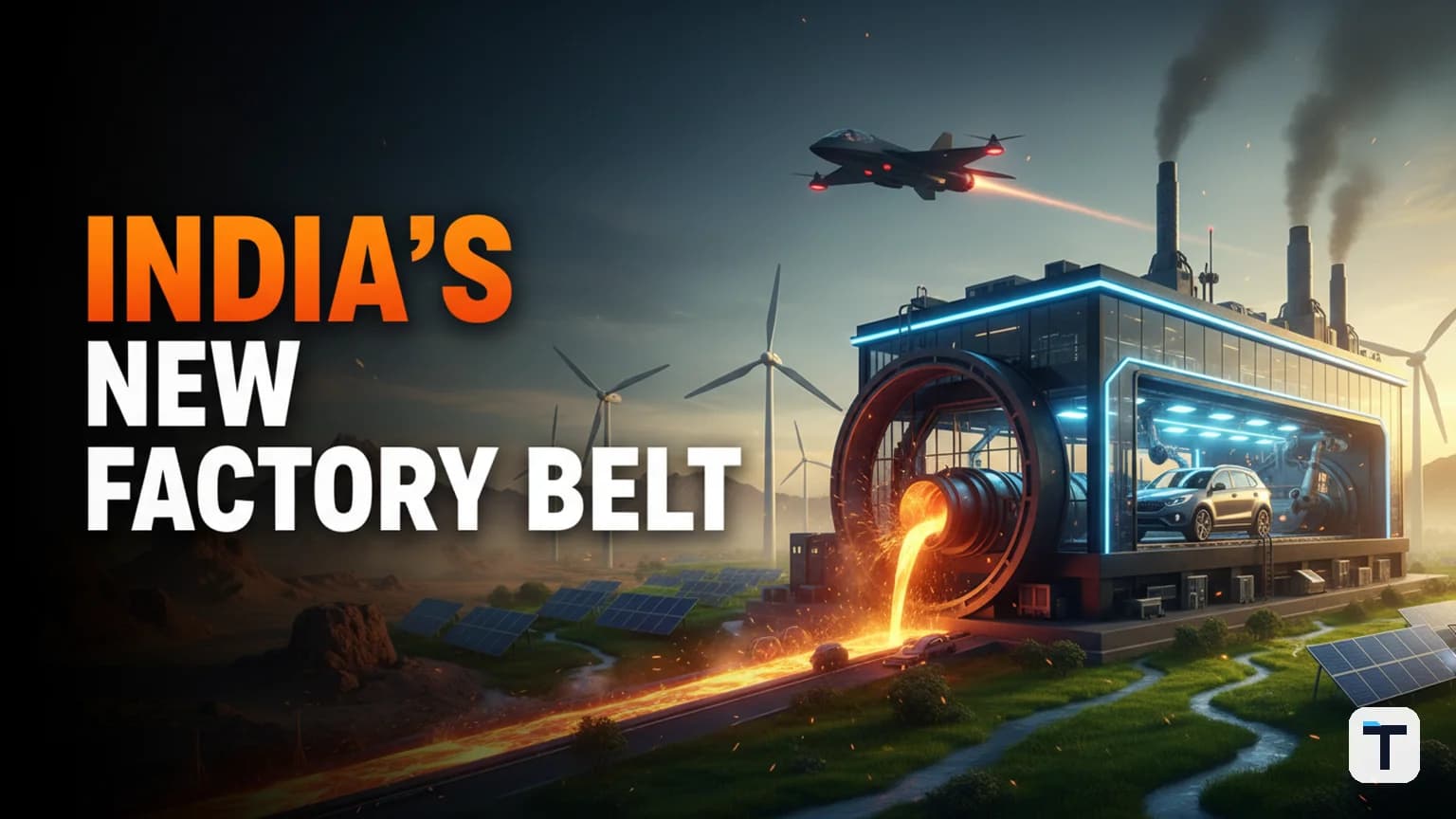

Verdict: Rayalaseema — a rain-shadow region in Andhra Pradesh once synonymous with famine and outward migration — has become one of India's fastest-growing industrial corridors, with 275 projects worth ₹4.58 lakh crore in the pipeline and an estimated 3.57 lakh jobs on the horizon. The transformation is driven by a deliberate "district-cluster" strategy: each of Rayalaseema's eight districts gets a specialised manufacturing identity (steel in Kadapa, defence in Sri Sathya Sai, autos in Anantapur, electronics in Tirupati), anchored by marquee names like Kia, JSW, DRDO, Royal Enfield, and Bharat Forge. The shift from "ease of doing business" to "speed of doing business" — a phrase the state's own Economic Development Board now uses — is the operational engine behind it.
Last verified: 2026-07-31 · Total pipeline: ₹4.58 lakh crore across 275 projects (AP government data) · Key anchors: Kia (₹8,000 crore, Anantapur), JSW Steel (₹16,350 crore, Kadapa), DRDO AMCA complex (Puttaparthi), Royal Enfield (₹2,500 crore, Tirupati) · Jobs projected: ~3.57 lakh · Strategy: District-specific industrial clusters, not scattered incentives.
Investment figures and project statuses change frequently — last checked July 2026.
What Is Driving Rayalaseema's Industrial Transformation?
Rayalaseema's rise is not accidental. It sits in the rain shadow of the Deccan Plateau, missing both the southwest and northeast monsoons, which made it historically one of India's driest, most famine-affected regions. But the same geography gives it a strategic location — equidistant from Bengaluru, Chennai, and Hyderabad — plus abundant mineral resources and large tracts of available land. The Andhra Pradesh government, under Chief Minister N. Chandrababu Naidu, has exploited those advantages through a two-part strategy: (1) specialised industrial clusters assigned district by district, and (2) a shift from "ease of doing business" to "speed of doing business" via the State Investment Promotion Board (SIPB).
According to the Andhra Pradesh Economic Development Board (APEDB), 172 SIPB-approved projects have attracted proposed investments worth ₹4.58 lakh crore with the potential to generate nearly 2.76 lakh jobs. An additional 103 investment proposals signed during the CII Partnership Summit bring the total to 275 projects and over 3.57 lakh projected employment opportunities across the Rayalaseema region.
Which Companies Have Invested in Rayalaseema?
The investment pipeline spans automotive, defence, steel, renewable energy, and electronics. Here is a verified, district-by-district breakdown of the anchor projects:
Anantapur — Automotive and Defence Hub
Kia Motors (now Kia India) was the catalytic investment. In April 2017, Kia signed an MoU with the Andhra Pradesh government to build its first manufacturing plant in India at Anantapur, representing approximately US$1.1 billion (around ₹8,000 crore in combined investment with vendors). Construction began in Q4 2017, trial production started in January 2019, and the 536-acre facility has an installed annual capacity of up to 300,000 units. In January 2026, Kia inaugurated a second 300-acre facility at the same site, adding another 300,000-unit capacity — bringing total Anantapur output to 600,000 vehicles annually. Chief Minister Nara Chandrababu Naidu called it "the largest single foreign investment in the state's history." Approximately 40% of the new facility's output is earmarked for exports to the Middle East, Africa, Latin America, and ASEAN markets.
Tirupati — Electronics, Motorcycles, and Space City
Royal Enfield, owned by Eicher Motors, announced in May 2026 that it will invest ₹2,500 crore in a new greenfield manufacturing facility at Tada in Tirupati district — its first plant outside Tamil Nadu. The phased development will augment Royal Enfield's existing capacity of approximately 1.46 million motorcycles per year (which is near full utilisation) and support its next phase of growth. The company already has over 100 retail and service outlets in Andhra Pradesh, employing more than 1,200 people directly and indirectly.
The Tirupati cluster also includes Sri City, one of India's fastest-growing electronics and HVAC manufacturing ecosystems, with investments from LG Electronics, Daikin, Carrier Global (a ₹1,000-crore facility expected to generate ~3,000 jobs), and RRP Electronics. The government has also proposed a "Space City" near Sriharikota, home to India's only rocket launch pad.
Sri Sathya Sai — Renewable Energy and Defence Corridor
Three major defence projects have broken ground in this district:
DRDO's Aircraft Integration and Flight Testing Complex (Puttaparthi): The Defence Research and Development Organisation and the Aeronautical Development Agency (ADA) are establishing a facility in Puttaparthi to support the Advanced Medium Combat Aircraft (AMCA) programme — India's planned fifth-generation stealth fighter. The state government has proposed 350 acres for the project, including 150 acres adjoining the Puttaparthi runway and 200 acres for a satellite office complex and residential township. The runway is to be extended to 10,000 feet. The first AMCA prototype is targeted for completion between late 2026 and early 2027, with the first flight expected by 2028. The programme plans to produce around 140 fifth-generation jets. (For more on the DRDO's broader challenges, see our analysis of the DRDO data breach listing.)
Agneyastra Energetics (Bharat Forge subsidiary): In May 2026, Agneyastra Energetics Limited — a wholly owned subsidiary of Kalyani Strategic Systems Limited, the defence arm of Bharat Forge — broke ground on a 1,000-acre integrated defence manufacturing campus near Madakasira. The planned investment is ₹1,500 crore over 2–4 years, with ~800 direct and ~2,500 indirect jobs projected. The facility will manufacture advanced energetics and ammunition systems.
HFCL Defence Manufacturing Facility: HFCL Limited's board approved a ₹230 crore defence plant in Sri Satya Sai District in May 2026, targeting completion by December 2027. The facility will manufacture Multi-Mode Hand Grenades (MMHG) and similar products, with an installed capacity of approximately 40 lakh units. APIIC has allotted 329 acres in Phase I, with an additional 671 acres in Phase II.
Beyond defence, the district is also attracting major renewable energy investments, including Reliance Industries' ₹51,300-crore energy project, along with investments by Greenko, Chinta Green Energy, and Adani Hydro Energy.
Kadapa — Steel Plant Cluster
JSW Rayalaseema Integrated Steel Plant broke ground on July 3, 2026, at Sunnapurallapalli and Peddandluru villages in YSR Kadapa district. The total investment is ₹16,350 crore, structured in two phases:
- Phase I: ₹4,500 crore, 1 MTPA capacity, targeting commercial production by March 2028.
- Phase II: ₹11,850 crore, expanding to a cumulative 2 MTPA, with production expected by 2034.
The 1,100-acre plant is designed as a "green steel" facility using scrap-based Electric Arc Furnace (EAF) technology powered by renewable energy — not traditional coal-fired blast furnaces — significantly reducing carbon emissions. The project was originally approved in 2019 but stalled under the previous state government. It was revived after the NDA government assumed power in 2024. The project is expected to generate 2,500 direct and 5,000 indirect jobs, plus ancillary industries across the region.
A 12-kilometre railway link connecting the plant to Muddanuru railway station has been completed under the PM Gati Shakti initiative.
Kurnool — Semiconductor and Drone City
Kurnool is emerging as a destination for semiconductors, logistics, and renewable energy. The ₹22,976-crore Indichip Semiconductors project anchors the district's ambitions, alongside an emerging drone ecosystem and the strengthening of the Kurnool Cluster.
How Does the "Speed of Doing Business" Model Work?
The operational shift from "ease of doing business" to "speed of doing business" is the less-celebrated but arguably more important part of the story. The APEDB serves as a single-window interface between investors and the government, handling:
| Function | What APEDB does |
|---|---|
| Single Window Clearance | One interface for all permits, reducing bureaucratic friction |
| Land & Proposal Assessment | Pre-vetted land parcels matched to investor needs |
| Investment Facilitation | Ongoing hand-holding from proposal to commissioning |
| Policy Formulation | Sector-specific incentive frameworks |
| Industrial Incentives | Tax breaks, concessional land rates, infrastructure support |
The JSW steel plant illustrates the model. Originally approved in 2019 with foundation ceremonies in both 2019 and 2023, the project stalled for years under the previous government. After the NDA government took power in 2024, the project was revived through "sustained engagement with JSW, the resolution of long-pending issues, timely policy decisions and coordinated action across departments," according to an official release. The APIIC executed a definitive sale agreement, transferred 1,100 acres, and JSW paid ₹55 crore for the land. The 12-km rail link was completed. Ground was broken on July 3, 2026 — less than two years after the government change.
What Can Other Regions Learn From Rayalaseema's Model?
The Rayalaseema playbook offers three transferable lessons for any region — in India or elsewhere — trying to industrialise from a low base:
Specialise by district, don't scatter. Instead of offering blanket incentives across a whole state, Andhra Pradesh assigned each Rayalaseema district a specific industrial identity (autos in Anantapur, defence in Sri Sathya Sai, steel in Kadapa, electronics in Tirupati, semiconductors in Kurnool, footwear in Chittoor, horticulture in Annamayya, renewables in Nellore). This concentrates supply chains, talent, and infrastructure investment rather than diluting them.
Anchor with one marquee name, then cluster. Kia's 2017 investment in Anantapur was the trigger. Once a global manufacturer commits, suppliers, logistics providers, and ancillary units follow. The same pattern is now visible around Royal Enfield in Tirupati and JSW in Kadapa. An anchor investor reduces perceived risk for every subsequent one.
Pre-build infrastructure before the investor arrives. The 12-km rail link to the JSW plant, the runway extension at Puttaparthi for DRDO, and the dedicated water supply for the steel cluster — these were built or committed before construction started. Investors don't wait for infrastructure; they go where it already exists.
This model echoes India's broader industrial strategy. The country's smartphone export boom, which hit a record $9.84 billion, followed a similar pattern of anchor-investor + cluster + infrastructure (see our analysis of India's smartphone export numbers). The fast breeder reactor programme at Kalpakkam represents the same sovereignty-through-manufacturing philosophy in nuclear energy — read our fast breeder reactor explainer. And the Samudra Manthan deepwater oil exploration programme applies the same state-backed, capital-intensive resource play to energy security — see our Samudra Manthan breakdown.
What Are the Risks and Open Questions?
Not everything in the Rayalaseema story is guaranteed. Several risk factors deserve attention:
Execution gap. The JSW steel plant was "approved" in 2019 and ceremonially launched twice before actually breaking ground in 2026. Government changes can derail timelines. Many of the 275 projects in the current pipeline are at the "proposed investment" stage — proposed is not the same as commissioned.
Concentration risk. EIeach district is specialised, which is a strength but also a vulnerability. If the AMCA programme faces delays (India has historically struggled with fighter jet timelines — first flight was targeted for 2028 after years of design work), the Sri Sathya Sai defence corridor loses its anchor.
Water scarcity. Rayalaseema's fundamental constraint remains water. A "green steel" plant using EAF technology and renewable energy is less water-intensive than a blast furnace, but dedicated water supply infrastructure is still being built. Manufacturing at scale requires water, and Rayalaseema's hydrology does not naturally provide it.
Job creation vs. capital intensity. The investment-to-jobs ratio matters. ₹4.58 lakh crore creating 3.57 lakh jobs works out to roughly ₹1.28 crore per job — high, suggesting that many of these projects are capital-intensive rather than labour-intensive. The regions may not see the mass employment that politicians promise.
What This Means for You
If you are a business owner or supply chain operator: Rayalaseema's cluster strategy means that if your business serves automotive, defence, steel, or electronics supply chains, there are now concentrated opportunities in specific districts rather than scattered across a state. The time to evaluate vendor partnerships and land acquisition is now — before the clusters mature and prices rise.
If you are an investor: the distinction between "proposed investment" and "commissioned project" is everything. The SIPB pipeline is a wishlist; ground-breaking is a milestone; commercial production is the proof. Track the JSW Phase I timeline (March 2028) and the Kia second-plant ramp as real-time indicators of whether the execution model is working.
If you are a policymaker: the Rayalaseema model — specialise by sub-region, anchor with a marquee investor, pre-build infrastructure — is replicable. The key variable is the "speed of doing business" institutional infrastructure (APEDB's single-window system), without which the cluster strategy is just a zoning map.
FAQ
Q: How much investment has Rayalaseema attracted in total?
A: As of July 2026, the Andhra Pradesh government reports 275 projects in the pipeline with proposed investments worth ₹4.58 lakh crore, potentially creating over 3.57 lakh jobs. This includes 172 SIPB-approved projects and 103 additional proposals from the CII Partnership Summit. However, "proposed investment" does not mean the money has been spent — many projects are still in early stages.
Q: When did Kia start production in Andhra Pradesh?
A: Kia signed an MoU with the Andhra Pradesh government in April 2017, began construction in Q4 2017, commenced trial production in January 2019, and officially opened the Anantapur plant later in 2019. The initial investment was approximately US$1.1 billion, with Kia and its vendors investing a combined $2 billion. A second facility was inaugurated in January 2026, bringing total capacity to 600,000 units per year.
Q: What is the JSW Rayalaseema Steel Plant and when will it produce steel?
A: The JSW Rayalaseema Integrated Steel Plant is a ₹16,350 crore, 2 MTPA green-steel facility in Kadapa district using scrap-based EAF technology powered by renewable energy. Phase I (₹4,500 crore, 1 MTPA) targets commercial production by March 2028. Phase II (₹11,850 crore, expanding to 2 MTPA) is expected by 2034. Construction formally began on July 3, 2026.
Q: What is DRDO's AMCA project in Puttaparthi?
A: DRDO and the Aeronautical Development Agency are building an Aircraft Integration and Flight Testing Complex in Puttaparthi, Sri Sathya Sai district, to support the Advanced Medium Combat Aircraft (AMCA) programme — India's fifth-generation stealth fighter. The state has proposed 350 acres, with the runway extended to 10,000 feet. The first AMCA prototype is targeted for late 2026 to early 2027, with first flight expected by 2028.
Q: Why was Rayalaseema historically underdeveloped?
A: Rayalaseema sits in the rain shadow of the Deccan Plateau, missing both the southwest and northeast monsoons, making it one of India's driest and most drought-prone regions. Despite abundant mineral resources and a strategic location between Bengaluru, Chennai, and Hyderabad, the lack of water and historical political neglect kept it on the margins of industrial development until the Kia investment in 2017.
Q: What is "speed of doing business" and how does it differ from "ease of doing business"?
A: "Ease of doing business" refers to reducing regulatory friction — fewer permits, simpler procedures. "Speed of doing business," a term now used by the Andhra Pradesh Economic Development Board, goes further: it means rapid project execution through coordinated action across departments, pre-built infrastructure, single-window facilitation, and proactive resolution of investor issues. The JSW steel plant case — stalled for years under "ease of doing business" but advancing rapidly under "speed of doing business" — illustrates the difference.
Discussion
0 comments