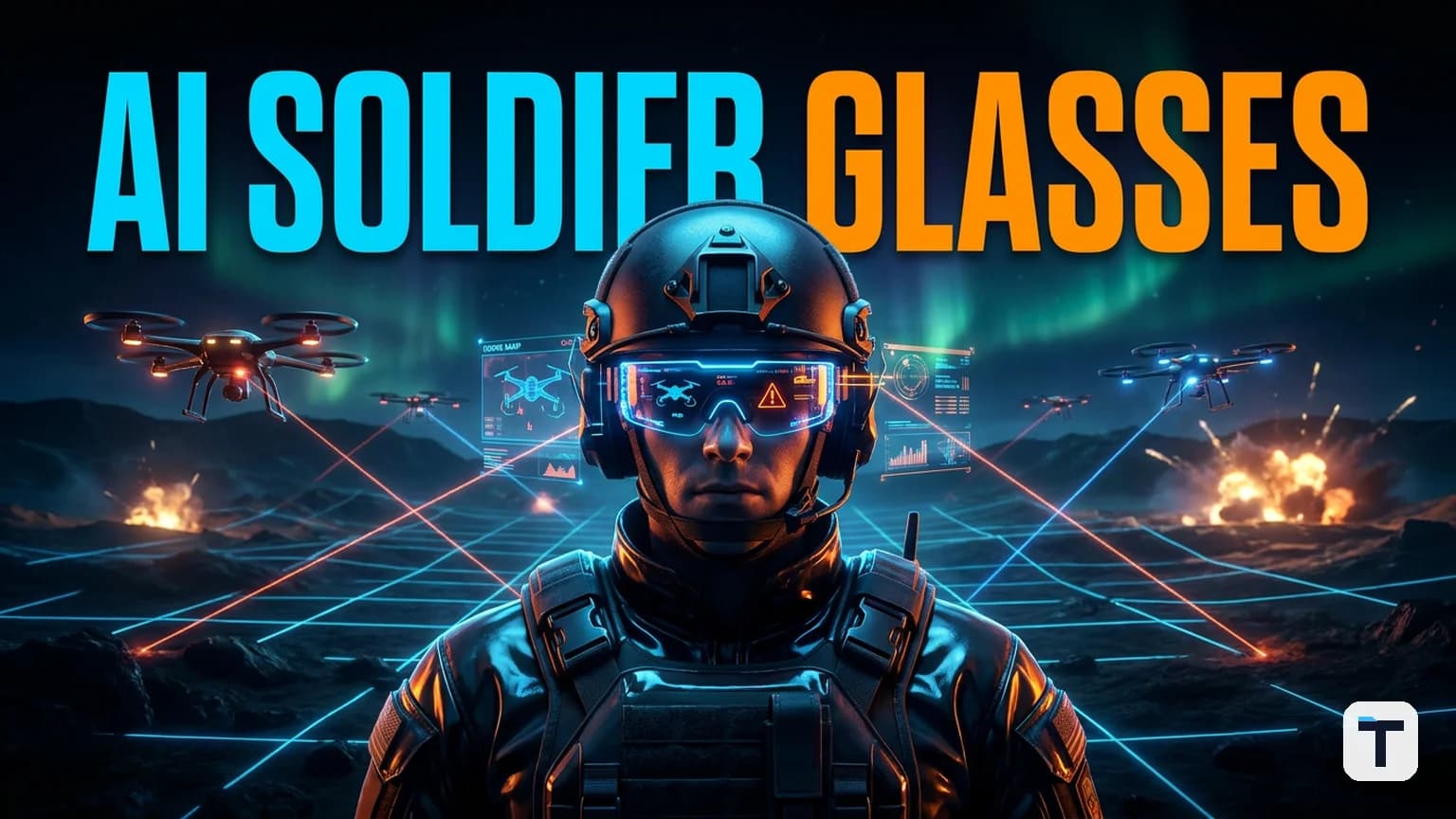

Verdict: Meta and Anduril are turning augmented-reality hardware and AI software built for consumers into a new class of military wearable. The system — part of the U.S. Army's Soldier Borne Mission Command program and Anduril's own EagleEye family — overlays maps, drone feeds, teammate locations, and AI-processed targeting cues onto a soldier's field of view. It is now in the prototyping and field-testing phase, not mass deployment, and still faces real hurdles around cognitive overload, supply-chain security, and battlefield reliability.
Last verified: 2026-06-16 · Status: Prototypes being delivered for Army testing · Key players: Meta (AR/XR), Anduril (Lattice AI), U.S. Army · Primary program: Soldier Borne Mission Command (SBMC), formerly IVAS Next
What is actually being built?
The project is not a single "Iron Man helmet." It is two parallel efforts that share much of the same technology:
| Project | Funding | Form factor | Status |
|---|---|---|---|
| Soldier Borne Mission Command (SBMC) | U.S. Army contract, reported at $159 million for initial prototyping | AR glasses or visor that attaches to existing helmets; separate compute/battery pack | Prototyping contract awarded September 2025; component deliveries underway |
| EagleEye | Anduril self-funded; also a proposed SBMC solution | Custom helmet-and-headset combo with integrated display, sensors, and protection | Announced October 2025; ~100 units planned for Army evaluation |
Sources: Anduril SBMC contract announcement, Anduril EagleEye announcement, MIT Technology Review
Both systems are built around three layers:
- The display. A helmet-mounted or glasses-mounted HUD that blends the real world with digital overlays — maps, compass headings, drone video, friendly-force positions, and object labels.
- The sensor fusion. Cameras, thermal imagers, night-vision sensors, spatial-audio microphones, and RF detectors pull in data from the soldier's surroundings and the wider battlespace.
- The AI backbone. Anduril's Lattice software ingests those feeds, identifies objects and threats, and presents only what the soldier needs, ideally without removing hands from the weapon.
Source: Anduril EagleEye overview
What can a soldier actually do with it?
The capabilities advertised fall into four buckets. We list them with the confidence they currently deserve.
1. See through darkness, smoke, and around corners (partially confirmed)
The system fuses daytime transparent optics, digital night vision, and thermal imaging into one view. Anduril also says EagleEye uses rear and flank sensors to alert soldiers to threats behind or beside them — a "rearview mirror" for combat.
Source: Anduril EagleEye announcement, Core77 first look
The "see through walls" idea from popular coverage is overstated. The system does not provide X-ray vision. It can display the last-known or estimated position of an enemy or teammate using networked sensor data — useful, but not the same as literally seeing through cover.
2. Command drones and robots by voice or glance (in testing)
The Army has already demonstrated a soldier tasking a drone from more than 3 kilometers away through a Lattice-integrated headset, without a dedicated drone pilot.
Prototypes are also being tested with:
- Plain-language voice commands ("send a drone to surveil that area"),
- Eye tracking to select targets or scroll menus,
- Subtle taps or gestures when voice is too loud.
Sources: Anduril SBMC contract announcement, MIT Technology Review
3. Track teammates and threats in 3D (advertised)
Traditional blue-force trackers show a dot on a 2D map. Anduril claims its system can show a teammate's exact 3D position, including which floor of a building they are on.
Source: Anduril EagleEye announcement
4. Use AI to interpret battlefield information (experimental)
Anduril says the system will run large language models — including Meta Llama, Google Gemini, and Anthropic Claude in testing — to translate spoken commands into instructions for military software. Object-recognition models may also label vehicles or positions in the display.
Source: MIT Technology Review
Why Meta? Why Anduril?
This partnership is notable because it pairs two very different companies.
Meta has spent more than a decade building AR, VR, and AI through Reality Labs. Its consumer-facing work — Ray-Ban Meta smart glasses, Quest headsets, and Orion AR prototypes — gives it production-scale expertise in displays, optics, and low-power compute that defense programs historically lacked.
Anduril is the defense contractor building Lattice, an AI command-and-control system the U.S. Army is already integrating across much of its infrastructure under a reported $20 billion, 10-year contract for mission software and network modernization.
Source: Anduril Meta partnership announcement, Army Technology SBMC report
The collaboration is also personally symbolic: Anduril was founded by Palmer Luckey, who created Oculus VR — the company Meta acquired in 2014 for roughly $2 billion. Luckey left Meta in 2017 and later founded Anduril. The two companies are now working together again, this time on military systems.
Sources: Anduril Meta partnership announcement, Auganix partnership summary
What are the real risks?
Cognitive overload
The biggest risk is not the hardware; it is the human inside it. Former U.S. Marine and RAND researcher Jonathan Wong has warned that adding more screens, audio channels, and AI suggestions could simply overwhelm soldiers. In combat, even two radio conversations at once can break comprehension.
"How much mental bandwidth do you have to be both aware of your surroundings and to operate this technology in a way that makes you and your whole unit better?" — Jonathan Wong, RAND Corporation, via MIT Technology Review
Source: MIT Technology Review
AI reliability in combat
Object-recognition models and LLMs can be wrong. In a contested environment — smoke, motion, jamming, camouflage — error rates rise. The system is currently designed so that lethal actions, such as drone strikes, still require approval through the normal chain of command.
Source: MIT Technology Review
Supply-chain security
Because this is a federal military program, hardware supply chains must avoid Chinese suppliers — a constraint that does not apply to Meta's commercial smart glasses. That requirement can slow sourcing and raise costs.
Source: MIT Technology Review
Cost and fielding timeline
The SBMC program is still in initial prototyping. Production for the Army's chosen design is not expected before 2028, if the Army selects a design at all. EagleEye is separately funded and may be offered to foreign militaries if the U.S. Army does not buy it.
Source: MIT Technology Review
What this means for you
If you follow AI, defense, or emerging hardware, this is a case study in dual-use technology — consumer tech originally built for games, meetings, and social media is now being adapted for national security. For founders and builders, the pattern is worth watching: the same advances in on-device AI, sensor fusion, and lightweight optics that power consumer AR are being redirected into enterprise and government markets.
For small businesses and marketers, the near-term lesson is simpler. This is not a product you can buy or deploy. It is a government R&D program. The useful takeaway is that AI-augmented perception — combining cameras, language models, and real-time data overlays — is maturing fast, and similar building blocks are already appearing in logistics, field service, and industrial safety tools.
Related reading
FAQ
Is this an actual "Iron Man" helmet? No. It is a mixed-reality headset or helmet-mounted display that overlays digital information on the real world. It does not provide X-ray vision or autonomous combat capability.
Can it really let soldiers see through walls? Not literally. It can show estimated positions of friendly or enemy forces based on networked sensor data and AI inference, but it cannot see through solid cover.
When will soldiers actually use this in combat? Mass fielding is unlikely before 2028. Around 100 EagleEye units are being delivered for Army evaluation, and the SBMC program is still in initial prototyping.
Who is paying for it? The U.S. Army awarded Anduril a reported $159 million contract for SBMC prototyping. EagleEye is Anduril-funded. The Meta-Anduril partnership itself is described as privately funded.
Can the helmet shoot weapons or order drone strikes on its own? No. Lethal actions require human approval through the normal chain of command. The system is a decision-support and command tool, not an autonomous weapon.
What AI models does it use? Anduril is reportedly testing Meta's Llama, Google Gemini, and Anthropic Claude to translate voice commands into software instructions, along with computer-vision models for object recognition.
Discussion
0 comments