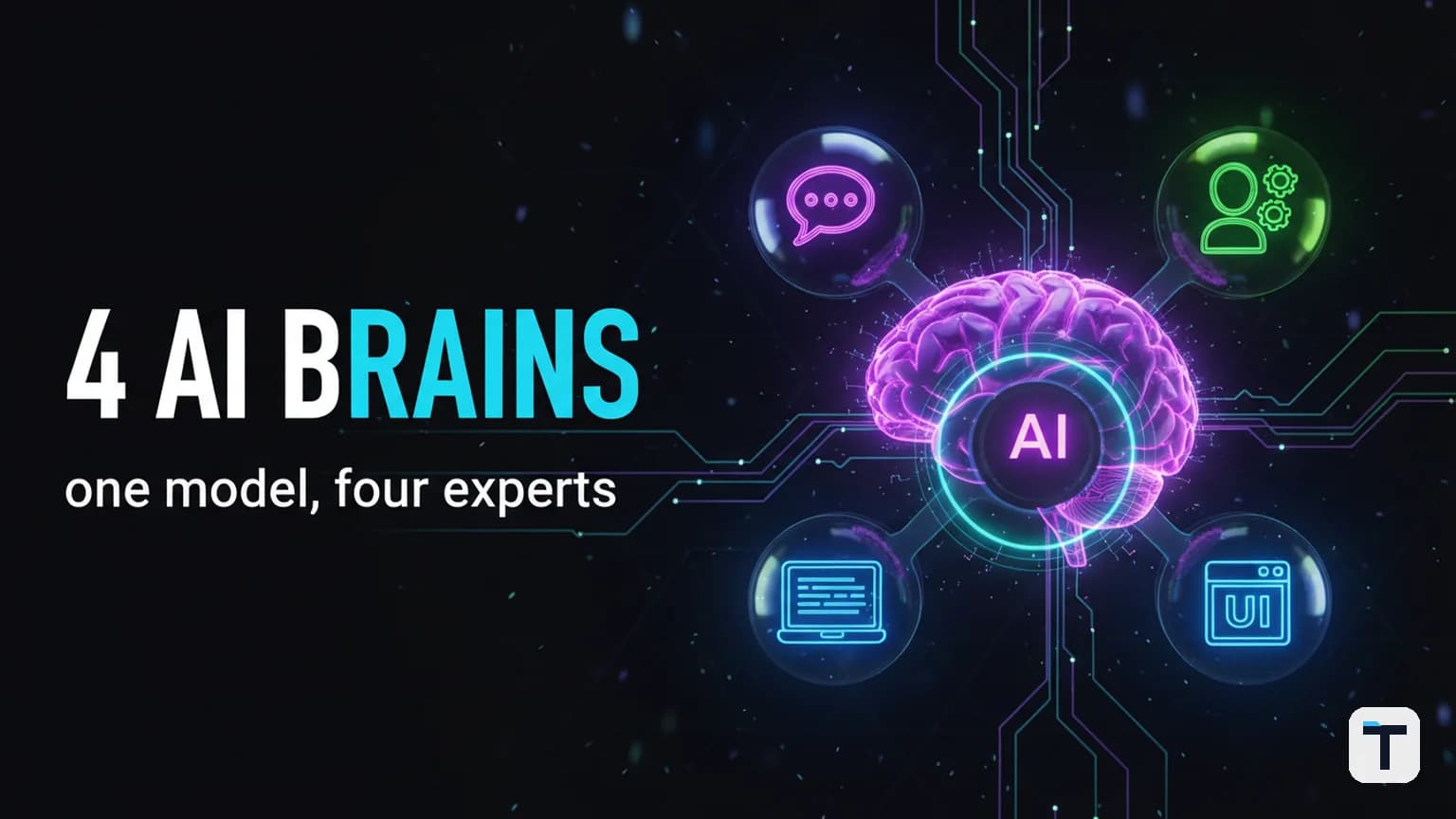

Macaron-V1 is an open-weight AI agent model from Mind Lab that solves a real problem: one model trying to do everything gets worse at each individual thing. Instead of training a single jack-of-all-trades, Macaron-V1 freezes a large base model and bolts on four small, independently trained specialist adapters (LoRAs) — one for chat, one for agent/tool-use, one for coding, and one for generative UI. A router picks the right specialist for each request automatically. Released July 21, 2026 under the MIT license, it is the first model post-trained on Z.ai's GLM-5.2 foundation and one of the most credible open-source multi-specialist agent systems available as of mid-2026.
Last verified: 2026-08-01 · License: MIT (open weights on HuggingFace) · Flagship: Venti, 748B params · Lightweight: Tall, 50B params · Context: 1M native, 2M with LongStraw
What is Macaron-V1?
Macaron-V1 is a post-trained multi-capability AI agent system from Mind Lab (the research arm of Mindverse), built on Z.ai's GLM-5.2 base model. It uses a technique called Mixture-of-LoRA (MoL): the 744-billion-parameter base model stays frozen, and four small LoRA expert modules — each roughly 1 billion parameters — are mounted on top, each trained independently for a single capability (Pandaily, July 2026; 36kr, July 2026).
The four specialists are:
| Specialist | Domain | What it handles |
|---|---|---|
| Chat | Conversation | General dialogue, Q&A, explanations |
| Agent | Tool use / planning | Multi-step task decomposition, tool calling, terminal operations |
| Coding | Software engineering | Code generation, debugging, repo-level refactoring |
| UI (Generative UI) | Interface generation | Building interactive forms, dashboards, clickable components on the fly |
When you send a request, a component called L0 (the router) inspects it and activates the appropriate specialist. If your next message continues the same task, it stays with that specialist; when you switch topics, it hands off to a different one and passes a short summary so context is not lost (GitHub: MindLab-Research/Mixture-of-LoRA-Harness).
The key insight is that this is not a Mixture-of-Experts (MoE) in the pre-training sense. Traditional MoE trains multiple experts jointly during pre-training and they share parameters, which can still cause interference. MoL mounts fully independent LoRA adapters during post-training — each expert is completely isolated, trains in its own parameter space, and never interferes with the others. New capabilities can be added later by mounting another LoRA without retraining the existing ones (ai-all.info deep dive).
Why a multi-specialist architecture matters
Most AI tools today — whether closed API models or open-weight releases — are single models trying to do everything. Chat, code, plan, design, all squeezed into one set of weights. The well-known problem: improving one capability often degrades another. In multi-task post-training, this is called the "seesaw effect" — you push coding up and reasoning slips, or you tune for conversation and tool-use gets worse.
Macaron-V1's approach flips this. Because each LoRA specialist trains in complete isolation on its own adapter space, there is zero capability interference. The chat specialist does not forget how to converse just because the coding specialist learned a new debugging pattern. The cost is remarkably low: Mind Lab reports training the Venti variant on just 64 GPUs — a fraction of what pre-training a 748B model from scratch would require (Pandaily, July 2026).
This matters for a specific reason: Mind Lab reports that by adjusting only about 0.5% of the model's parameters (the LoRA adapters), the system exceeds the base GLM-5.2's performance across multiple benchmarks and secured 6 state-of-the-art results in 12 benchmark tests (36kr, July 2026). That is an extraordinarily efficient way to add specialized capabilities without paying for a full pre-training run.
If you are interested in why post-training has become its own discipline — and how models now learn skills on the job rather than during pre-training — we cover the full post-training progression in AI Agent Post-Training in 2026: How Models Learn Skills on the Job.
What benchmarks actually show (and what they do not)
Mind Lab reports the following headline numbers for the Venti variant:
| Benchmark | Score | What it measures | Confidence |
|---|---|---|---|
| Terminal-Bench 2.1 | 87.6 | Terminal/CLI agent tasks | Vendor-reported |
| Macaron ChatBench | 87.8 (reported) | Conversation quality in agent settings | Vendor-reported |
| SWE-bench Verified | Close to frontier, not past Claude Opus 4.8 | Real-world bug fixing | Vendor-reported |
Important caveat: All of these are vendor-reported numbers. As of August 1, 2026, independent testers have not fully verified all of Macaron-V1's benchmark claims. The Terminal-Bench leaderboard maintained by llm-stats.com shows verified results for 0 of 25 models — all are self-reported — with the current leader at 50.0% (Claude Sonnet 4.5) using the standard pass-rate metric (llm-stats.com Terminal-Bench leaderboard). The discrepancy in scale (87.6 vs 50.0) likely reflects different benchmark versions, harness configurations, or scoring methods. Treat the 87.6 figure as a strong claim, not confirmed fact, until independent evaluations land.
Mind Lab's own launch post is notably honest about where Venti stands: "Venti matches or outperforms the frontier baselines across most tracks while remaining open and self-hostable. Coding is where we currently sit close to, rather than ahead of, the frontier" (Macaron-V1 launch post, macaron.im). On SWE-bench Verified specifically, Macaron-V1 trails Claude Opus 4.8. So this is a strong open-source contender, not an automatic upgrade over every closed model.
How does the router work?
The router — called L0 — is the piece that makes Macaron-V1 feel like one tool instead of four. When you send a message, L0 classifies your request and routes inference through the matching LoRA specialist. The harness exposes a single OpenAI-compatible API endpoint, so from the developer's perspective you are talking to one model. Behind the scenes, the right expert is activated (GitHub: Mixture-of-LoRA-Harness).
The handoff mechanism is what prevents context loss across specialist switches. When the router decides a new message needs a different specialist, it passes a short summary of what already happened so the next expert picks up where the last one left off. This is a deliberately simple design — not a learned meta-controller, but a classification-plus-summary approach that keeps latency low and behavior predictable.
For teams that have dealt with the opposite problem — AI agents that lose track of context across sessions and threads — the router's summary-passthrough is a step toward context that compounds rather than resets. We discuss context management discipline more broadly in The One AI Agent Mistake That Quietly Sabotages Your Business: Session Sprawl.
The two variants: Venti vs. Tall
Mind Lab released Macaron-V1 in two sizes to cover different deployment scenarios:
| Venti (Flagship) | Tall (Lightweight) | |
|---|---|---|
| Total parameters | 748B | 50B |
| Base model | GLM-5.2 (744B, frozen) | Qwen 3.6 35B (frozen) |
| LoRA specialists | 4 x ~1B params | 4 x 3.7B Rank-64 |
| Native context | 1M tokens | 2M tokens |
| Extended context | 2M (via LongStraw) | — |
| Deployment target | Multi-GPU servers | Consumer-grade GPUs / local |
| License | MIT | MIT |
The Venti variant is the performance play — it sits among the largest open-weight models available. The Tall variant is the practical play for developers who want to run a multi-specialist agent locally or on edge devices without a server rack.
What is the context window and why 2M tokens matter?
Macaron-V1 Venti supports 1 million tokens natively (inherited from GLM-5.2's 1M context window) and extends to 2 million tokens via Mind Lab's LongStraw technique (ai-all.info). GLM-5.2 itself was released by Z.ai on June 13–16, 2026, as a 744-billion-parameter Mixture-of-Experts model with 40 billion active parameters per forward pass and a verified 1M-token context window (NVIDIA NIM model card; Z.ai developer docs).
In practical terms, 2 million tokens means the model can hold an entire long-running project — conversations, documents, code, specifications — in its head simultaneously without forgetting the start. A year ago, most AI tools lost track of what you told them ten messages back. This is a genuine architectural shift, not marketing. That said, large context does not guarantee perfect recall of every detail; Z.ai's own documentation acknowledges that long-context models still need verification and sandboxing, and needle-in-haystack recall at full 1M depth has not been independently tested (codersera.com GLM-5.2 analysis).
Is Macaron-V1 actually open source?
Yes — and this is one of its most significant properties. Both Venti and Tall are released under the MIT license with open weights on HuggingFace (mindlab-research/Macaron-V1-Coding-Venti). MIT is among the most permissive open-source licenses available: developers and companies can use it, build on top of it, and sell products built with it with very few restrictions.
There are some requirements tied to the underlying base models. GLM-5.2 (Z.ai) is also MIT-licensed, and Qwen 3.6 (Alibaba) has its own licensing terms. But overall, this is about as open as a frontier-scale AI release gets in 2026. This is worth underscoring: most major AI labs keep their best models locked behind an API or paid plan. Mind Lab is handing developers the weights.
For context on how open-weight model releases are reshaping the landscape, our guide to Kimi K3 — another major open-weight release — covers the broader trend in Kimi K3 Open Source Release: What the Largest Open AI Model Means for Builders in 2026.
How to deploy Macaron-V1
Two major serving frameworks added day-zero support for Macaron-V1 at launch: vLLM and SGLang. Both expose an OpenAI-compatible API, so any tool that speaks OpenAI can talk to them.
Option 1: vLLM
pip install vllm
vllm serve "mindlab-research/Macaron-V1-Coding-Venti"
Call it with curl:
curl -X POST "http://localhost:8000/v1/chat/completions" \
  -H "Content-Type: application/json" \
  --data '{
    "model": "mindlab-research/Macaron-V1-Coding-Venti",
    "messages": [{"role": "user", "content": "What is the capital of France?"}]
  }'
Option 2: SGLang
pip install sglang
python3 -m sglang.launch_server \
    --model-path "mindlab-research/Macaron-V1-Coding-Venti" \
    --host 0.0.0.0 \
    --port 30000
SGLang confirmed day-0 support in a public announcement, highlighting "Mixture-of-LoRA: Chat / Agent / Coding / GenUI specialists, auto-routed per request" and "SGLang native multi-LoRA serving" (SGLang on X, July 2026).
Hardware requirements
The Venti variant's weights are approximately 1.51 TB on disk in safetensors format, based on the HuggingFace repository size (HuggingFace model files). For self-hosted inference at FP8, GLM-5.2-class models typically need around 8× H200 SXM GPUs (1,128 GB total HBM) for the full 1M context window. INT4 quantization reduces this to roughly 200 GB — feasible on 4× H200 — at a 1–3% coding-benchmark regression (codersera.com GLM-5.2 deployment notes).
The Tall variant (50B based on Qwen 3.6) is designed for consumer-grade GPUs and local deployment, making it the practical entry point for individual developers.
Official hosted API
Mind Lab also offers an official hosted API at https://mint.macaron.im for teams that do not want to self-host (Macaron-V1 launch post).
Who built Macaron-V1?
Mind Lab was founded in October 2025 by Chen Kaijie, a serial entrepreneur who suspended his studies at Duke University, previously launched the AI interactive story platform MidReal, and created the Personal Agent application Macaron (which topped Product Hunt's daily chart on launch day). The team includes core researchers from DeepSeek, ByteDance, and xAI, and has about 30 members (36kr, July 2026).
Mindverse, Mind Lab's parent company, has raised a total of $60 million in financing. The team reports reaching $10 million in ARR within two weeks of commercialization — a signal that there is real market demand for open, multi-specialist agent models.
Technically, Mind Lab was the only team in China (and one of two globally, alongside Thinking Machines Lab) that could run LoRA-based reinforcement learning on trillion-parameter models as of mid-2026. Their distributed training platform, called MinT, manages millions of LoRA models and only transmits the lightweight LoRA adapter during training, evaluation, deployment, and rollback — with real-time loading speed increased by nearly 10× (36kr).
How does Mixture-of-LoRA compare to fine-tuning and RAG?
This is the question most builders actually have. Here is the honest comparison:
| Approach | What it does | When to use it | Limitations |
|---|---|---|---|
| Full fine-tuning | Updates all model weights | You have a narrow domain + large dataset + budget | Expensive; catastrophic forgetting; one capability at a time |
| Single LoRA | Trains a small adapter on a frozen base | You need one specialized skill (e.g., a coding style) | Cannot handle multiple skills without interference |
| Mixture-of-LoRA | Mounts multiple independent LoRAs + a router | You need multiple specialized capabilities from one model | Router adds a classification step; needs the harness to manage switching |
| RAG | Retrieves relevant documents at inference time | Your knowledge changes frequently or is too large to fit in weights | Does not change model behavior; retrieval quality is the bottleneck |
MoL is not a replacement for RAG — they solve different problems. MoL changes what the model is good at (capabilities); RAG changes what the model knows (knowledge). In practice, a production system might use Macaron-V1's coding specialist to generate code and a RAG pipeline to inject the latest API docs at the same time.
For a deeper dive into the data pipeline that makes specialized fine-tuning work — sourcing, filtering, teacher selection — see our guide on Data Curation for Post-Training LLMs.
What this means for you
For developers and builders: Macaron-V1 is a credible open-source alternative to running multiple specialized API models. If you are currently orchestrating separate calls to a chat model, a coding model, and an agent model, Macaron-V1's single-endpoint-with-routing design simplifies that architecture. The MIT license means you can build commercial products on it. Start with the Tall variant (50B) if you want to test locally; move to Venti (748B) when you need frontier-class performance.
For small business owners: The generative UI specialist is the most immediately useful capability for non-technical users. Instead of getting a wall of text back when you ask an AI for help, Macaron-V1 can return an actual interface — a form, a dashboard, clickable buttons. That is the difference between reading a plan and getting something you can use right away. If you are evaluating AI tools for your business, look for this kind of "interface-on-demand" capability; it is where agent UIs are heading.
For anyone tracking the AI landscape: The pattern here — freeze a large base, add small specialized adapters, route between them — is becoming a proven architecture. Thinking Machines Lab independently confirmed the same finding in its "LoRA Without Regret" paper: using LoRA for reinforcement learning on a sufficiently large MoE model causes no performance loss (36kr, July 2026). This is not a one-off trick; it is a repeatable engineering path. And the broader shift from preference-tuned assistance to goal-driven automation is the through-line we trace in What Comes After RLHF? The Shift From AI Assistance to AI Automation.
FAQ
Q: Is Macaron-V1 free to use commercially? A: Yes, under the MIT license. Both Venti and Tall variants ship with open weights on HuggingFace. You can use them, build on them, and sell products built with them with minimal restrictions. Some requirements may apply from the underlying base models (GLM-5.2 is also MIT; Qwen 3.6 has its own terms).
Q: Can Macaron-V1 replace Claude, GPT, or Gemini? A: Not overnight. Mind Lab's own evaluation shows Venti matches or outperforms frontier baselines on most tracks but trails on coding — specifically SWE-bench Verified, where it does not surpass Claude Opus 4.8. It is a strong open-source contender and the best option if you need self-hostable, multi-specialist agents, but closed frontier models still lead on some benchmarks.
Q: Do I need multiple GPUs to run it? A: For Venti (748B), yes — approximately 8× H200 GPUs for full FP8 inference with 1M context, or 4× H200 with INT4 quantization (1–3% benchmark regression). For Tall (50B), no — it is designed for consumer-grade GPUs and local deployment.
Q: What is the difference between Mixture-of-LoRA and Mixture-of-Experts? A: Traditional MoE trains multiple experts jointly during pre-training, and experts share some parameters, which can still cause interference. MoL (Mixture-of-LoRA) freezes the base model during post-training and trains fully independent LoRA adapters. Each expert is completely isolated, does not share parameters, and expert switching is controlled by an explicit router rather than an implicit gate.
Q: What is generative UI in Macaron-V1? A: The UI specialist (called UI4A) can generate interactive interfaces — forms, dashboards, clickable buttons — instead of plain text. This means instead of reading a paragraph describing a plan, you get something you can actually use on screen. It is designed for rapid front-end prototyping, data visualization, and low-code application development.
Q: Are the benchmark scores independently verified? A: No, as of August 1, 2026, the benchmark scores (including Terminal-Bench 2.1 at 87.6) are vendor-reported. The Terminal-Bench public leaderboard shows all current entries as self-reported, with no independently verified results yet. Treat the numbers as strong claims pending third-party evaluation.
Discussion
0 comments