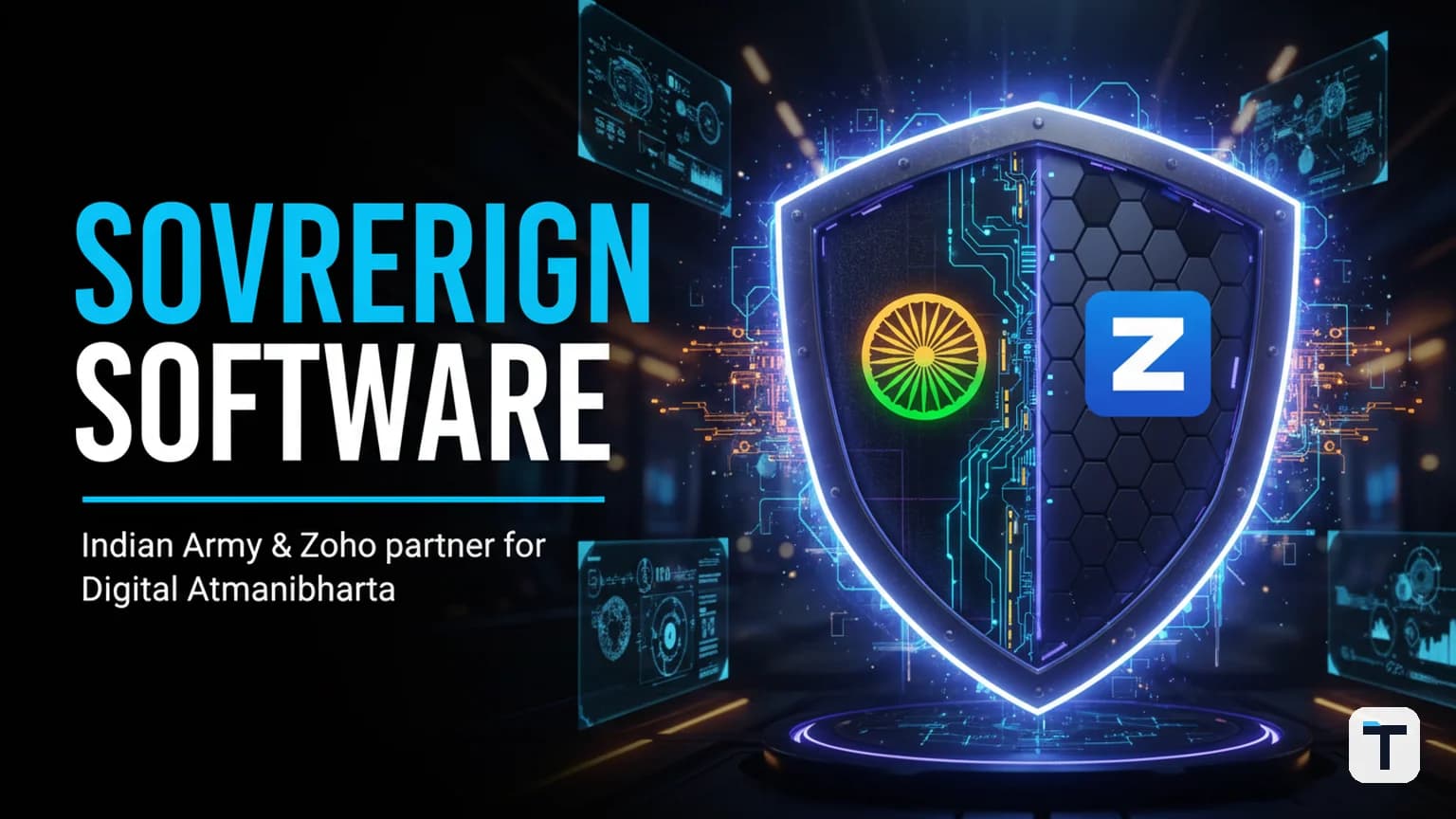

The Verdict: The Indian Army has signed a landmark Memorandum of Understanding (MoU) with Zoho Corporation to drive indigenous digital transformation. This partnership, under the JAI (Jointness, Atmanirbharta & Innovation) mission, shifts India's defense strategy from hardware-only self-reliance to sovereign software infrastructure, ensuring that the nation's most sensitive data remains on home-grown, secure platforms.
| Key Fact | Details |
|---|---|
| Partnership | Indian Army & Zoho Corporation |
| Mission | JAI (Jointness, Atmanirbharta & Innovation) |
| Primary Signatories | Lt Gen Harsh Chhibber (DGIS) & Rajendran Dandapani (Zoho) |
| Date Signed | June 23, 2026 |
| Core Focus | Secure digital infrastructure, R&D, and Skill Development |
| Last Verified | June 24, 2026 |
Why did the Indian Army choose Zoho for its digital transformation?
The choice of Zoho Corporation is a strategic move toward vertical integration and data sovereignty. Unlike many global tech giants that rely on third-party cloud infrastructure, Zoho builds and maintains its entire technology stack—from data centers to application code.
For the Indian Army, this "sovereign" approach minimizes the risk of foreign backdoors, data leaks, or service disruptions caused by geopolitical tensions. By leveraging Zoho’s expertise in building scalable, enterprise-grade software, the Army can transition away from legacy systems into a future-ready, digitally empowered force. This move is similar to how organizations are now slashing enterprise AI costs by moving to more efficient, indigenous search and data architectures.
What is the JAI (Jointness, Atmanirbharta & Innovation) mission?
The JAI mission is the latest evolution of India’s self-reliance strategy. While previous initiatives focused on "Atmanirbhar Bharat" in hardware (tanks, missiles, and semiconductors), JAI expands this to include the digital and cognitive layers of modern warfare.
- Jointness: Ensuring seamless communication and data sharing across different wings of the armed forces.
- Atmanirbharta: Reducing dependency on foreign software vendors and cloud providers.
- Innovation: Fostering a culture of application-oriented research and development (R&D) within the force.
This framework ensures that the Indian Army isn't just a consumer of technology but a creator, much like how developers are now building their own AI agent operating systems to automate complex workflows without relying on a single vendor.
How does sovereign software protect national security?
In the digital era, sovereignty is defined by who controls the code. Sovereign software provides three critical layers of protection:
- Data Residency: All metadata and sensitive communications remain within Indian borders on locally managed servers.
- Security Audits: Unlike proprietary "black box" software from foreign entities, indigenous software allows for deep security audits by national agencies.
- Sustainable Lifecycle: Sustainable technology platforms ensure that the Army can maintain and upgrade its software infrastructure independently, regardless of international sanctions or supply chain issues.
The road to future-ready forces: R&D and skill development
The MoU isn't just about deploying existing software; it focuses on application-oriented R&D. This means Zoho and the Indian Army will collaborate to build bespoke solutions for logistics, secure messaging, and resource management.
Furthermore, the partnership emphasizes technology-driven skill development. By training personnel on indigenous platforms, the Army is essentially teaching AI new skills and building a workforce that can maintain the nation’s digital sovereignty for decades to come.
What this means for you
For the broader tech ecosystem and small businesses, this partnership is a signal that sovereign tech is the next frontier. As the Indian Army prioritizes "Made in India" software, we expect a surge in demand for local alternatives to global SaaS platforms. If you are building or buying software in 2026, look for vendors that offer high levels of data control and indigenous hosting.
Frequently Asked Questions
Q: Is the Indian Army using Zoho's commercial apps? A: While specific apps weren't named, the partnership focuses on building custom, secure digital infrastructure and application-oriented R&D tailored to military needs.
Q: Does Zoho have its own data centers in India? A: Yes, Zoho is one of the few global software companies that owns and manages its entire data center stack, including locations in India, which is critical for data sovereignty.
Q: What is the significance of the JAI mission? A: JAI (Jointness, Atmanirbharta & Innovation) represents a unified approach to making the Indian armed forces self-reliant in both physical hardware and digital software.
Q: Will this partnership involve AI development? A: Yes, the focus on R&D and "future-ready" forces strongly implies the integration of AI and machine learning for predictive logistics and secure data analysis.
Q: Who are the primary signatories of the MoU? A: The MoU was signed by Lt Gen Harsh Chhibber, Director General Information Systems (DGIS), and Rajendran Dandapani, Director of Engineering at Zoho Corporation.
Every claim here is traced to a primary source, dated, and listed under Sources. Research and drafting are AI-assisted; editing, verification and publication are human decisions, and a person is accountable for what appears on this page. How we work →
Discussion
0 comments