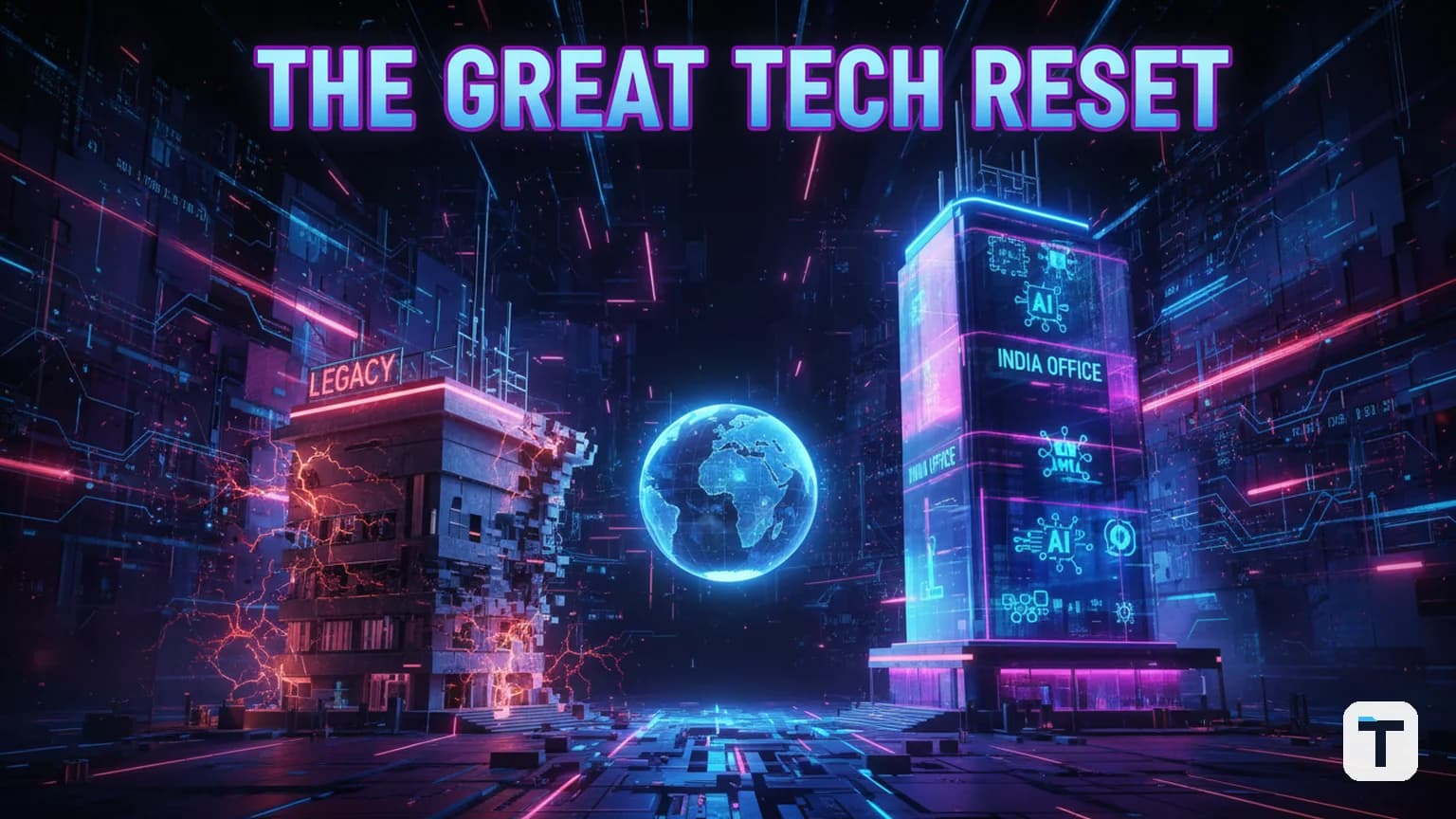

Verdict: The Indian tech sector is experiencing a fundamental "Great Reset" where the traditional IT services model is shrinking in favor of high-value Global Capability Centers (GCCs), now increasingly rebranded as "India Offices." While legacy firms like TCS are shedding thousands of roles due to a skill-mismatch in the AI era, US Big Tech (Meta, Amazon, Apple, Microsoft, Netflix, and Google) added over 32,000 jobs in India in 2025 alone to drive original R&D and global platform ownership.
Last verified: 2026-06-19 · Jobs added by Big Tech (2025): 32,000+ · Jobs cut by TCS (FY26): 12,200 · Total GCCs in India: 2,117 · Volatile facts: Headcount and H-1B policies fluctuate monthly.
This shift marks the end of India as a mere "back office" and the beginning of its role as the global "nerve center" for the AI-first enterprise.
Why is TCS cutting 12,200 jobs?
The restructuring at Tata Consultancy Services (TCS), which involves cutting roughly 2% of its global workforce (12,200 employees) by March 2026, is the most significant downsizing in the company's 50-year history. This is not a simple "AI replacing humans" story; it is a structural realignment driven by three factors:
- Legacy Skill Phase-out: The layoffs primarily target mid-to-senior level employees (10+ years experience) operating in outdated delivery models or legacy technologies that cannot easily transition to Cloud, AI, and Agile environments.
- Tightened Bench Policies: In June 2025, TCS enforced a policy requiring a minimum of 225 billable days annually, allowing only 35 days for "bench" time.
- Delayed Discretionary Spend: Revenue growth at TCS slowed to 1.3% YoY in Q1 FY26, as global clients paused spending on traditional services in favor of high-impact AI pilots.
This reset follows a broader trend seen in our analysis of India’s electronics export milestone, where the focus is moving from low-margin execution to high-value manufacturing and design.
Why is Big Tech adding 32,000 jobs in India?
While traditional services shrink, the "FAAMNG" cohort (Facebook/Meta, Amazon, Apple, Microsoft, Netflix, and Google) grew their Indian headcount by 18% in 2025. This expansion is driven by the maturation of Global Capability Centers (GCCs):
- AI & Frontier R&D: Big Tech is hiring in India specifically for AI/ML operations, data engineering, and cybersecurity. These are not support roles; they are the teams building the core products.
- H-1B Policy Tailwinds: With the US imposing $100,000 fees on H-1B visas and shifting to a wage-prioritized lottery, US firms are moving the work to where the talent is.
- Global Leadership: Leadership models have evolved, with 64% of India site leaders now holding dual mandates that include global functional ownership.
The Rise of the "India Office" vs. the "Back Office"
The term "GCC" is being dropped by mature organizations in favor of "India Office." This shift represents a move from labor arbitrage (saving money on salaries) to "capability arbitrage" (accessing talent that doesn't exist elsewhere at scale).
| Feature | Old "Back Office" (ODC/Captive) | New "India Office" (CoE) |
|---|---|---|
| Primary Goal | Cost Savings | Innovation & R&D |
| Reporting | Reports to global HQ function | Owns the function globally |
| Focus | Process execution | IP creation & AI transformation |
| Talent | L1/L2 Support | AI Architects, MLOps, Product Owners |
India now hosts over 2,100 GCCs contributing $98.4 billion in total market revenue (FY26). This compounds with India’s semiconductor surge to create a "Global Neural Network" where capability, not proximity to a US headquarters, determines where a project is led.
What skills are actually in demand in 2026?
The "skill mismatch" cited by IT leaders is real. If you are in the "8-15 year experience" bracket, the industry is looking for innovators, not just executors. According to 2025-2026 market data, the highest compensation premiums are in:
- Generative AI Engineering: Average ₹34.5 LPA (for <8 years experience).
- MLOps & AI Infrastructure: Average ₹33 LPA.
- Cybersecurity & AI Governance: Average ₹31 LPA.
This demand for "agentic" skillsets is exactly why SEOs are switching to tools like Claude for automation rather than simple content generation.
The Tier-2 Shift: Beyond Bengaluru
The "Beyond Bengaluru" initiative is working, but it’s moving in a hub-and-spoke model. While Bengaluru remains the primary hub, infrastructure constraints and a 25-30% cost advantage are driving growth in:
- Hyderabad: Now leads in new GCC setups (46% of new centers in 2025).
- Coimbatore & Kochi: Emerging as R&D spokes, especially for engineering and manufacturing GCCs.
- Telangana: Targeting 120 new GCCs by the end of 2026.
What this means for you
For Developers: Upskilling is mandatory. If your role is primarily L1 support or manual QA, it is at high risk of being automated or phased out. Focus on AI/ML operations and "critical thinking" capacity—learning to present case studies and architectural decisions rather than just code.
For Business Owners: If you are building with AI, India is no longer just a place to hire a cheap dev shop. It is a place to find the "India Office" talent that can own your product's AI roadmap. We recommend following our guide to building a personal agent OS to see how small teams can leverage these same talent shifts.
FAQ
Q: Is the H-1B visa change permanent? A: The shift to a wage-driven model and higher fees appears structural under current US administration policies, making the "work-from-India" model a permanent tailwind for Big Tech expansion.
Q: Are GCCs taking jobs from the US? A: Not necessarily. Industry leaders like Nasscom argue it is a "Global Neural Network" where capability determines location. Many roles are "new" AI roles that didn't exist two years ago.
Q: Should I move to a Tier-2 city for a GCC job? A: Retention is higher in Tier-2 cities (Coimbatore, Jaipur) because the quality of life is often better and costs are 30% lower, but most leadership roles still reside in Tier-1 hubs like Bengaluru and Hyderabad.
Q: What is the "bench policy" at TCS? A: As of 2025, TCS requires 225 billable days a year. Spending more than 35 days on the "bench" without a project can lead to job termination under the new "future-ready" guidelines.
Discussion
0 comments