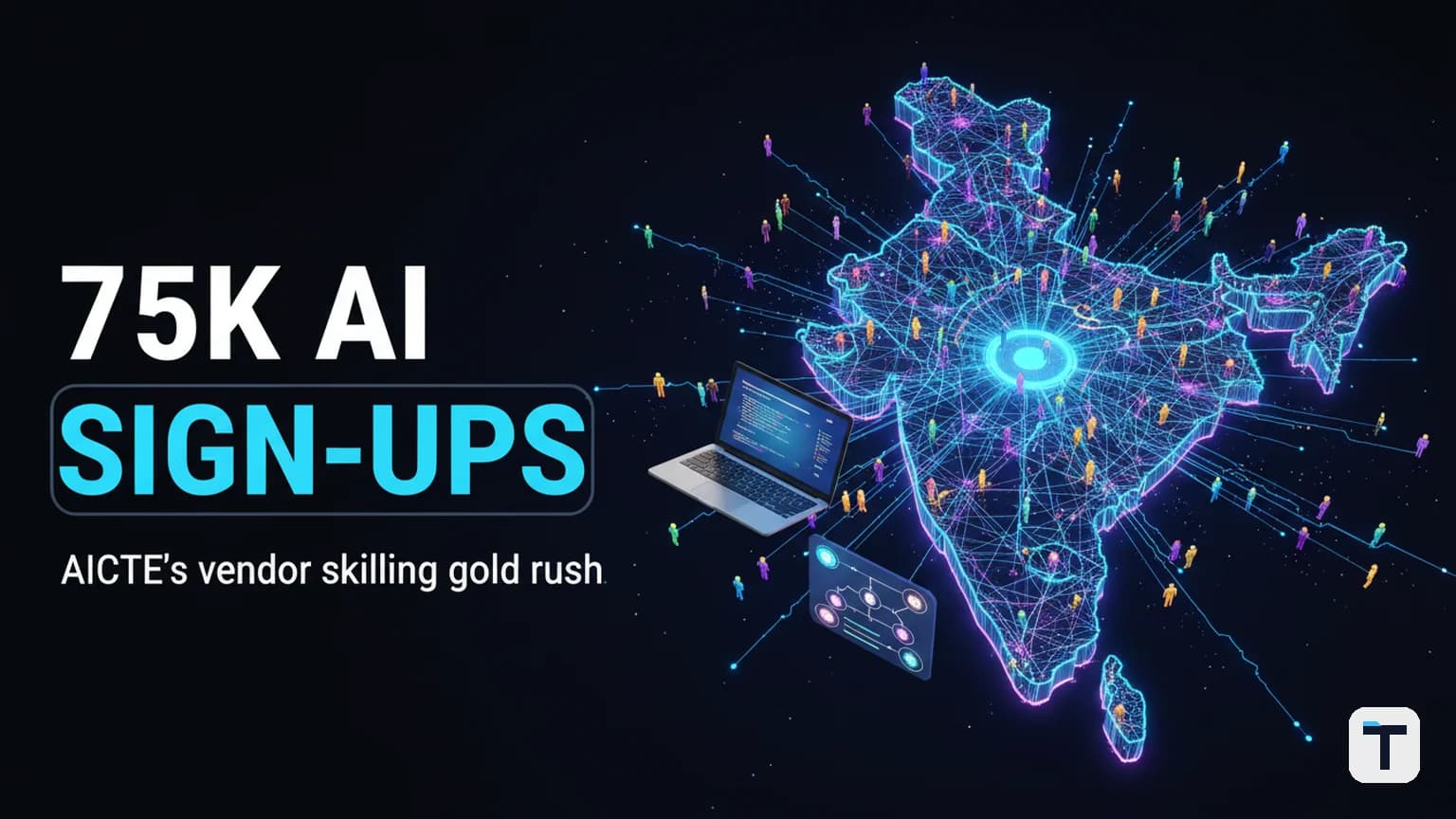

Nearly 75,000 engineering students across roughly 1,500 Indian colleges signed up for a single five-week virtual internship in enterprise AI — run by Pegasystems with the All India Council for Technical Education (AICTE) and SmartBridge Educational Services, announced at Pega's PEGAInnovate event in July 2026. That wave of registrations, from 10,000 in the first ten days to nearly 75,000 within weeks, signals something bigger than one company's outreach success: India has decided the AI skills gap is real enough to let virtually every major tech vendor run its own funnel under the same government stamp. The question is whether those funnels converge or just compete.
Last verified: 2026-08-01
- Pega's National Internship Program (NIP) enrolled ~75,000 students across ~1,500 colleges; five-week virtual program with AICTE and SmartBridge.
- Microsoft's Elevate for Educators targets 2M teachers and 200K institutions by 2030 (8M students downstream).
- IBM built a National AI Lab at AICTE HQ with IBM SkillsBuild; OpenAI signed an MoU with AICTE in September 2025.
- MIB + Google + YouTube launched 15,000 scholarships for creative-sector AI skills in March 2026.
- The core unverified claim: India has 1.3M AI learners (largest globally) but ranks 89th of 109 nations in measured AI proficiency (vendor report, not independently verified).
What Is the Pega AICTE National Internship Program (NIP)?
The Pega NIP is a five-week, fully virtual internship that introduces engineering students to generative AI, Pega Blueprint (Pega's generative-AI-powered application design tool), agentic engineering, workflow automation, and enterprise transformation. Students attend instructor-led sessions, complete hands-on projects, and receive mentorship from Pega engineers and senior executives. It was announced at Pega's PEGAInnovate event and is delivered in partnership with AICTE and SmartBridge Educational Services (CIOL, July 29 2026; Analytics India Magazine, July 30 2026).
The program is designed as a precursor to Pega's University Academic Program (UAP), which launches in August 2026 with an AI-focused curriculum. It is explicitly not about teaching coding — Pega's own VP of Application Development, Goutham Parcha, said the goal is "to shift how a student approaches a problem, moving them from writing code toward designing outcomes" (CIOL).
Applications were open through the AICTE National Internship Portal with a July 31, 2026 deadline (SightsIn Plus, July 29 2026).
How Big Is the India AI Skilling Push Across All AICTE Partners?
The Pega deal is not isolated — it is one of several overlapping, vendor-branded AI skilling programs that AICTE has signed in the same year. Here is a verified map of the major programs:
| Program | Vendor Partner | Scale Target | Audience | Key Content | Date |
|---|---|---|---|---|---|
| National Internship Program (NIP) | Pega (Pegasystems) | ~75,000 students, ~1,500 colleges | Engineering students | Gen AI, Pega Blueprint, agentic engineering, workflow automation | July 2026 |
| Elevate for Educators | Microsoft | 2M teachers, 200K schools/institutions, 8M students (by 2030) | Teachers + students | AI literacy, computational thinking, responsible AI | Feb 2026 |
| National AI Lab + SkillsBuild | IBM | Part of 2M-in-AI-by-2026 target | Students, faculty, researchers | AI, cloud, sustainability; 1,000+ SkillsBuild courses | Oct 2025 |
| AICTE–OpenAI MoU | OpenAI | Not specified | Students + educators | AI in education (details limited) | Sept 2025 |
| MIB Creative AI Scholarships | Google + YouTube (+ IICT) | 15,000 scholarships | Creative-sector professionals + students | Generative AI, prompt engineering, creative production workflows | March 2026 |
| SOAR Programme | MSDE + Ministry of Education | School students (Classes 6–12) + educators | School students + educators | AI literacy, ethics, hands-on modules | July 2025 |
Sources: Microsoft Elevate (Economic Times, Feb 2026; Microsoft/academicjobs.com); IBM National AI Lab (IBM News Room, Oct 31 2025); AICTE–OpenAI MoU (AICTE press release PDF); MIB Scholarships (Indian Express, March 25 2026); SOAR (PIB, Oct 2025).
Is India Building One Coordinated AI Talent Pipeline or Letting Every Vendor Run Its Own Funnel?
On the surface, these programs cover different layers — school-age literacy (SOAR), educator upskilling (Microsoft Elevate), creative-sector AI (MIB/Google/YouTube), enterprise workflow design (Pega NIP), research infrastructure (IBM National AI Lab), and curriculum integration (OpenAI MoU). That could read as coordinated layering. But the evidence points to a more fragmented picture.
The Pega NIP serves as a pipeline into Pega's own University Academic Program — a vendor-specific curriculum that trains students on Pega Blueprint and Pega Platform workflows. Microsoft's Elevate is part of its own commitment to train 20M people in AI in India, delivered through Microsoft tooling. IBM's National AI Lab pushes IBM SkillsBuild courses. Each partner brings its own platform, its own certification, and its own hiring pipeline. AICTE's role is to confer the government stamp, open the portal, and provide the student reach — not to coordinate a shared curriculum or a common standard across vendors.
The result is that Indian engineering students can now earn multiple AI-skilling credentials from competing vendors, each certifying proficiency on a different platform, with no clear equivalency between them. Whether that produces a deeper, broader talent pool — or merely segment-by-vendor lock-in at the pre-employment stage — is the open question.
What Does the AICTE AI Skilling Push Mean for Engineering Students?
For engineering students, the practical takeaway is that enterprise AI skills — designing AI-assisted workflows, building with generative AI tools, understanding agentic AI and automation — are now the differentiator, not coding alone. Entry-level IT roles in India have contracted by 20–25% as AI handles routine coding and testing, and fewer than 25% of students at some respected institutions had secured job offers by graduation in 2026 (Metaintro/Bloomberg, April 2026).
The Pega program reflects this shift directly: it does not teach coding, it teaches outcome design. A student who can articulate business problems, design AI-driven workflows, and understand how agent-based systems operate has a credential that aligns with what enterprises are now hiring for — not what universities were teaching five years ago.
The risk for students is vendor lock-in: a five-week program centered on Pega Blueprint produces Pega-fluent graduates, which benefits Pega's ecosystem but does not necessarily transfer to a Salesforce, ServiceNow, or open-source agentic framework environment. Students should treat these programs as one signal among many, not as a complete career platform.
What Does This Mean for Businesses Hiring AI Talent in India?
For enterprises and small businesses hiring in India, the AICTE-backed programs create a larger pool of graduates who have at least been exposed to enterprise AI concepts — generative AI, agentic workflows, automation, and AI-assisted application design. But exposure is not proficiency. A five-week virtual internship cannot substitute for a candidate who has actually shipped an AI-assisted workflow in production.
The practical implication: when evaluating graduates from these programs, check what they built, not just which certificate they earned. A portfolio of real projects — even small ones — using AI to automate a real workflow, design a business process end-to-end, or integrate an LLM into a working application, is a stronger hiring signal than a vendor completion certificate. The AICTE programs are useful for widening the top of the funnel; they do not close the skills gap on their own.
How Can a Student Actually Prepare for Enterprise AI Roles Beyond These Programs?
For students who want to go beyond a vendor-branded certificate, the most effective path is to build the skills that transfer across platforms:
- Learn to design workflows, not just write code. The shift Pega describes — from writing code toward designing outcomes — is real and cross-platform. Practice breaking a business process into steps, identifying where AI can automate or assist, and mapping that to a working prototype.
- Get hands-on with at least one generative AI tool API. OpenAI, Anthropic, Gemini, or open-source models (Llama, Qwen) — the API is the lingua franca. Build a working application that calls an LLM, handles context, and returns a useful result.
- Understand agentic AI patterns. Agent-based systems — where an AI reasons, plans, and takes actions through tools — are the frontier. Frameworks like LangChain, CrewAI, or AutoGen are accessible and free. Our analysis of the developer skills gap covers which roles are growing and which are contracting.
- Build a portfolio of real projects. One shipped project beats five certificates. Even a small automation — an AI agent that triages emails, a workflow that processes invoices — demonstrates the capability employers are actually screening for.
- Learn the enterprise context. Enterprise AI is not just model quality; it is security, compliance, integration with legacy systems, and stakeholder management. Our framework for when not to use AI covers the decision-making layer that separates senior practitioners from certificate-holders.
What this means for you
If you are a student: enroll in these programs for the exposure and the signal, but do not confuse a vendor certificate with a career. Build real projects that demonstrate you can design and ship AI-assisted workflows — that is what the 75,000-student funnel is trying to produce, and that is what hiring managers actually filter for. If you are a business: the talent pool is widening, but you still need to assess candidates on what they have built, not which platform's badge they carry. The AICTE vendor deals are useful infrastructure, not a finished solution — and the gap between enrollment and actual capability remains the real story.
FAQ
Q: How many students signed up for the Pega AICTE AI internship? A: Nearly 75,000 students across approximately 1,500 colleges, up from 10,000 registrations in the first ten days. The program is a five-week virtual internship run by Pegasystems with AICTE and SmartBridge Educational Services, covering generative AI, Pega Blueprint, agentic engineering, and workflow automation (CIOL, July 2026).
Q: What is Pega Blueprint? A: Pega Blueprint (now Pega GenAI Blueprint) is a generative-AI-powered SaaS application design tool that accelerates the creation of Pega Platform applications by suggesting case types, data models, and personas from a business description. It is publicly accessible at pega.com/blueprint, and the Pega internship teaches students to use it for enterprise application design (Pega Academy; Pega docs).
Q: Is the Pega AICTE internship free? A: Yes. The program is listed on the AICTE National Internship Portal and is free to apply through the government portal. AICTE internships listed on the official portal are free; AICTE explicitly warns against anyone asking for registration fees (AICTE internship portal; SightsIn Plus).
Q: Does completing the Pega internship guarantee a job at Pega? A: No. The organizers have explicitly stated that completion of the program does not guarantee employment (SightsIn Plus, July 2026). It serves as a precursor to Pega's University Academic Program (UAP) launching in August 2026, which builds a longer-term pipeline — but it is not a hiring promise.
Q: How does the Pega program compare to Microsoft Elevate for Educators? A: The Pega NIP targets engineering students directly with enterprise AI workflow skills. Microsoft Elevate for Educators targets 2 million teachers across 200,000 schools by 2030, aiming to train educators who will then teach AI literacy and computational thinking to an estimated 8 million students downstream. IBM's National AI Lab (October 2025) focuses on research infrastructure and IBM SkillsBuild courses. The programs overlap in goal but differ in audience, platform, and depth (Economic Times, Feb 2026; IBM, Oct 2025).
Q: What is the India AI skills gap, and are AICTE's vendor deals actually closing it? A: India has an estimated 1.3 million AI learners — the largest pool globally — yet ranks 89th of 109 nations in measured AI proficiency, and there is reportedly one qualified engineer for every ten open generative AI roles (vendor-reported data, not independently verified — Metaintro, April 2026). AICTE's vendor partnerships widen exposure at the top of the funnel but do not uniformly close the capability gap: each program certifies platform-specific skills, and there is no cross-vendor standard or verified proficiency benchmark yet.
Discussion
0 comments