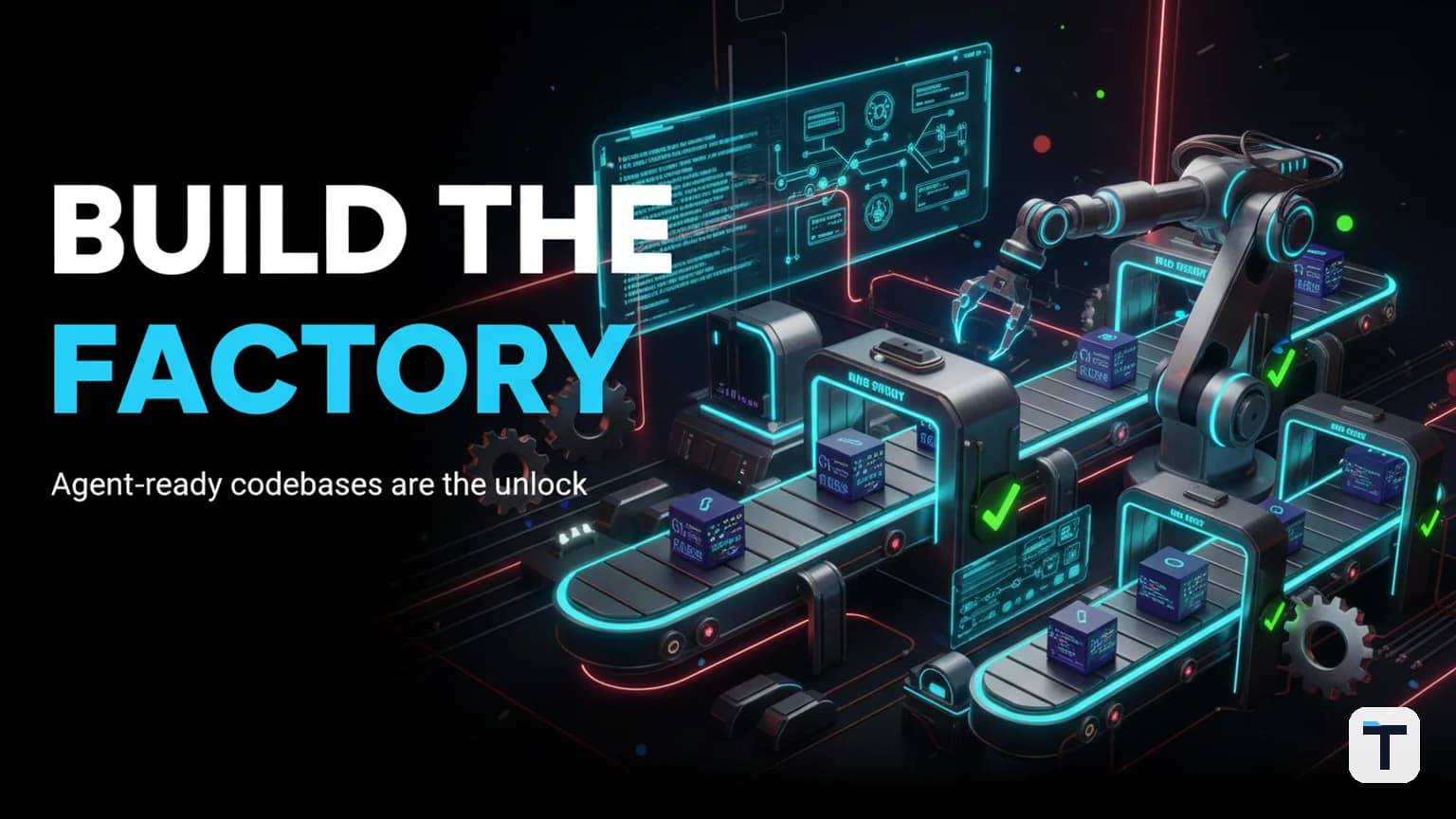

Forward deployed engineering is shifting from a model where humans parachute into customer codebases to one where they build agent-ready software factories — automated pipelines that flow from signal to deploy with minimal human interruption. The bottleneck is no longer model intelligence; it is verification density. If your codebase cannot deterministically validate an agent's work at every step, no frontier model will let you run autonomously.
Last verified: 2026-07-31
- FDE was pioneered by Palantir in the early 2010s; OpenAI, Anthropic, and Google DeepMind now run large FDE teams (TechCrunch, 2026).
- Factory.ai (Sequoia-backed, founded 2023) builds "Droids" — autonomous coding agents that achieved #1 on Terminal-Bench at 58.8% and 19.27% on SWE-bench Full (Factory technical report, 2024; Terminal-Bench results, 2026).
- FDE job postings grew over 700% year-over-year (Business Insider, 2026).
- Verdict: The deployed engineer's job is not to do custom work for customers — it is to make the product self-assemble, make the codebase agent-ready, and prove the ROI loop. The organizations that win are the ones that invest in deterministic validation loops, not just better prompts.
What Is a Software Factory?
A software factory is the automated pipeline that every engineering organization already runs — often implicitly and instrumented poorly. Signals from the outside world (customer conversations, bug reports, Slack threads, executive directives) flow in, humans prioritize and triage them, plans are converted into code changes, changes pass through validation (code review, QA, security scans, linters, type checkers), and the result ships and deploys. Deployed software then generates new signals, and the loop repeats.
The thesis is straightforward: if you can instrument and automate each stage of this pipeline and connect signal-to-deploy without a human blocking the flow, you achieve autonomous software development. The humans are still part of the system — they design, refine, and scale it — but they are no longer manually routing every change through the pipeline.
This is built, not bought. No platform snaps its fingers and produces a software factory. It requires investment from the organization in the form of agent readiness, workflow design, and a clear autonomy maturity model. For a deeper look at why most enterprise AI pilots fail without this kind of process re-engineering, see our analysis of why AI fails in the enterprise.
What Does "Agent Ready" Actually Mean?
Agent readiness is a measurable property of a codebase: the density of deterministic validation loops it contains. Linters, type checkers, unit tests, integration tests, security scans (SAST), and end-to-end tests are all examples. Each one is a binary gate — the code passes or it does not. The more of these gates exist, and the more comprehensively they cover the codebase, the longer an AI agent can operate autonomously on complex tasks without human intervention.
This is not a vague qualitative property. It directly determines how much autonomy you can grant. A codebase with a thin test suite and no static analysis gives an agent almost nothing to verify its work against — so a human must review every change. A codebase with comprehensive tests, type checking, linting, and CI gates gives an agent dense reward signal at every step, keeping it on track over long-running, multi-file tasks.
Why does this work? It mirrors how the models themselves are trained. Frontier LLMs receive dense reward during post-training on complex tasks. Those verification signals form the basis of the reward that keeps the model on track over a long, goal-directed problem. Your codebase's validation loops are the equivalent of that reward signal in production.
For organizations evaluating whether FDEs are the right investment, our 2-question test for when your company actually needs forward deployed engineers covers the decision framework.
How Is This Different From the Original Palantir Model?
The original forward deployed engineer, pioneered by Palantir in the early 2010s under the internal codename "Delta," embedded software engineers directly into customer environments to customize platforms around the nuances of the real world (fde10x.com, 2026; Ramp Builders Blog). By 2009, Palantir had 120 forward deployed engineers; up until roughly 2016, the company had more FDEs than traditional software engineers (Wikipedia).
That model made sense when the only way to integrate deeply into a customer's environment was to physically send engineers behind the curtain. But the role has fragmented. Today, "forward deployed engineer" can mean professional services work, product customization, net-new development on top of a platform, or — in the newest pattern — building out the infrastructure for autonomous agents to operate inside the customer's environment.
| Dimension | Palantir-era FDE | Software-factory FDE |
|---|---|---|
| Primary deliverable | Customized platform deployment | Agent-ready codebase + automated pipeline |
| Human role | Manually writing integrations | Designing and maintaining the system that builds software |
| Customer relationship | Ongoing consulting | Self-assembled product + occasional hands-on enablement |
| Revenue model | Billable hours + platform license | Platform license; customer owns the factory |
| Scalability | Linear with headcount | Exponential with agent autonomy |
The critical distinction: the software-factory model explicitly rejects professional services. When a customer asks for a codebase modernization that big consulting firms quoted at a high price, the modern FDE's job is not to do that migration — even using their own product. Custom work does not make the product better, and it does not scale. Instead, the deployed engineer's role is to be the tip of the spear of the product: the stream of information from the largest, most critical customers back into the product team so the product can rapidly adapt.
Our deeper comparison of how to structure a forward deployed engineering team that scales without becoming a custom dev shop covers the org design side of this shift.
What Is the Autonomy Maturity Model?
Most organizations do not have an autonomy maturity model. They have no roadmap, no conception of what it means to build an autonomous software organization. The model is simple in outline but hard in execution:
| Stage | What happens | Autonomy ratio |
|---|---|---|
| 0. Manual | Humans write all code; AI is autocomplete at best | ~0% |
| 1. Assisted | AI drafts code; humans review and merge everything | ~10-20% |
| 2. Supervised autonomy | AI handles scoped tasks; humans approve at gates | ~40-60% |
| 3. Validated autonomy | AI runs long-horizon tasks; deterministic gates validate | ~70-85% |
| 4. Full autonomy | Signal-to-deploy with no human interruption | ~90-100% |
The "autonomy ratio" is the ratio of actions done by AI systems to actions done by humans before interruption. The companies at the frontier today report ratios in the upper 80% range for portions of their codebase — not the whole thing. Internal tools and tightly constrained workflows can reach near-100% autonomy; core systems with hard visual problems or ambiguous requirements stay lower.
The shift from writing software to maintaining a system that builds software is a real-level abstraction upgrade. It is difficult, and even thoughtful engineers face a learning curve. The people best suited for this transition are DevEx engineers who already think about enablement of other developers, and product managers who want to become deeply technical.
What Are "Missions" and How Do They Work?
A Mission is the operating unit of high-autonomy agent work: a long-running harness that takes a bounded, well-specified task and pushes inference until the task is complete. The human defines the task and what "complete" means (the verification criteria). The agent then runs — potentially for hours or days — generating and validating solutions until the gates pass.
The effectiveness of a Mission is directly proportional to the degree to which the task is verifiable. If you can frame a problem as a set of verification systems that need to validate the output, you can solve it with AI today. If you cannot — if "done" is subjective, aesthetic, or requires external context the agent does not have — you need humans in the loop.
This is why agent readiness matters more than model selection. The same frontier model that excels on a well-tested codebase flounders on one with no validation gates. For teams exploring the operational and ROI side of deploying AI coding agents at scale, our forward deployed engineering and AI coding agents ROI playbook breaks down the metrics that matter.
How Do You Make a Codebase Agent-Ready?
Making a codebase agent-ready is a concrete engineering effort, not a philosophical shift. Here is the practical sequence:
Audit your validation loops. List every deterministic gate in your CI/CD pipeline: linters, type checkers, unit tests, integration tests, E2E tests, SAST scans, dependency checks. For each, note coverage percentage and which parts of the codebase are uncovered.
Fill the gaps. Roughly 30-40% of agent-readiness improvements are low-hanging fruit: add missing type annotations, expand test coverage to untested modules, wire up static analysis. An agent can often fix these itself with a single prompt.
Design for the remaining 60%. The harder cases involve workflow changes. Humans are not used to the nitpickiness of automated validation systems, and introducing stricter gates can interrupt existing dev flows. This requires organizational awareness — you are changing how people work, not just how code is checked.
Define verification criteria per task type. For each category of work the agent will handle (bug fixes, migrations, feature work, refactors), write down what "done" means in deterministic terms. If you cannot express it as a passing test or a passing gate, the agent cannot self-verify.
Start with constrained workflows. Internal tools, documentation pipelines, and tightly scoped migrations are the easiest places to reach near-100% autonomy. Use these as proof points before expanding to core systems.
Measure the autonomy ratio. Track the percentage of actions taken by AI versus humans per workflow. This is your maturity metric. The goal is to move it upward over time by adding validation density, not by loosening human review.
Who Should Be a Deployed Engineer in the Software-Factory Model?
The role profile is narrow and specific. The best candidates are:
- Former founders — people who have owned outcomes end-to-end and can navigate both engineering and business reasoning.
- Technical communicators — people fluent enough in AI to speak to every level of an organization, from on-the-ground engineers to executive leadership, with business acumen and executive presence.
- Systems thinkers — people who love designing systems, closing feedback loops, modeling data flows, and understanding how work moves through a complex organization.
The work itself combines engineering knowledge, business knowledge, and product thinking. A deployed engineer must understand the customer's environment, what flows through it, and how to prove a clear ROI story: every code change that gets AI code review, AI QA, and AI security analysis is measurably less likely to hit production bugs, which improves customer satisfaction, which drives revenue.
What Does Model Independence Mean and Why Does It Matter?
A software factory built on a single-model vendor lock-in is fragile. If your autonomous pipeline depends entirely on one model provider — with no ability to swap models per task, no ownership of the traces and data flowing through the system, and no control over what the model can and cannot do — you are betting your engineering velocity on a vendor's roadmap and pricing.
The alternative is model independence: a harness that routes across multiple frontier models (Claude, GPT, Gemini) per task, owns all traces and data, and lets you air-gap the system entirely for the most security-sensitive environments (finance, health care, government). Factory's Droid platform is built around this principle — its Terminal-Bench results show that the top three single-model configurations (Claude Opus 4.1 at 58.8%, GPT-5 at 52.5%, Claude Sonnet 4 at 50.5%) all outperform multi-model agents from other vendors, while preserving the customer's freedom to choose (Factory Terminal-Bench, 2026).
Factory's pricing reflects this: the Pro tier starts at $20/month for individuals, with Plus at $100/month and Max at $200/month, while Teams and Enterprise tiers offer custom governance, SSO/SCIM, audit logging, and air-gapped deployment options (Factory pricing, accessed 2026-06-16; aiidelist.com review).
What Is the Epcot Problem and Why Does It Matter for Adoption?
There is a delicate balance in demonstrating the future. Build an example that is too advanced — too far from how the rest of the world works today — and people will dismiss it as a theme park, an unrealistic showcase that could never apply to their reality. Build an example that is too modest, and nobody sees the future is achievable.
The goal is to create a working example of a codebase of the future — one that runs largely on autopilot, with comprehensive validation, dense feedback loops, and high autonomy — that is achievable enough that other teams look at it and say, "That is cool. Let us bring that to our part of the codebase." The lesson: if you have a working exemplar, people are clever. They will adapt it. But if your exemplar is too far removed from reality, it becomes a curiosity, not a model.
This is why deployed engineers do not just build one perfect factory and leave. They build the exemplar in a couple of places, prove it works, and then hand the model over so the customer's own team can scale it across the company. The deployed engineer is the catalyst, not the permanent operator. For teams running parallel AI coding agents to accelerate this kind of work, our guide to running parallel AI coding agents for free covers one practical setup.
What This Means for You
If you are an engineering leader, the action is to audit your verification density before you invest in agents. Count your deterministic gates. Measure your test coverage. Map which workflows are fully verifiable and which are not. The gap between where you are and where you want to be is not a model problem — it is an infrastructure problem you can solve with engineering work today.
If you are a builder or a developer, the opportunity is to become the person who designs these systems. The deployed engineer role in the software-factory model combines deep technical knowledge, business reasoning, and systems thinking — and the demand is growing faster than the supply, with job postings up over 700% year-over-year (Business Insider, 2026).
If you are evaluating AI coding platforms, insist on model independence. A platform that locks you to one model is betting your engineering future on one vendor. The platforms that survive the next two years will be the ones that let you own your traces, your data, and your model routing.
FAQ
Q: What is a software factory in the context of forward deployed engineering? A: A software factory is an automated pipeline that flows from external signals (customer requests, bug reports, executive directives) through prioritization, planning, code changes, validation, and deployment — ideally with no human interruption between signal and deploy. The humans design and maintain the system rather than manually routing each change.
Q: What does "agent readiness" mean for a codebase? A: Agent readiness is the density of deterministic validation loops (linters, type checkers, unit tests, integration tests, SAST scans) in a codebase. The more gates exist and the more comprehensively they cover the code, the longer an AI agent can operate autonomously without human review. It is the single most important factor in achieving high autonomy ratios.
Q: How is the software-factory FDE model different from the original Palantir model? A: The Palantir model embedded engineers to manually customize platforms inside customer environments. The software-factory model explicitly rejects ongoing professional services — the deployed engineer builds agent-ready infrastructure, proves the ROI loop, and hands the model over so the customer's team can scale it. The deliverable is a self-assembling system, not billable hours.
Q: What is an autonomy ratio and how do you measure it? A: The autonomy ratio is the percentage of actions performed by AI systems versus humans before interruption, per workflow. You track it by logging which steps in a pipeline were executed by an agent and which required human intervention. The goal is to increase it over time by adding verification density — not by loosening human review standards.
Q: What are Missions in the context of autonomous software development? A: A Mission is a long-running agent harness that takes a bounded, well-specified task and pushes inference until the task is complete. The human defines the task and its verification criteria; the agent runs autonomously, validating its own work against deterministic gates. Missions are only effective when the task is fully verifiable.
Q: Do I need model independence, or is one provider enough? A: Model independence matters because model capabilities are highly task-dependent, vendor pricing changes, and a single-vendor dependency is fragile. A harness that routes across Claude, GPT, and Gemini per task — and lets you own your traces and data — protects your engineering velocity from vendor lock-in. The same harness with different models already shows 8+ point swings on benchmarks like Terminal-Bench.
Discussion
0 comments