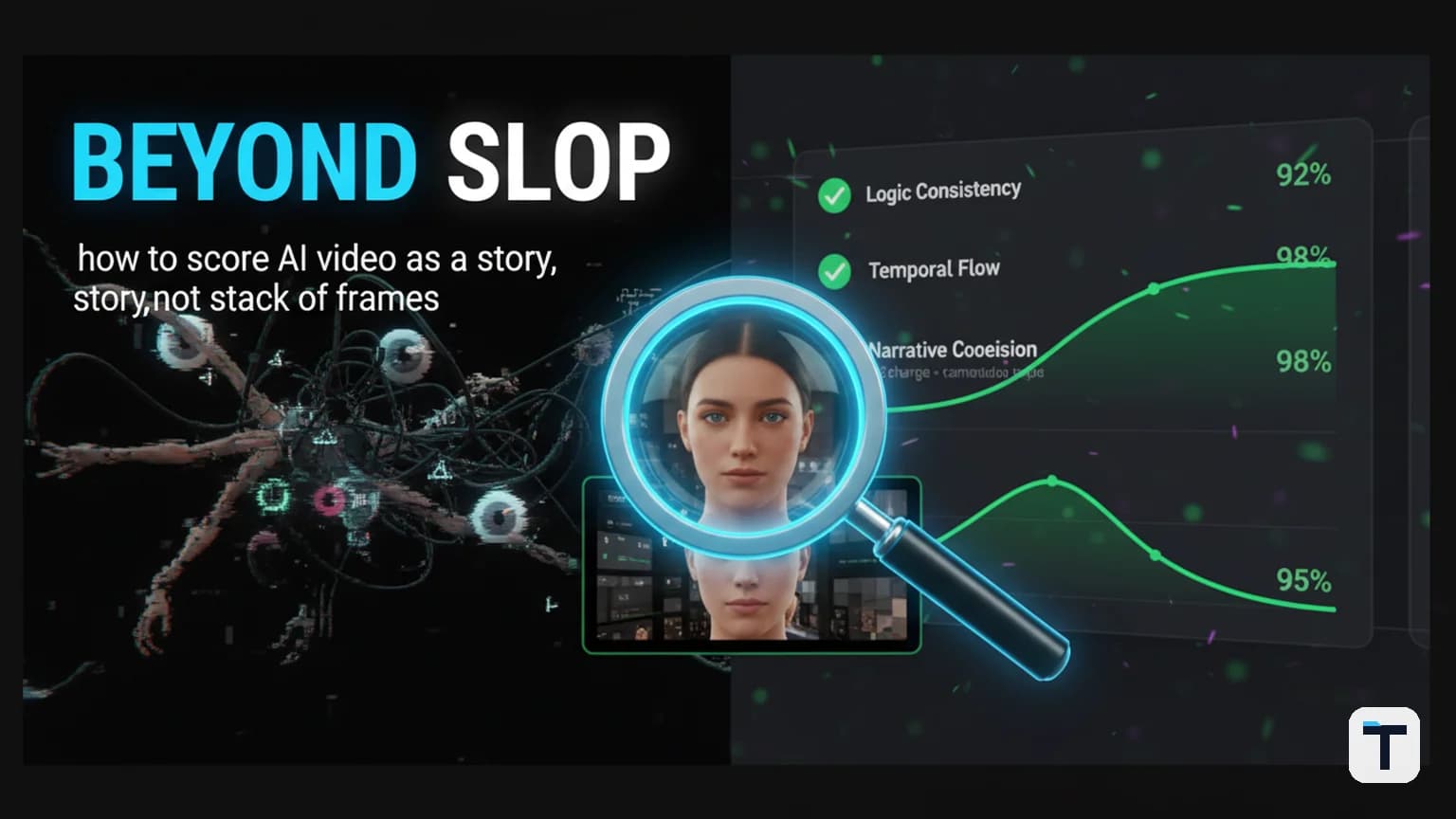

AI-generated video has never been cheaper to produce or harder to judge. Models like Veo 3.1, Kling 3.0, and Sora 2 can render photorealistic clips in seconds — but most of what they produce is riddled with hallucinations: extra limbs, floating characters, broken physics, and audio that drifts from the visuals. The bottleneck has shifted from generation to evaluation, and the tools most teams still rely on were built for a previous era. The fix is a multi-axis evaluation framework that scores video as a storytelling medium — not as a stack of individual frames — and embeds quality checks inside the generation loop, not after it.
Last verified: 2026-07-30
- Traditional metrics (CLIP score, LPIPS, FVD) evaluate frames, not stories
- A distilled vision-language model can score a 15-second clip in ~3 seconds
- Relative comparison (A vs. B) outperforms absolute scoring (1–10) for consistency
- Catching drift early — before stitching clips into a 5-minute video — cuts rework cost dramatically
- The shift from fixed pipelines to agentic workflows lets models self-correct during generation
Why Are Traditional Video Metrics Insufficient for Generative Video?
CLIP score, LPIPS, and Fréchet Video Distance (FVD) were designed for the image era, and they do that job well — but video is not a sequence of images. CLIP score measures how well a single frame matches the text prompt that generated it. LPIPS calculates perceptual distance between two images using deep features, which helps detect drift between adjacent frames. FVD compares distributions of real and generated video features in aggregate. All three operate at the frame or distribution level — none of them can tell you whether the video told a coherent story, whether the physics made sense, or whether the audio synced with the action on screen.
A 2025 CVPR Workshop survey on generative AI video evaluation confirmed this gap: traditional metrics like CLIP-Score and FVD "often correlate poorly with human judgment due to their lack of deep vision-language understanding and sensitivity to sample size" (Safavigerdini et al., CVPR 2026W). The survey identified temporal consistency, motion realism, and long-form storytelling coherence as the dimensions where existing metrics most conspicuously fail.
VBench, a comprehensive benchmarking suite introduced at CVPR 2024, attempted to address this by decomposing "video quality" into 16 fine-grained dimensions — subject identity consistency, motion smoothness, temporal flickering, spatial relationships, and more. Its successor, VBench-2.0 (arXiv, March 2025), pushed further into "intrinsic faithfulness," adding dedicated evaluation axes for physics-based realism, commonsense reasoning, human motion fidelity, and creativity. That work validates what practitioners have found empirically: you need to score the axes that matter, not just the ones that are easy to compute.
What Should You Actually Evaluate in AI-Generated Video?
The most useful evaluation framework treats video as a storytelling medium and scores it along axes that matter to viewers — not axes that are trivially computable. Based on production systems and academic literature, here are the five axes that carry the most signal:
| Axis | What It Checks | Why Traditional Metrics Miss It |
|---|---|---|
| Storytelling coherence | Does the video tell the intended narrative from start to finish? | CLIP score only checks single-frame prompt match; it cannot evaluate whether a sequence of shots adds up to a story. |
| Physics consistency | Do objects obey physical laws — gravity, collisions, momentum? | LPIPS detects pixel-level frame drift but cannot reason about whether a character is hovering or walking. |
| Character consistency | Does the same character look the same across all shots? | Frame metrics cannot track identity across cuts; they compare adjacent frames, not scenes minutes apart. |
| Pacing | Does the temporal progression make sense — does it take the right amount of time to go from one place to another? | No standard metric addresses narrative pacing; FVD measures aggregate distribution, not narrative timing. |
| Audio-visual sync | Does the sound of a door slamming occur at the exact frame the door slams? | Audio evaluation is almost entirely absent from standard video quality metrics. |
VBench-2.0's five evaluation dimensions — Human Fidelity, Controllability, Creativity, Physics, and Commonsense — overlap significantly with this framework. The key insight from both research and production systems is the same: score the axes you actually care about. Don't expect a single frame-level score to magically encompass storytelling quality.
How Do You Build a Fast, Repeatable Video Evaluation System?
Building a production-grade video evaluation system requires four stages, moving from slow-but-thorough to fast-and-integrated.
Stage 1: Assemble the Committee of Experts
Start with a repeatable benchmark that combines multiple evaluation approaches:
- Frame-level metrics — Use CLIP score for prompt adherence on individual frames and LPIPS for frame-to-frame perceptual consistency. These run on both CPU and GPU and are cheap.
- LLM-as-a-judge — Feed the video to a frontier multimodal LLM and ask it to evaluate the axes above. LLM judges are flexible but slow, and their output varies significantly based on prompt wording.
- Human annotation calibration — Have human annotators regularly score a random subset of videos across multiple axes. Feed that feedback back into the LLM-judge prompts to align the judge with human quality standards.
This approach works and produces aligned results — but it is expensive and, critically, it happens too late. By the time the committee scores a video, the generation cost is already sunk.
Stage 2: Distill Into a Fast Evaluation Model
The committee's knowledge can be distilled into a single small vision-language model (VLM) that scores video fast enough to live inside the generation loop. A production implementation at Character.AI used this approach: the distilled VLM scores a 15-second video in approximately 3 seconds, providing per-axis feedback about why a video scored low (extra limb, physics violation, audio desync) rather than just a binary slop-or-not verdict.
The VLM architecture is essential because the model needs to actually see the video frames — a text-only LLM cannot evaluate visual quality. Qwen2-VL (arXiv 2409.12191, Sept. 2024), for example, ships in 2B, 8B, and 72B parameter sizes and supports understanding videos over 20 minutes in length, making it a practical base for distilled evaluation models. The smaller sizes (2B–8B) match the speed-first requirement: the Character.AI team tested a larger model that produced better results but was "significantly slower" — the marginal quality gain did not justify the latency cost when the goal was in-loop evaluation.
Stage 3: Train on Relative Comparisons, Not Absolute Scores
The single most impactful design choice in training a video quality model is this: don't score, compare.
If you ask ten people to rate a video's storytelling from 1 to 10, you will get ten different answers with wide variance. But if you show those same people two videos and ask "which one tells a better story?", the vast majority will agree on the winner. This observation — borne out in preference-modeling research across modalities — means that training on pairwise comparisons (Video A vs. Video B) produces a far more consistent and generalizable model than training on absolute scores.
To generate training data, you need both good and bad video pairs. Good video is easy to find — the internet is full of high-quality footage. Bad video can be manufactured by either corrupting good video (introducing frame glitches, reversing temporal order, desyncing audio) or by generating intentionally flawed AI clips.
A critical pitfall: if your pairs are "real footage = good, AI footage = bad," your model may not learn quality — it may learn to detect whether something is AI-generated. This overfits to encoding artifacts and surface-level "gloss," producing a model that confidently scores videos based on vibe rather than substance. One production team reported a V1 model that scored a frozen still image 9.2 out of 10 for "cinematography" because the camera didn't move for 4 seconds — the model mistook no motion for excellent camera work.
The fix is careful data engineering:
- Match encoding quality across both sides of the pair so there are no resolution, compression, or artifact differences for the model to exploit
- Use identical annotation methods for real and AI footage so all axes are scored the same way regardless of source
- Corrupt good videos to create controlled badness rather than relying solely on AI generation artifacts, so the model learns what "bad" looks like independent of its source
Stage 4: Move From Pipelines to Agentic Workflows
The final shift is architectural. A fixed evaluation pipeline works well for a single, well-defined use case — but once users bring their own characters, images, and narrative intentions, rigid pipelines cannot adapt. The alternative is an agentic workflow: give a generation agent the evaluation model as a tool. The agent generates a clip, validates it against the quality axes, identifies the specific problem, and regenerates or corrects — all within the same generation loop.
This matters for unit economics. A three-to-five-minute AI video is typically a collection of many short (4–8 second) clips stitched together. If you evaluate each clip as it is generated — before stitching — a bad 6-second clip costs almost nothing to regenerate. If you evaluate only after the full edit, you have already paid for all the generation, editing, and compositing time. The sooner you catch drift, the cheaper it is to fix. This is analogous to catching a bug at the type-checker stage versus catching it in production — the cost differential is orders of magnitude.
This same principle — close the evaluation loop around the generation — generalizes beyond video. If you are building closed-loop AI agent evaluation for production systems, the same four-stage pattern applies: assemble experts, distill into a fast evaluator, train on relative judgments, and embed the evaluator in the loop where the agent can use it to self-correct. The same is true for one-shot build-testing of AI coding models — evaluating each component as it is generated, not just the final assembly, catches failures at a fraction of the cost.
How Do You Evaluate Audio-Visual Synchronization?
Audio evaluation is one of the most underdeveloped areas in AI video quality. The approach used in production systems combines two techniques:
- Audio quality assessment — Use a dedicated audio quality model to ensure sound is intelligible and free of artifacts. The model can verify that the audio track itself is clean before checking sync.
- Key-frame correlation — The VLM learns to identify key visual events in the video (a door slamming, a person speaking). When provided with the generation prompt (e.g., "the door slammed"), it looks for the visual event and checks for a corresponding spike in the audio waveform at that timestamp. The model does not need to recognize the specific sound — it needs to confirm that an audio event occurs at the same timestamp as the matching visual event.
Lip syncing remains an acknowledged unsolved problem, particularly for animated characters whose mouth movements have no natural correlation to speech. For realistic human characters, lip-sync detection techniques exist but are imperfect; for stylized or animated characters, the concept itself breaks down.
What Does a Comparison of Evaluation Approaches Look Like?
| Approach | Speed | Cost | What It Evaluates | Best For |
|---|---|---|---|---|
| CLIP score (per-frame) | Very fast | Very low | Single-frame prompt adherence | Spot-checking whether a frame matches its prompt |
| LPIPS (frame pairs) | Fast | Low | Perceptual distance between adjacent frames | Detecting inter-frame drift and flicker |
| FVD (distribution) | Moderate | Moderate | Aggregate real-vs-generated distribution comparison | Research benchmarking, model-level quality |
| LLM-as-judge | Slow | High | Any axis prompted — storytelling, physics, pacing | Early alignment with human judgment |
| Distilled VLM (pairwise) | Very fast (~3s/15s clip) | Low | Multi-axis, with per-axis attribution | In-loop production evaluation |
| Human annotation | Very slow | Very high | Everything — the ground truth | Calibrating automated judges |
The practical answer is not to pick one — it is to use all of them at different stages: humans and LLM-judges for calibration and training data, frame metrics for cheap spot-checks, and the distilled VLM for real-time in-loop evaluation at production volume.
What This Means for You
If you are building AI video features into a product: embed evaluation inside the generation loop, not after it. The cost difference between catching a drift before you stitch clips and catching it after the full edit is enormous. Start with a committee (frame metrics + LLM judge + human calibration), then distill into a fast VLM once you have enough annotation data.
If you are evaluating AI video for marketing or content production: don't trust a single score. Check the five axes independently — especially physics and character consistency, which are where current models fail most visibly. Compare candidate clips pairwise rather than scoring each in isolation; relative judgment is more reliable. And remember that AI-generated content, like any AI output, has systematic blind spots — understanding where AI fails the comprehension test helps you set realistic expectations for what automated evaluation can and cannot catch.
If you are building evaluation tooling: the open-source ecosystem is still maturing. VBench and VBench-2.0 offer a structured 16–18 dimension framework with human-aligned scoring. The Q-Save benchmark (arXiv 2511.18825) provides ~10,000 annotated videos with fine-grained attribution labels across visual quality, dynamic quality, and text-video alignment. Use these as starting points rather than building from scratch. For more open-source AI tooling worth watching, see our roundup of free open-source AI tools on GitHub.
FAQ
Q: Can CLIP score evaluate AI-generated video quality? A: No. CLIP score measures how well a single frame matches the text prompt that generated it. It cannot evaluate storytelling coherence, physics consistency, character consistency across shots, pacing, or audio-visual sync — all of which are critical for video quality. Use it for per-frame prompt adherence checks, not as a holistic video quality metric.
Q: What is the fastest way to evaluate AI video quality at production scale? A: Distill a small vision-language model (e.g., Qwen2-VL 2B or 8B) trained on pairwise comparisons. A production system at Character.AI achieved ~3-second scoring for a 15-second clip — fast enough to embed inside the generation loop. The model provides per-axis feedback (storytelling, physics, character consistency, pacing, audio sync), not just a binary slop verdict.
Q: Why does relative comparison work better than absolute scoring for video quality? A: Human annotators show high variance when assigning absolute scores (1–10) but strong agreement when making pairwise comparisons (A vs. B). Training a model on pairs produces more consistent, generalizable results because the model learns what "better" looks like across many comparisons rather than trying to calibrate to an arbitrary absolute scale that no two humans agree on.
Q: Should I evaluate every AI-generated clip or just the final stitched video? A: Evaluate each clip inside the generation loop before stitching. A 5-minute AI video is typically a collection of dozens of 4–8 second clips. Catching drift or physics violations at the clip stage costs nearly nothing to fix (just regenerate the clip). Catching them after the full edit means you have already paid for all generation, compositing, and editing time — the rework cost is orders of magnitude higher.
Q: Is AI video "slop" detectable automatically? A: Partially. Common failure modes — extra limbs, hovering characters, physics violations, frame flicker — can be detected by a trained VLM scoring axes independently. However, "slop" is ultimately a judgment about whether a video tells its story well, which is subjective and evolves with taste. The best practice is to calibrate automated judges against regular human annotation sessions, not to fully automate the verdict.
Q: Is lip sync a solved problem for AI-generated video? A: No. Lip sync remains an acknowledged unsolved challenge, particularly for animated characters whose mouth movements have no natural correlation to speech. For realistic human talking-head characters, techniques exist but are imperfect. Production systems at Character.AI have reported this as an active area of ongoing work.
Discussion
0 comments