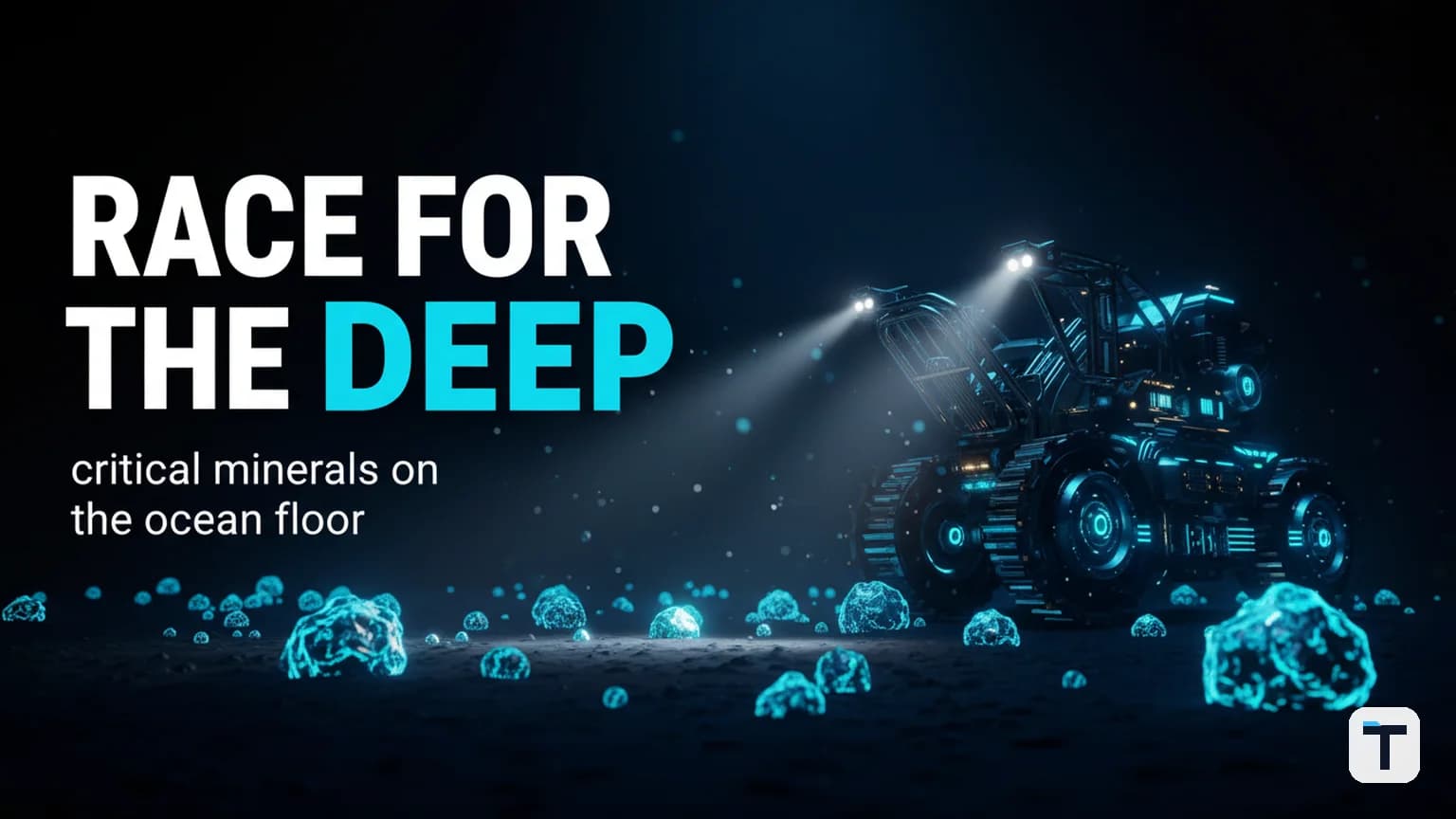

Verdict: The Seabed Is the Next Critical Minerals Frontier
Deep-sea mining is the extraction of mineral-rich concretions — primarily polymetallic nodules — from the ocean floor at depths of 4,000 to 6,000 meters. These potato-sized rocks contain manganese, cobalt, nickel, and copper in concentrations that rival or exceed the richest land deposits. With land-based supply chains increasingly dominated by China, the seabed has become a geopolitical chess piece. A US executive order in April 2025 authorized unilateral seabed mining claims in international waters, bypassing the International Seabed Authority. China holds more exploration contracts than any other nation. Thirty-seven countries have called for a moratorium. The question is no longer whether deep-sea mining will happen — it is who controls the minerals, and at what cost to the least-explored ecosystem on the planet.
TL;DR: Why Deep-Sea Mining Matters Now
- The Issue: The world needs more cobalt, nickel, copper, and manganese for batteries, semiconductors, AI data centers, and renewable energy infrastructure. Land-based supplies are concentrated in volatile regions, and demand is outpacing new discoveries.
- The Insight: The Clarion-Clipperton Zone (CCZ) in the Pacific Ocean holds an estimated 21.1 billion dry tons of polymetallic nodules — potentially the largest untapped mineral deposit on Earth. But it sits in international waters governed by a treaty the United States never ratified.
- The Stakes: Whoever controls these nodules controls a slice of the future energy and technology economy. China has been positioning for years. The US is now pushing to catch up through unilateral action that could fracture the international legal order governing the deep seabed.
What Are Polymetallic Nodules?
Polymetallic nodules are mineral concretions that form over millions of years on the abyssal plain, at depths between 4,000 and 6,000 meters. They look like lumpy black potatoes, typically 5 to 10 centimeters across, and they carpet vast stretches of the deep ocean floor.
They are not rock. They are metal. A typical nodule from the Clarion-Clipperton Zone contains roughly 30% manganese, 1.5% nickel, 1% copper, and 0.2% cobalt — alongside smaller amounts of molybdenum, zinc, and rare earth elements. Those four base metals are the backbone of the clean-energy transition: manganese and nickel for battery cathodes, copper for wiring and electronics, cobalt for battery stability and high-performance alloys.
What makes nodules attractive is not just their composition — it is their form. Unlike land-based ores, which require digging pits and processing tons of rock to extract thin seams of metal, nodules sit on the surface of the seabed. You do not need to blast or tunnel. You collect them. The environmental trade-off is different: instead of destroying rainforest or displacing communities, you potentially destroy benthic ecosystems that scientists have barely studied.
The Clarion-Clipperton Zone: The Richest Patch Nobody Owns
The Clarion-Clipperton Zone (CCZ) is a 4.5-million-square-kilometer region of the Pacific Ocean between Hawaii and Mexico. It is the most studied and most coveted deep-sea mineral province on Earth. The USGS and International Seabed Authority estimate it holds roughly 21.1 billion dry tons of nodules.
To put that in perspective: the CCZ contains more cobalt, nickel, and manganese than all known land reserves combined, according to multiple assessments. It is the single largest deposit of these metals in any form, anywhere on the planet.
But the CCZ sits in international waters — the "Area" in UNCLOS terminology. The Area and its resources are designated under Article 136 of the United Nations Convention on the Law of the Sea as the "common heritage of mankind," to be administered by the International Seabed Authority (ISA), a body established under the 1982 convention.
The ISA has issued 17 exploration contracts for the CCZ to date, covering approximately 1.2 million square kilometers. But none of these contracts has converted to a commercial exploitation license. The ISA has been drafting a mining code — the regulatory framework for commercial extraction — for over a decade, and it remains incomplete.
The Supply Chain Problem: Why the Seabed Looks Attractive
The push toward deep-sea mining is not happening in a vacuum. It is a response to a materials crunch that is tightening by the year.
Cobalt: The Democratic Republic of the Congo produces roughly 70–80% of global cobalt supply. China controls approximately 72% of cobalt and copper mining in the DRC through state-backed companies and equity stakes, according to analysis by C4ADS. This means the world's cobalt supply is effectively a Chinese-controlled chokepoint in a conflict-prone region.
Nickel: Indonesia produced approximately 60–61% of global nickel in 2024. Chinese companies control an estimated 75% of Indonesian nickel processing capacity, giving China effective dominance over the nickel used in stainless steel and EV battery cathodes.
Copper: The International Energy Agency projects copper demand will grow from roughly 27 million tons in 2024 to 33 million tons by 2035 and 37 million tons by 2050. Meanwhile, mine output from existing sources is projected to peak around 24 million tons in the late 2020s and decline to below 19 million tons by 2035 as ore grades fall and aging mines deplete.
These are not abstract projections. They are the reason automakers, battery manufacturers, and semiconductor companies have begun exploring alternative supply sources. The deep seabed is the largest untested option on the table.
The US-China Race for the Seabed
The strategic competition over deep-sea minerals mirrors the broader technology competition between the United States and China — and the seabed is one arena where China has a meaningful head start.
China holds five ISA exploration contracts — more than any other country — covering areas in the CCZ, the Indian Ocean ridge, and the Western Pacific. Chinese companies, backed by state financing, have invested years in nodule collection technology, metallurgical processing, and environmental baseline research. China's strategy has been methodical: secure contracts, build capability, wait for the regulatory window to open.
The United States took a different approach. On April 24, 2025, President Trump signed Executive Order 14285, "Unleashing America's Offshore Critical Minerals and Resources," which authorized the US to issue seabed mining licenses in both its own Exclusive Economic Zone and — controversially — in areas of the international seabed beyond national jurisdiction. The directive effectively asserted that the US can grant mining permits in international waters without ISA approval.
This is legally explosive. The US signed the 1994 Agreement relating to the implementation of UNCLOS Part XI (the seabed mining provisions) but has never ratified UNCLOS itself. The US argument is that it is not bound by the convention's deep-seabed mining regime because it is not a party to the treaty. The counterargument, from ISA members and UNCLOS parties, is that UNCLOS Part XI and the 1994 Agreement reflect customary international law — and that unilateral mining in the Area violates the "common heritage of mankind" principle regardless of US ratification status.
The result is a standoff. China is working within the ISA system, accumulating contracts and influence over the regulatory process. The US is moving outside it, attempting to create a parallel licensing regime. Both are racing for the same minerals, but under different legal frameworks, and neither has begun commercial extraction.
The Environmental Frontier We Barely Understand
The deepest argument against mining the CCZ is the one we know the least about: the ecosystem itself.
The abyssal plain at 4,000–6,000 meters depth is one of the least-explored environments on Earth. The basic science is sobering. Studies in the CCZ over the past decade have revealed species new to science on virtually every research cruise. A 2020 study in the journal Nature found that the majority of meiofauna (microscopic animals) collected from CCZ nodule fields belonged to species not yet described. Nodule fields are not barren — they are slow, ancient, and diverse in ways we are only beginning to measure.
The argument for mining is efficiency: nodules sit on the surface, so there is no need for the kind of habitat destruction that strip mining or deep-pit mining causes on land. Nodule collection — essentially vacuuming rocks off the seabed — is technologically simpler and potentially less carbon-intensive than opening a new terrestrial mine.
The argument against is irreversibility. Deep-sea ecosystems operate on timescales that make terrestrial ecosystems look fast. Nodule growth rates are measured in millimeters per million years. Sediment resuspension from collection activity could smother benthic communities over wide areas. Noise and light from mining ships could disturb mid-water organisms. The full extent of the damage is unknown because the baseline is unknown.
As of 2025, 37 nations had called for a moratorium or precautionary pause on deep-sea mining, including Germany, France, Spain, Canada, Brazil, and several Pacific Island nations. The United Kingdom reversed its prior pro-mining stance in 2023. The supporters of a moratorium argue that the ISA should not approve exploitation contracts until sufficient scientific baseline data exists to assess environmental impacts. The opponents — primarily the mining companies and the countries holding contracts — argue that indefinite delay is functionally equivalent to a ban.
What This Means for Technology and AI Infrastructure
The minerals in CCZ nodules are not just for EVs. They are also the materials that underpin the AI compute buildout.
Copper is the backbone of data center power distribution. Nickels and cobalt are used in advanced battery chemistries that power backup systems and grid-scale storage for renewable-powered facilities. Manganese is increasingly used in lithium-manganese-oxide battery chemistries and as a doping agent in semiconductor manufacturing.
The AI infrastructure boom is creating a parallel surge in demand for these minerals. Data center construction, power transmission, and the manufacturing of advanced chips all require copper, cobalt, and nickel in quantities that strain existing supply chains. The connection is not speculative — it is why companies like Microsoft have invested in critical minerals recycling, and why the US government has added copper to its Critical Minerals List.
Deep-sea mining represents a potential alternate supply route — one that, if developed, could reduce Western dependence on Chinese-controlled processing of Congolese cobalt and Indonesian nickel. It is no accident that the strategic argument for seabed mining is framed in terms of energy security and technology competitiveness, not just resource economics.
The Legal Question: Common Heritage or Law of the Sea?
The central legal tension is whether the "common heritage of mankind" principle can survive unilateral action by a non-party.
UNCLOS Article 136 states: "The Area and its resources are the common heritage of mankind." Article 137 adds that no state can claim sovereignty over any part of the Area, and that rights to resources are administered by the ISA on behalf of mankind as a whole, with benefits to be shared equitably — particularly with developing states.
The US executive order treats this framework as optional. By asserting the right to license mining in international waters without ISA approval, the US is effectively challenging the ISA's monopoly over seabed resource allocation in the Area. If other countries follow suit — or if the US begins issuing licenses that overlap with ISA exploration contracts — the result could be a fragmented governance regime where competing national claims replace a single international authority.
The ISA's 2024 deadline for completing the mining code passed without a finalised framework. As of 2025, the regulatory gap remains. That gap is the space in which the political contest is unfolding: mining companies want certainty, environmental groups want a halt, and the geopolitical players are positioning for whichever outcome prevails.
FAQ: Deep-Sea Mining and Polymetallic Nodules
What is deep-sea mining? Deep-sea mining is the extraction of mineral deposits — primarily polymetallic nodules, but also seafloor massive sulfides and cobalt-rich crusts — from the ocean floor at depths typically ranging from 400 to 6,000 meters. For nodules, collection vehicles crawl along the seabed, vacuuming nodules and pumping them to a surface vessel.
Where are the most polymetallic nodules located? The Clarion-Clipperton Zone — a 4.5-million-square-kilometer region of the Pacific between Hawaii and Mexico — holds the largest known concentration, estimated at 21.1 billion dry tons. The Indian Ocean and the Atlantic also have smaller nodule provinces.
What metals are in polymetallic nodules? Manganese (approximately 30% of nodule mass), nickel (1.5%), copper (1%), cobalt (0.2%), plus trace amounts of molybdenum, zinc, and rare earth elements. The exact composition varies by deposit.
Why is deep-sea mining controversial? It threatens deep-sea ecosystems that scientists have barely studied. The seabed at 4,000+ meters supports slow-growing, poorly understood communities that could take decades or centuries to recover from mining disturbance. Sediment plumes, noise, and light pollution are additional concerns.
Who controls mining in international waters? Under UNCLOS, the International Seabed Authority (ISA) administers mineral resources in the Area — the seabed beyond national jurisdiction. The ISA issues exploration contracts and is tasked with developing a regulatory code for commercial exploitation. However, the mining code is not yet finalised, and the US has asserted the right to issue its own licenses.
Has the US ratified UNCLOS? The United States signed the 1994 Agreement implementing UNCLOS Part XI but has never ratified UNCLOS itself. The Senate has not given its advice and consent. The US nonetheless generally treats most of UNCLOS as customary international law — except for Part XI, which it has challenged through the 2025 executive order.
What is China's position on deep-sea mining? China holds five ISA exploration contracts — the most of any nation — and has invested in nodule collection technology and processing infrastructure for over a decade. China supports the ISA process and is advocating for a mining code that would allow commercial exploitation.
Why do 37 countries want a moratorium? They argue that commercial mining should not proceed until scientific understanding of deep-sea ecosystems is sufficient to assess and mitigate environmental harm. The precautionary pause would give researchers time to establish baselines and give the ISA time to strengthen environmental protections in the mining code.
When will commercial deep-sea mining begin? No commercial exploitation license has been issued by the ISA as of 2025. The mining code remains under negotiation. The Metals Company (TMC), a Canadian-listed firm working in the CCZ, has stated it plans to apply for exploitation licenses under the ISA's two-year rule, which allows exploitation applications if the ISA fails to finalize regulations, though this pathway is contested. The US unilateral licensing approach adds further uncertainty.
Discussion
0 comments