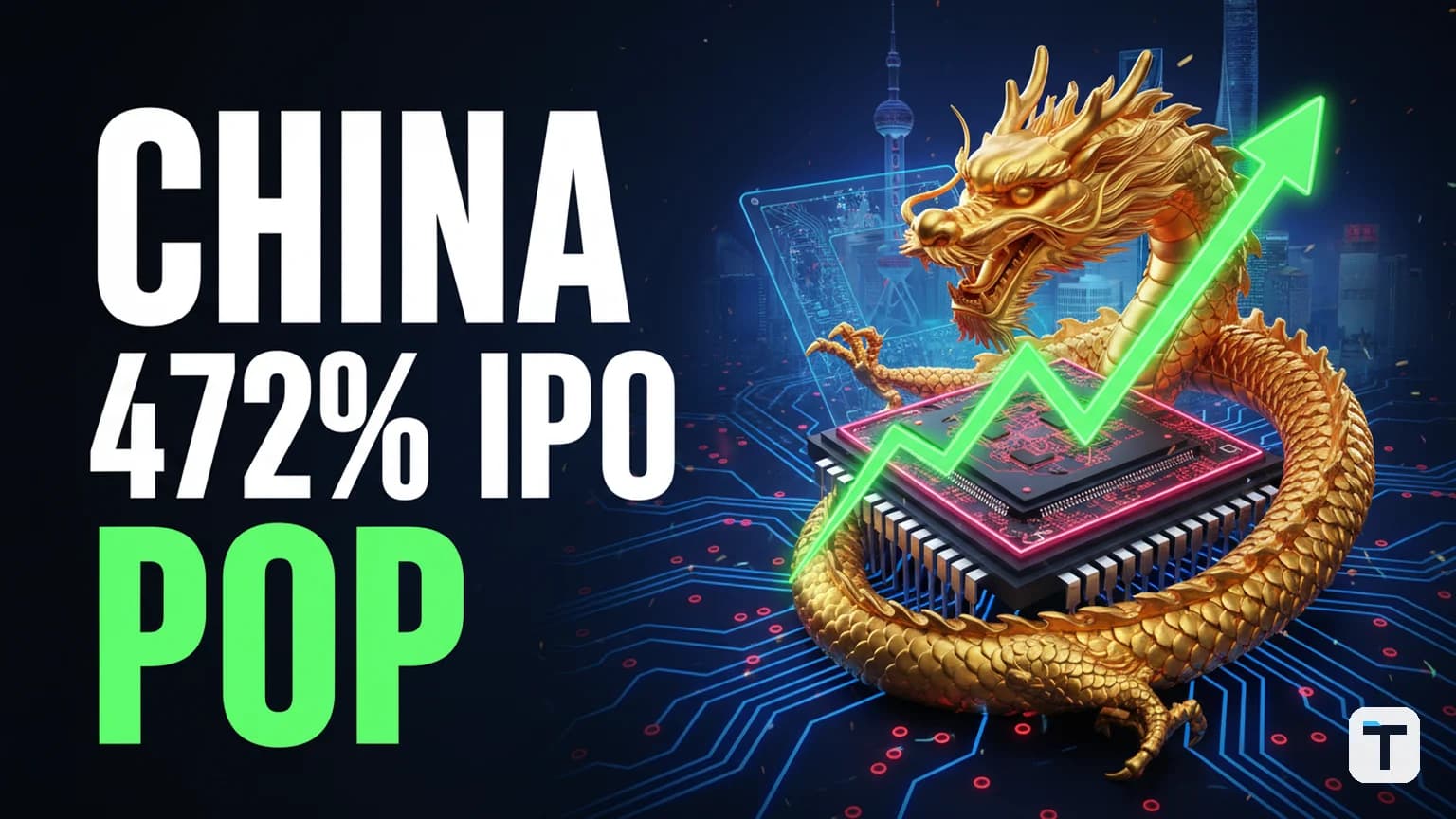

The CXMT IPO priced at 8.66 yuan per share on Monday, 27 July 2026, and closed the morning session at 49.50 yuan on Shanghai's STAR Market, a rise of about 472%. That move gave ChangXin Memory Technologies a market capitalisation of roughly 3.31 trillion yuan (about $489 billion), making the Hefei-based DRAM manufacturer the most valuable company listed on China's mainland exchanges. The offering raised around 57.9 billion yuan (about $8.55 billion), the largest IPO anywhere in Asia so far in 2026.
TL;DR
- CXMT priced its IPO at 8.66 yuan; shares peaked at 49.50 yuan on debut day, a 472% jump.
- Market capitalisation at the peak was roughly 3.31 trillion yuan, or about $489 billion.
- The listing raised approximately $8.55 billion, Asia's biggest IPO of 2026.
- CXMT listed under the STAR Market's newly revised "fifth standard," which waives profit and revenue thresholds for cutting-edge tech firms.
- Q1 2026 revenue reached 50.8 billion yuan, up around 700% year on year, driven by AI memory demand.
- CXMT still cannot access ASML's EUV lithography tools because of US export controls.
What is CXMT and why did it list now?
ChangXin Memory Technologies is China's largest domestic DRAM maker. It was founded in 2016 in Hefei, Anhui province, and began volume production in 2020. By the first quarter of 2026, the company was shipping DDR5 memory into Lenovo laptops and had climbed to roughly 8% of the global DRAM market, up from 3% a year earlier. That puts CXMT in fourth place worldwide behind Samsung, SK Hynix and Micron.
The timing of the listing is deliberate. AI training clusters have absorbed so much high-end memory that commodity DRAM supply is tight, and Apple raised MacBook and iPad prices by roughly $100 to $300 in early 2026, citing higher component costs. SK Hynix completed a $26.5 billion Nasdaq listing earlier in July, signalling how eagerly public markets are pricing memory as an AI input. The CXMT IPO is China's answer to that same trade.
How did the CXMT IPO price and trade on debut?
The company priced 6.68 billion new shares at 8.66 yuan (about $1.30), raising 57.9 billion yuan. Shares immediately traded above the offer price and reached 49.50 yuan by midday. The 472% swing is consistent with prior STAR Market debuts, where retail demand and a five-day absence of daily price limits produce sharp first-session moves.
At 49.50 yuan, CXMT's market capitalisation was about 3.31 trillion yuan, eclipsing Kweichow Moutai and every A-share bank and energy giant on the Shanghai board.
What is the STAR Market's "fifth standard" and why does it matter?
The STAR Market is Shanghai's Science and Technology Innovation Board. In April 2026 the CSRC approved a revised fifth qualification standard for AI chip, semiconductor, robotics and quantum firms. It drops the usual profit and revenue thresholds and lets loss-making companies list on technology position and estimated valuation instead.
That is a structural shift. It creates a mainland-China parallel to the Nasdaq route that has long served US chip and biotech firms, and it removes the earnings discipline that would otherwise keep a company like CXMT private for years. For a lab that is spending heavily on fabs and process R&D while its margins are still catching up, that pathway matters.
Why is CXMT's revenue growing so fast?
The reported first-quarter 2026 revenue of 50.8 billion yuan, up roughly 700% year on year, reflects two things. First, CXMT has moved from trailing-node DDR4 into DDR5 shipments, which sells at higher prices and lands in premium laptop and server designs. Second, the wider AI build-out has drained standard DRAM capacity at Samsung, SK Hynix and Micron toward high-bandwidth memory, leaving room in the commodity market that CXMT has walked into.
CXMT is also an aspiring entrant in HBM, the stacked memory that sits on modern AI accelerators. That segment is currently dominated by SK Hynix at about 58%, Micron at 23% and Samsung at 21% (Counterpoint Research, Q1 2026). CXMT's HBM effort is early stage and is directly constrained by the tooling limits described below.
How do US export controls constrain CXMT?
CXMT cannot buy ASML's extreme ultraviolet (EUV) lithography systems, the machines that Samsung, SK Hynix and Micron rely on for their most advanced DRAM nodes. Under the current US-led export control regime, CXMT is forced to work with older-generation deep ultraviolet tools and rely on multi-patterning to reach comparable geometries, which raises cost and complicates yield.
The political overlay is also live. The US Department of Defense has listed CXMT as a firm with links to China's military, a designation Beijing rejects. US lawmakers have urged the Trump administration to bar American companies from buying CXMT chips on national and economic security grounds. Kyle Chan, a fellow at the Brookings Institution specialising in China's technology policies, notes that CXMT "plays a critical role in China's AI push, particularly in the face of US export controls." Any tightening on that front would affect where CXMT's DDR5 can ship next.
For readers tracking the broader hardware picture, this fits the same pattern as recent deals such as the AMD and Anthropic $5 billion compute agreement, where AI demand and export policy are shaping who can buy what.
What does the CXMT IPO mean for the global DRAM market?
Samsung, SK Hynix and Micron together still control 90% to 95% of global DRAM. CXMT is not about to unseat them. What the IPO does is fund a longer race: an operator with $8.55 billion in fresh capital and a domestic customer base large enough to absorb output can iterate on process nodes and packaging without needing to run at Western margins.
For buyers of AI infrastructure, three effects are worth watching. Commodity DRAM prices may soften over the next 12 to 24 months if CXMT keeps ramping, easing system pricing on non-AI servers and PCs. HBM will remain tight because CXMT is not yet a credible supplier there. Export-control rules will keep moving, so procurement teams outside China should assume that any segment of their memory bill of materials could become subject to new licensing.
The packaging side of this story is also worth tracking, particularly the emerging OSAT capacity outside China. See the note on Paras Defence and India's OSAT semiconductor push for the assembly and test dimension.
Should investors expect the 472% pop to hold?
STAR Market first-day gains do not have daily price limits for the initial five sessions, and they routinely give back a significant share of the move over the following weeks. The relevant number is not 49.50 yuan on day one but the level shares settle at once the free-float base widens and lock-ups begin to matter. CXMT's fundamentals, particularly the DDR5 ramp and any progress toward HBM, will do the work from there.
FAQ
Q: When did CXMT list on the STAR Market? A: 27 July 2026, priced at 8.66 yuan per share.
Q: How much did the CXMT IPO raise? A: About 57.9 billion yuan ($8.55 billion), Asia's largest IPO of 2026.
Q: What is CXMT's global DRAM market share? A: About 8% in Q1 2026, up from 3% a year earlier (Counterpoint Research), ranking fourth behind Samsung, SK Hynix and Micron.
Q: Why does CXMT use older lithography tools? A: US export controls block CXMT from buying ASML EUV systems, so it relies on older deep ultraviolet tools with multi-patterning.
Q: Is CXMT a competitor in high-bandwidth memory (HBM)? A: CXMT is an early-stage HBM entrant. SK Hynix leads at about 58%, then Micron (23%) and Samsung (21%); CXMT's HBM effort is constrained by the same tooling limits that block its advanced DRAM nodes.
Q: What is the STAR Market's fifth listing standard? A: Approved by the CSRC in April 2026, it waives profit and revenue requirements for AI, semiconductor, robotics and quantum firms, allowing them to list on technology merit.
Discussion
0 comments