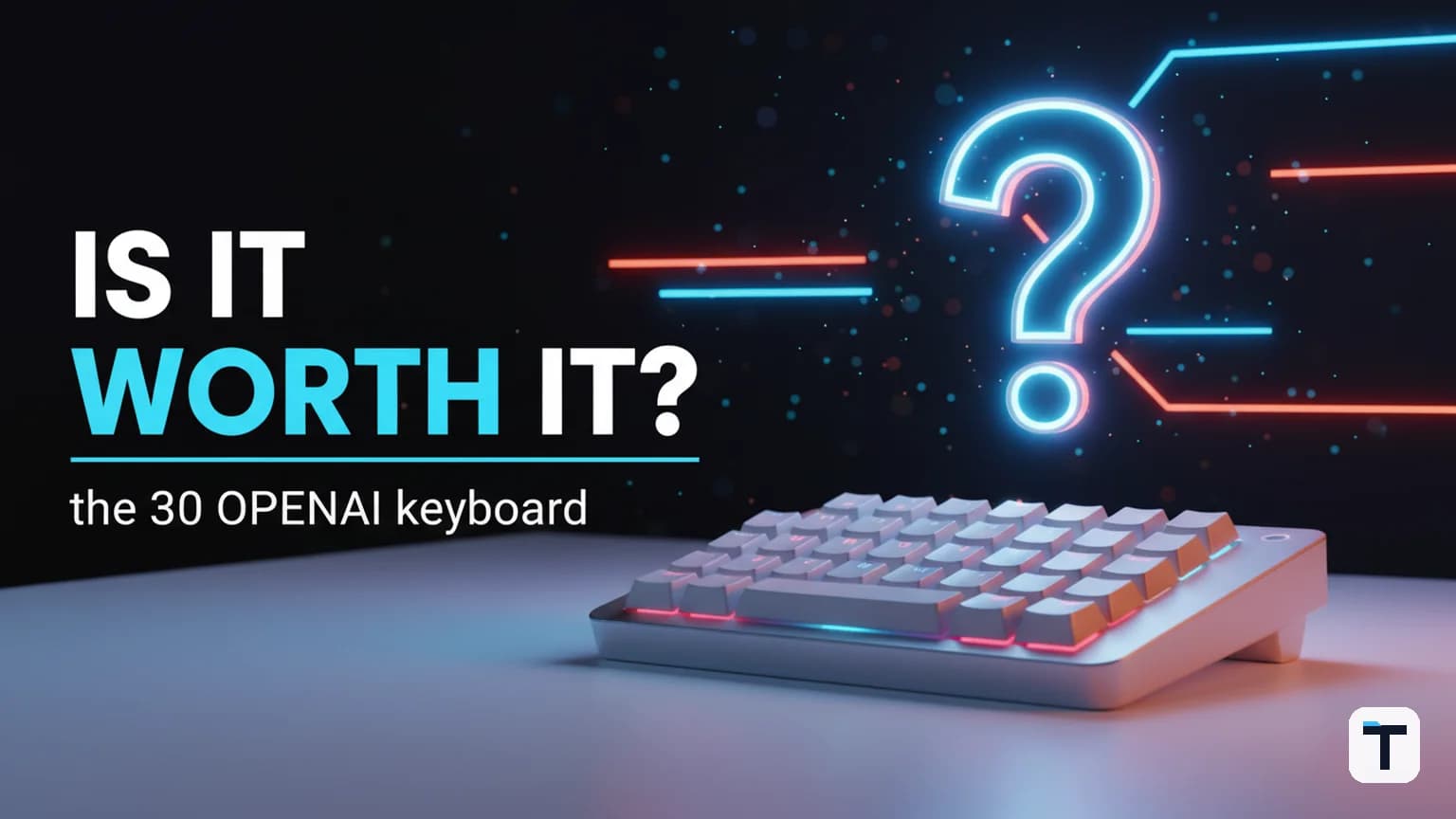

Verdict: The Codex Micro is a well-built but expensive ($230) macro pad that only pays for itself if you run multiple OpenAI Codex agents in parallel every day and genuinely lose time alt-tabbing between them. For everyone else — including most developers who use Codex as a single-thread coding assistant — the same actions are already keyboard shortcuts inside the ChatGPT desktop app, for free, on hardware you already own. OpenAI itself shipped this as a limited-run collaboration, not a mass-market product, so treat it as a niche accessory or a collectible rather than a productivity investment.
Last verified: 2026-08-02 · Price: $230 · Limited run, sold out at launch · Built on the Work Louder Creator Micro 2 · Requires the ChatGPT desktop app (Mac or Windows) · Pricing and stock are volatile — re-check the OpenAI Supply Co. page before buying.
What is the Codex Micro?
The Codex Micro (model kbd-1.0-codex-micro) is OpenAI's first branded hardware product — a compact, 13-key programmable macro pad co-designed with Work Louder, a Montreal–Italy keyboard maker known for specialty macro pads it has previously co-branded with Figma and Framer (OpenAI Supply Co. × Work Louder). It launched on July 15, 2026, for $230, after a teaser at the AI Engineer World's Fair on June 29 that reportedly drew around a million views in 24 hours (Axios, July 15, 2026).
It is not a full keyboard and not a general-purpose computer. It sits beside your regular keyboard and gives you physical, lit-up controls for the AI coding agent inside Codex — now folded into the ChatGPT desktop app as of July 9, 2026 (OpenAI, "ChatGPT is now a partner for your most ambitious work"). The device connects over Bluetooth or USB-C and works on Mac and Windows.
The hardware itself is not new. It is a reskinned Work Louder Creator Micro 2 — the same CNC polycarbonate-and-aluminum chassis, the same 13 low-profile mechanical switches, the same joystick, dial, and touch sensor — plus 32 Codex-branded icon keycaps and the software integration that lets the keys mirror live Codex agent state (Ars Technica, July 15, 2026; TechCrunch, July 15, 2026). That lineage matters for the price: the underlying Creator Micro starts around $139–$199, so you are paying an OpenAI-branded premium of roughly $30–$90 for the Codex integration and keycaps (The Awesomer listing for Work Louder Creator Micro).
What does the Codex Micro actually do?
The Codex Micro is built around four control surfaces, each tied to a real workflow inside the ChatGPT desktop app:
| Control | What it does by default | How it helps |
|---|---|---|
| 6 Agent Keys (frosted, RGB) | Each mirrors a live Codex thread. White = idle, blue = thinking, green = complete, amber = needs your input, red = error. One tap selects the chat; a double-tap brings the ChatGPT window forward. | Lets you see which agents are stuck or finished without alt-tabbing. This is the only feature a generic macro pad cannot replicate. (OpenAI Supply Co.; Yanko Design, July 20, 2026) |
| Command keys (the rest of the row) | Accept, reject, push-to-talk, start a new chat, and other Codex actions. Remappable. | Gives your most-used Codex actions a permanent physical shortcut instead of a menu hunt. |
| Joystick | Default actions include plan-mode toggle, navigate forward/back/sidebar, and mapped Codex workflows like PR review, debug, or refactor. | One-thumb navigation between agents and workflows. |
| Rotary dial | Adjusts Codex's reasoning level in the moment — fast for trivial tasks, deeper for harder ones. | No more digging into settings to switch reasoning effort. |
The device has no microphone of its own; the push-to-talk key uses your computer's mic over Bluetooth (OpenAI Supply Co.). Configuration happens inside the ChatGPT desktop app, not through a separate driver (TechTimes, July 16, 2026). Keys are also remappable through Work Louder's Input app and the open-source VIA tool, so the pad can double as a general-purpose productivity controller when Codex is not running.
Why a $230 macro pad exists at all
OpenAI's own framing is candid: this is a limited-run collaboration, sold until stock runs out, with no confirmed restock plan (TechCrunch, July 15, 2026). The product page says "Out of stock" as of August 2026. That positioning — niche, collectible, while-supplies-last — tells you what this really is: a low-cost, low-risk experiment to gauge demand for physical AI-agent hardware ahead of OpenAI's much larger consumer device bet with former Apple designer Jony Ive, expected around 2027 (Business Insider, July 2026).
The context matters for your buying decision. Codex's user base is the reason OpenAI thinks a physical controller is even worth testing: Codex crossed 5 million weekly active users in June 2026, up more than 6x since the desktop app launched in February (OpenAI, "Codex is becoming a productivity tool for everyone"), and by mid-July 2026 it had reportedly climbed past 8 million weekly users across Codex and the merged ChatGPT Work (The New Stack, July 15, 2026). A fraction of those users run multiple agents in parallel — and that fraction is exactly who the Codex Micro is for.
Is the Codex Micro worth it? A two-question decision
Start with the two questions that actually decide whether $230 is money well spent.
Do you run 3 or more Codex agents in parallel, daily?
The Agent Keys are the only feature a generic macro pad cannot copy. Each of the six frosted keys mirrors a live Codex thread's state — thinking, idle, waiting on you, completed, error — without you touching anything. If your daily workflow is "dispatch three agents, step away to do something else, come back and check which one finished or is stuck," the Agent Keys replace that alt-tab-and-scan loop with a peripheral glance. Over a full day, that compounds.
If you run Codex as a single-thread assistant — one prompt, one answer, repeat — there is nothing here the ChatGPT desktop app does not already let you do with a keyboard shortcut or a menu click. The Agent Keys would just show one status light and five empty ones.
Are you willing to lock into the ChatGPT desktop app?
This is the part most coverage of the Codex Micro glosses over. Its headline feature — the live RGB Agent Keys — only works through the ChatGPT desktop app, which acts as the bridge between Codex's live thread state and the device's LEDs (TechTimes, July 16, 2026). If you use Codex through the CLI, an IDE extension, or the browser, you get the standard HID keystrokes but no status lights.
The timing makes this riskier than it looks. On July 9, 2026 — six days before the Codex Micro shipped — OpenAI folded the standalone Codex app into the unified ChatGPT desktop app and renamed the old version "ChatGPT Classic" (OpenAI, July 9, 2026). The "Codex" brand, as a standalone product, no longer exists. You are buying a device branded for a product line that just became a mode inside ChatGPT. If OpenAI reshuffles its desktop app again — and given how often it has in 2026 — the Agent Key integration depends entirely on OpenAI keeping that bridge alive.
Codex Micro vs cheaper alternatives
If you just want tactile shortcuts for Codex, the Codex Micro is not the only option. Here is how it stacks up against the three real alternatives.
| Option | Price | What you get | Best for |
|---|---|---|---|
| Free keyboard shortcuts inside ChatGPT desktop | $0 | Every Codex action the Micro maps — accept, reject, push-to-talk, new chat, reasoning toggle — is already a keyboard shortcut or menu action. | Anyone who uses Codex as a single-thread assistant. The Codex Micro duplicates this, it does not add to it. |
| Generic programmable macro pad (e.g. a $18–$50 numpad-style pad with VIA) | ~$18–$50 | Standard HID keystrokes for any app. Remappable. No Codex-specific integration, no Agent Key status lights. | Developers who want physical Codex shortcuts but do not need live agent-status RGB. Slashdot commenters on launch day pointed out their existing keyboard already does the job for $18 (AIToolsReview, July 20, 2026). |
| Work Louder Creator Micro 2 (the base hardware) | ~$139–$199 | The exact same chassis, switches, joystick, dial, and touch sensor. No Codex icon keycaps, no out-of-the-box Codex integration, no Agent Key RGB tie-in. | Designers or developers who want the hardware quality without the OpenAI branding premium. (Drop listing for Work Louder Creator Micro) |
| Codex Micro | $230 | Everything the Creator Micro 2 has, plus 32 Codex icon keycaps, the Codex desktop integration, and the live RGB Agent Keys. | The only option if you specifically want the agent-status dashboard. |
The honest read: the $230 buys you the Agent Key status lights and the Codex branding. If neither of those is load-bearing for your workday, the cheaper rows in that table deliver the same shortcut function. If you want to cut the cost of running Codex itself — which metered usage can dwarf the one-time hardware price — see our guide on how to use OpenAI Codex CLI for free in 2026.
What the Codex Micro gets right
Give the device credit where it is due. The hardware is genuinely well-built — the same Work Louder chassis that earned good reviews for designers — and the integration is more thoughtful than slapping a logo on a macro pad. The Agent Keys are not just decorative RGB; they are a two-way data surface. The ChatGPT desktop app pushes each Codex thread's live state to the corresponding key over a JSON-RPC bridge, so the lights update on their own without you sending a keystroke (TechTimes, July 16, 2026). That is a real architectural difference from a Stream Deck, which only ever sends keystrokes out.
The reasoning dial is the other genuinely useful touch. Adjusting how much an agent reasons — fast versus deep — is the kind of setting most people set once and never touch again, because it is buried in a menu. Putting it on a physical dial means you actually use it. Over a long coding session, that small friction reduction can change behaviour in a way that matters.
The included Codex icon keyset (32 keycaps) and the option of clicky or silent low-profile switches (40±10gf actuation, 2.8mm travel, rated for 50 million keystrokes) show that Work Louder's keyboard expertise carried over (Fonearena, July 2026). This is not cheap hardware; it is premium hardware in a small, expensive package.
What the Codex Micro gets wrong
The case against it rests on three things, and only one of them is about the price.
First, the feature ceiling is six agents. Each Agent Key maps to one Codex thread, and there are six keys. Once you routinely run more than six parallel agents — which the heaviest users do — the dashboard stops being a complete window and becomes a partial one. There is no documented answer for overflow (Axios, July 15, 2026).
Second, it is single-ecosystem. The Codex Micro is a Codex accessory first and a general macro pad second. If you switch to Claude Code, Cursor, or a multi-agent stack that runs across tools — like the agent operating systems we compared here — the Agent Keys become inert and you are left with a $230 Work Louder pad. For single-tool power users that is fine; for anyone building a portable workflow it is lock-in with a premium price tag.
Third, the timing risk is real, and this is the concern most coverage soft-pedals. Codex, as a standalone brand, does not exist anymore. On July 9, 2026, OpenAI merged the standalone Codex app into the ChatGPT desktop app; the old app was renamed "ChatGPT Classic" (OpenAI, July 9, 2026). The Codex Micro's product page now lists its supported software as "ChatGPT Codex" and "Work Louder Input." A device branded around "Codex" shipped six days after the Codex brand was folded into another product. If you want to understand how to manage agents that span multiple tools rather than lock into one — and avoid the kind of technical debt that single-tool AI coding can stack up — a locked-in accessory is the wrong starting point.
Who should buy the Codex Micro
Buy it if, and only if, all of these are true:
- You run 3 or more Codex agents in parallel on most workdays.
- You already use the ChatGPT desktop app (Mac or Windows) as the bridge.
- You have $230 of disposable income for a limited-run accessory — not a productivity bet you need to amortise.
- You are willing to treat it as a collectible, because the limited run and the post-merger brand make resale and longevity uncertain.
If that is not you, the cheaper paths in the comparison table above do the same job for less money, and the best free AI agent tools we tested in 2026 include options that run multi-agent workflows without any dedicated hardware at all.
What this means for you
The Codex Micro is a well-executed experiment in a category that is not ready for most buyers. Its real value is as a signal: OpenAI believes enough developers are running fleets of agents that a physical dashboard for them is worth manufacturing, even as a limited run. The bigger hardware bet — the Jony Ive screenless companion device — is still over a year away (Business Insider, July 2026). The Codex Micro tells you the direction; it does not have to be the device you buy into it with.
If you spend your day in Codex and want the RGB status dashboard, the $230 is defensible. If you just want shortcuts, your existing keyboard and the free ChatGPT desktop app already have them. The difference between those two sentences is the whole buying decision.
FAQ
Q: How much does the Codex Micro cost? A: $230, sold through OpenAI's Supply Co. store and Work Louder's store. It is a limited run with no confirmed restock plan; as of August 2026 the official page shows "Out of stock." Prices and stock are volatile — re-check the OpenAI Supply Co. page before buying.
Q: Does the Codex Micro work with Claude Code, Cursor, or other coding tools? A: The standard HID keystrokes (accept, reject, push-to-talk, new chat) work with any application that accepts keyboard input. The live RGB Agent Key status display, however, requires the ChatGPT desktop app to be running as the bridge — so it only lights up for Codex agents running inside ChatGPT desktop. Claude Code, Cursor, or Codex via CLI/IDE extension/browser users will not see the status lights.
Q: Is the Codex Micro the same as the Jony Ive OpenAI device? A: No. The Codex Micro is a $230 developer accessory that shipped July 15, 2026. The Jony Ive collaboration is a separate, screenless consumer AI companion device expected around 2027, and the two share nothing but the OpenAI name (Business Insider, July 2026).
Q: Can I use the Codex Micro for anything besides Codex? A: Yes. Work Louder's Input app supports up to five additional custom layers for other applications, and the open-source VIA tool allows real-time HID key remapping without reflashing firmware. The keys are fully remappable, so the pad can function as a general-purpose productivity controller when Codex is not in use.
Q: Do I need a Codex or ChatGPT subscription to use the Codex Micro? A: There is no subscription required to buy the keyboard, but the device is an accessory to the ChatGPT desktop app — which is where Codex now lives after the July 9, 2026 merger. You need the desktop app installed and running for the Agent Key integration to work. The app is available on all plans, including Free, on Mac and Windows.
Q: What happens to the Codex Micro now that the standalone Codex app merged into ChatGPT? A: The Codex Micro's product page now lists its supported software as "ChatGPT Codex" (the merged experience) and "Work Louder Input." Existing Codex app users who update after July 9, 2026 get the unified ChatGPT desktop app, and the Agent Key integration works through that app. The "Codex" branding on the device now refers to a mode inside ChatGPT, not a standalone product. The limited run, the brand merge, and the lack of a confirmed restock plan mean longevity is uncertain — treat it as a collectible rather than a long-term platform bet.
Discussion
0 comments