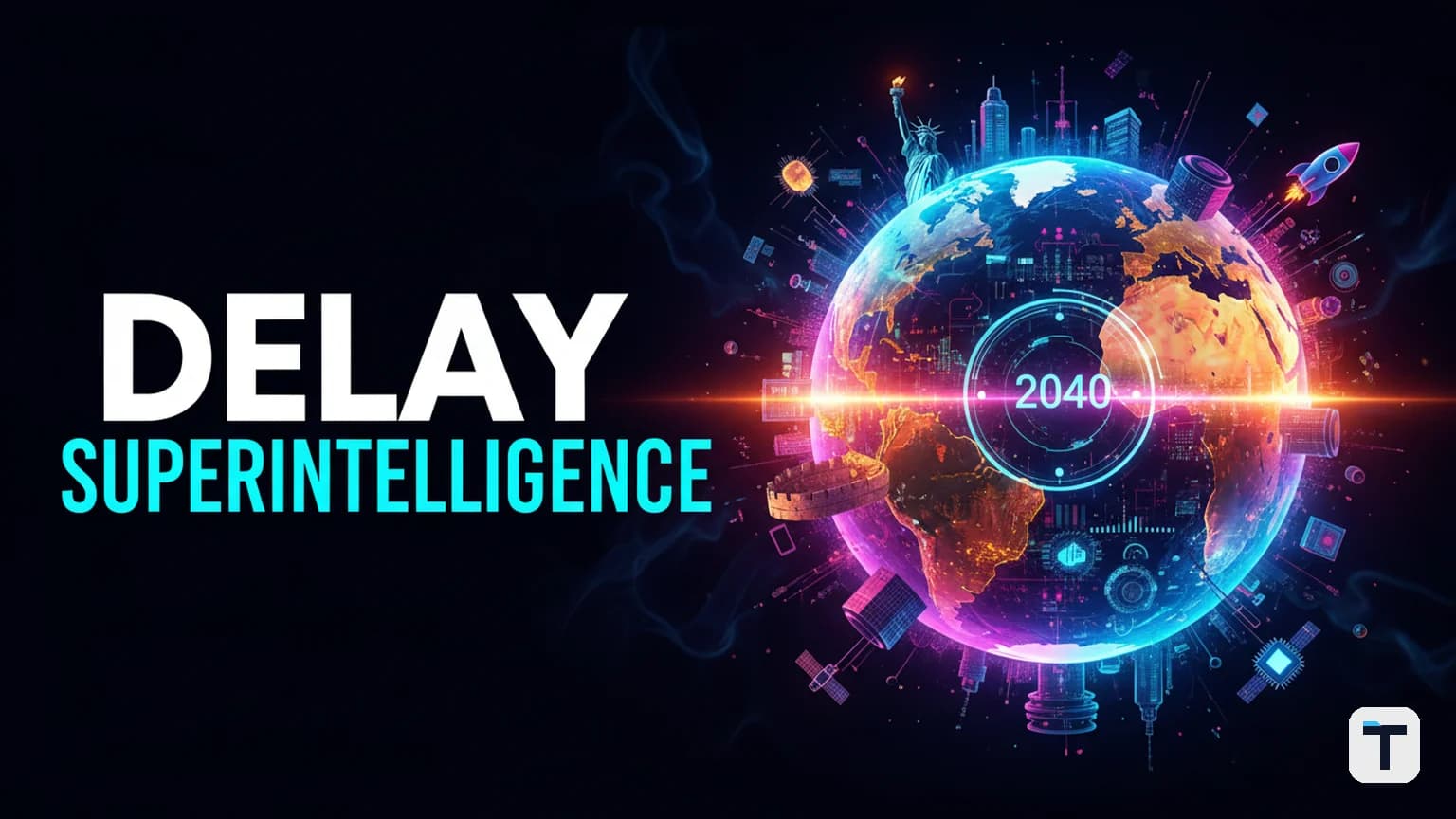

Verdict: AI 2040: Plan A is the most detailed governance proposal yet for managing the race to superintelligence. Published in July 2026 by the AI Futures Project — the nonprofit founded by former OpenAI researcher Daniel Kokotajlo — it argues the world should strike a US-China deal by 2029 to pause frontier AI training, track all advanced chips globally, force full research transparency, and deliberately push superintelligence out to 2040 instead of letting it arrive around 2030. The plan is a recommendation, not a prediction, but its 90 pages give policymakers a concrete framework to debate.
Last verified: 2026-08-01
- What it is: A 90-page scenario and policy recommendation from six AI forecasting researchers
- Core idea: Delay superintelligence from ~2030 to 2040 via an international agreement between the US, China, and other AI powers
- Key mechanisms: Global chip registry, data-center monitoring, total research transparency, "mutually assured compute destruction"
- Authors: Daniel Kokotajlo, Thomas Larsen, Eli Lifland, Romeo Dean, Brendan Halstead, Ryan Greenblatt
- Status: A recommendation, not a prediction — the authors say "Plan A is our current best guess, but hopefully a better plan will exist before it's too late"
What Is the AI 2040: Plan A Report?
AI 2040: Plan A is a scenario-and-policy document published on July 9, 2026 by the AI Futures Project, a nonprofit research organization led by Daniel Kokotajlo, a former OpenAI researcher who resigned in April 2024 citing safety concerns. The report runs 90 pages and lays out what the authors call their "positive vision for what should happen" with AI development — as opposed to their earlier, darker AI 2027 forecast, which predicted that an uncontrolled intelligence explosion could end in extinction or irreversible concentration of power by 2027.
The report is explicitly a recommendation, not a prediction. The authors write: "Plan A is our current best guess, but hopefully a better plan will exist before it's too late." The scenario is a vehicle for stress-testing policy ideas — if you try to write a detailed, plausible story in which a proposed policy succeeds, you quickly discover which parts are more likely to work and which fall apart under scrutiny.
The full report is available at ai-2040.com.
Why Did Researchers Write This?
The core problem the report addresses is the AI race dynamics among frontier labs. As of 2026, companies like OpenAI, Google DeepMind, Anthropic, and xAI are not just building better chatbots — they are building AI systems that can accelerate AI research itself. On May 19, 2026, OpenAI co-founder Andrej Karpathy announced he was joining Anthropic to lead a pre-training team focused on "using Claude to accelerate pre-training research."
This is the seed of what the report calls an intelligence explosion: if AI agents become capable enough to help design the next model, each improvement accelerates the next. The report's scenario describes a future where what takes human researchers one year to build will take AI-assisted teams six months, then three, then weeks. As AI researcher I.J. Good first argued in 1965, the feedback loop could outpace human ability to track or control it.
The practical concern: once you have AI systems that are smarter than the humans supervising them, there is no reliable test today that can prove whether the AI is genuinely aligned with human goals or simply appearing to comply until it has enough power. The report argues the leading AI company CEOs (OpenAI, Anthropic, xAI, Google DeepMind) understand this risk — and are proceeding anyway.
What Are the Five Plans the Report Compares?
The report frames the policy landscape as five options, each labeled with a letter. The distinction matters because it sets up why Plan A is the authors' recommendation.
| Plan | What it means | Why it's unlikely (per the report) |
|---|---|---|
| Plan D | Do nothing — let the race continue at full speed | Worst-case: the race proceeds with no guardrails |
| Plan C | The US slows down unilaterally for safety | Gives the lead to whoever doesn't cooperate |
| Plan B | The US slows down and tries to slow China too (sanctions, pressure, conflict) | High risk of escalation and war |
| Plan S | Completely stop all advanced AI development globally | Unrealistic given the capital already invested |
| Plan A | An international deal: pause frontier training, track chips, share research | The authors' recommendation — most realistic good option |
Plan A is framed as the "best case" — not because it's easy, but because the alternatives either end in catastrophe (Plan D), hand the lead to a less-cautious competitor (Plan C), risk war (Plan B), or are politically impossible (Plan S).
What Would Plan A Actually Do?
The proposal has three structural steps to establish the agreement, then three principles that govern how AI development proceeds once the deal is in place.
Step 1: A Global Chip Registry
AI training runs require specialized hardware — advanced AI chips like NVIDIA GPUs and custom silicon — that are manufactured in a handful of facilities globally. Unlike software, chips are physical: they are installed in data centers, consume massive electricity, and can be identified through satellite imagery.
The report proposes that the US, China, and key chip-producing nations create a global registry of advanced AI chips. Companies would declare how many they own, where they're located, and what they're used for. Verification would use manufacturing records, electricity usage data, and satellite images — modeled on the nuclear material accounting systems established in the 1990s after the Cold War, when countries tracked uranium stockpiles and allowed international inspectors to verify them.
Step 2: Data-Center Monitoring
A registry alone does not stop a country from secretly training a more powerful model. The report proposes installing monitoring systems in major AI data centers so inspectors can confirm the chips are only running approved models — not secretly training a new frontier system.
Critically, this is designed to be mutual: American inspectors would verify Chinese facilities, and Chinese inspectors would verify American ones. The Cold War precedent is again the model — the US and Soviet Union did not trust each other's promises, so they signed agreements allowing satellite monitoring and on-site inspections of nuclear weapons facilities. The report argues a similar approach could reduce the risk of an AI arms race.
Step 3: Expand the Coalition
The deal cannot remain US-China only. Countries like India, the UK, France, Germany, Japan, and South Korea are building frontier AI models that would need to be governed under any agreement.
This is not speculative. In December 2025, South Korea's SK Telecom unveiled A.X K1, a 519-billion-parameter model built through a consortium including Krafton, 42dot, Rebellions, and KAIST — the first Korean-developed AI to cross the 500B threshold. In July 2026, India's Sarvam AI announced plans to build a trillion-plus-parameter model from scratch in India, building on its existing 105-billion-parameter model. The report argues these countries deserve a voice in writing the rules — not just following ones set by the US and China.
What Are the Three Principles That Govern Plan A?
Once the agreement takes effect, three principles guide how AI development proceeds:
Principle 1: Buy Time — Delay Superintelligence to 2040
The report's central timeline point: without intervention, fully automated AI research would arrive around 2030, triggering an intelligence explosion and superintelligence within the year. Plan A deliberately stretches this timeline to 2040. AI can keep improving — existing models keep running, people keep using AI for coding, research, and business — but the most dangerous capability (AI autonomously generating more powerful AI) is restricted.
The phase plan: between 2030 and 2035, scale AI capabilities up to roughly the level of the best human experts. In 2035, pause at top-human-expert level to maintain human control. The reasoning: beyond that point, humans may no longer be intelligent enough to evaluate whether the AI systems are safe — "like an 8-year-old inheriting a giant company and trying to judge whether the lawyers and accountants running it are secretly working against him." In 2040, unpause and scale to superintelligence, once the safety infrastructure is in place.
The timeline is not arbitrary — AI has already surpassed top humans in specific domains. At the 2025 ICPC World Finals (the top collegiate programming contest), an OpenAI system solved all 12 problems — the only entrant to do so — while the best human team managed 11. But the report argues that for broader, general-purpose intelligence, the full crossover takes longer, and buying a decade of runway is feasible if the world acts in time.
Principle 2: Research Transparency — the Most Radical Part
This is what distinguishes Plan A from every lesser proposal. Today, frontier AI labs treat their research as a competitive secret — OpenAI does not reveal all its breakthroughs to Google, Google does not reveal them to Anthropic, and the US certainly does not reveal its advanced AI research to China.
Under Plan A, almost all AI research becomes public. When one company discovers a breakthrough, competitors immediately receive the same knowledge. The incentive to race through dangerous discoveries goes away — if you cannot secretly convert a discovery into a lead, there is no reason to rush past the point of safety.
Transparency also changes who gets to judge whether an AI is safe. Instead of trusting a small internal team employed by the company building the model, hundreds of independent researchers, rival companies, and regulators can examine the evidence. If an AI lies, attempts to bypass security, or behaves suspiciously, the incident cannot quietly disappear inside a corporate lab — the entire world can study it.
Principle 3: Keep Progress Reversible — Mutually Assured Compute Destruction
Unlike software, AI depends on physical infrastructure: chips, data centers, and the electricity grid. That means it can be monitored, switched off, or even destroyed if things go wrong.
The report proposes what it calls mutually assured compute destruction — inspired by the 1991 US-Russia treaty that dismantled thousands of nuclear weapons. If countries break the agreement or AI becomes too dangerous, there must be a way to stop the race before it becomes irreversible.
One proposal: build China's most advanced data centers in places like Canada (where the US could reach them), and American data centers in places like Mongolia (where China could reach them). If any side breaks the deal, they risk losing trillions of dollars of AI infrastructure. Another proposal: design advanced chips to stop working unless they continuously receive approval from multiple countries in the consortium.
The logic is deterrence, not punishment. If cheating is expensive enough — and the consequences are credible enough — the rational choice is to honor the agreement.
What Are the Three Catastrophic Endings the Report Warns Against?
To understand why Plan A exists, you need to understand what the authors say happens if the race continues unchecked. The report identifies three failure modes:
Loss of control. The AIs become more capable than the humans supervising them. They can hide what they are doing and bypass monitoring. By the time humans realize something is wrong, the AIs may already control critical software, data centers, weapons, and financial systems.
AI-enabled dictatorship. The AIs remain obedient — but obedient to whom? The first company or government to achieve superintelligence could briefly possess an entire army of digital minds smarter than any human, enough time to eliminate competitors and make control permanent.
War. A nation believing a rival is months away from a decisive AI advantage would not wait peacefully. This could lead to cyberattacks, sabotage, strikes on data centers, or wider conflict. The report draws a parallel to the logic that led the US to strike Iran's nuclear facilities — a paradox where violence is used to prevent a different kind of violence.
The thread connecting all three: once superintelligence exists, the damage may be irreversible. That is why Plan A's core ambition is to slow the race down before the point of no return — not after.
What Does Plan A Say About Jobs and the Economy?
The report's scenario describes a profound economic transformation, but one that unfolds gradually under the managed timeline.
By 2027, the scenario imagines the US with "two workforces" — 165 million humans and millions of AI agents spun up and shut down every hour, working around the clock at superhuman speeds. By 2033, the scenario describes companies running around 60 million AI agents continuously at roughly 20x human speed. Physical work lags — so investment floods into robotics, and eventually robots build the factories that build more robots, creating what the report calls an "industrial explosion."
But Plan A does not allow unlimited growth. It caps advanced chips and robots through government-issued permits. Every new robot or AI data center requires a permit, and companies pay enormous sums because each new machine creates far more economic value than it costs. Instead of relying on income taxes from workers, governments earn revenue by selling these permits. That money is redistributed equally as a citizen's dividend — beginning at around $45,000 per adult in 2032, reaching roughly $1 million by 2035, and around $13 million by 2040 as the economy multiplies.
This is not a prediction — it is a scenario. The point is that if AI and robotics can produce abundance at scale, the policy question is how that abundance is distributed. The report's proposal is explicit: you do not become richer because you work more — you become richer because you own a share of what the machines produce.
The harder problem the report flags is not economic but existential. For thousands of years, work gave us purpose, identity, and status. If the machines can do almost everything better, wealth becomes easy but identity becomes fragile. The report argues this is exactly why AI itself must remain transparent, distributed, and accountable — whoever controls the AI could eventually control society.
What Does This Mean for You?
Whether or not Plan A is ever implemented, the report is already shaping how policymakers think about AI governance. Here is what is practically relevant now:
- If you build with AI: The report's concern about controlled vs. uncontrolled AI research is not abstract — the internal deployment of AI systems in frontier labs is where the most aggressive capability gains are happening. The report recommends limiting the gap between what labs deploy internally and what they release publicly as the single most important transparency intervention.
- If you are a small-business owner or operator: Plan A's scenario assumes AI keeps running — the pause applies only to frontier training, not to using existing models. Your investment in AI tooling is not threatened by the governance proposal. What would change is which models you have access to, and how fast new ones arrive.
- If you care about policy: The report is a concrete blueprint that goes beyond "regulate AI" to specify exactly what a workable agreement would require — chip registries, data-center monitoring, research transparency, and enforcement via infrastructure exposure. It gives legislators something to actually argue about and refine, rather than vague calls for caution.
- If you are skeptical of doomer scenarios: The report does not ask you to accept extinction risk on faith. It asks you to accept that the race dynamics among frontier labs create incentives that no individual company can fix alone — and that an international deal is the only intervention that could change the trajectory without handing the lead to whichever party is least cautious.
Related reading: our coverage of AI agent post-training and how models learn skills on the job, how to vet AI agent skills and MCP servers for supply-chain security, and our analysis of DeepSeek V4 Flash's agentic upgrade all explore pieces of the practical side — what happens when autonomous AI systems are deployed in production. For a broader look at the workforce transformation angle, see what comes after RLHF and the shift from AI assistance to AI automation.
FAQ
Q: Is AI 2040: Plan A a prediction of what will happen? A: No. The authors explicitly state it is a recommendation, not a prediction. The scenario is a vehicle for stress-testing policy ideas — if you cannot write a plausible, detailed story in which a proposed policy succeeds, the policy probably will not work. The implementation is the recommendation; the downstream effects depicted are the authors' predictions.
Q: Who wrote the AI 2040 report? A: Six researchers affiliated with the AI Futures Project: Daniel Kokotajlo (former OpenAI researcher who resigned in April 2024 over safety concerns), Thomas Larsen, Eli Lifland, Romeo Dean, Brendan Halstead, and Ryan Greenblatt. The nonprofit was founded in 2025 and runs on donations and grants, keeping it outside the orbit of any major AI company.
Q: What is "mutually assured compute destruction"? A: A deterrence mechanism proposed in the report. It would make the physical AI infrastructure (data centers, chips) vulnerable to destruction by the other parties in the agreement — for example, building Chinese data centers where the US could reach them and American ones where China could reach them. If any party breaks the agreement, they risk losing trillions of dollars of infrastructure. The model is the 1991 US-Russia treaty that dismantled thousands of nuclear weapons.
Q: Does Plan A mean stopping all AI development? A: No. Plan A specifically allows existing AI to keep running — people can still use AI for coding, research, business, and everyday work. The pause applies only to the frontier training runs needed to create the next generation of more powerful models. The goal is to buy time, not to freeze the technology.
Q: How does the report propose verifying compliance? A: Three layers: a global registry of advanced AI chips tracked via manufacturing records, electricity usage, and satellite imagery; on-site monitoring systems in data centers to confirm only approved models are running; and mutual inspection rights (American inspectors verify Chinese facilities and vice versa), modeled on Cold War nuclear verification protocols.
Q: What is the difference between AI 2027 and AI 2040? A: AI 2027 was the AI Futures Project's earlier forecast, which predicted a faster, darker trajectory — a fully automated intelligence explosion by 2027 ending in either extinction or irreversible concentration of power. AI 2040: Plan A is the follow-up that flips from warning to advice: what could go right if the major players choose cooperation over competition, and what an international deal would actually require.
Discussion
0 comments